The Ground You're Working With

What a Tarrytown Lot
Comes With

Red Agave designs for Tarrytown's mature-tree lots: landscape lighting that shows the oaks at night, steel planters that add plants without digging into roots, and patios set outside the critical root zones. Every tree 19 inches and up is protected under Austin's code and every oak 24 inches and up is a heritage tree, so the design starts from the trunks. Owner-designed, built by our own crew. 5.0 stars across 86 Google reviews.
1915

Platted on Its Oaks

Tarrytown was platted in 1915 and sold in the 1930s under the line "Where oak trees charm the eye." About 2,800 homes, most built between the 1930s and 1960s, sit under that canopy today. The trees were the selling point then and they are the design constraint now.

19" / 24"

Austin's Tree Code Applies

Inside Austin city limits, any tree 19 inches or larger at 4.5 feet is protected and needs a City Arborist permit to remove. Oaks, pecans, elms, and other listed species at 24 inches and up are heritage trees, and removal is prohibited except as the code allows. In Tarrytown that covers most of the canopy.

Scale

The House Is Capped

Austin's McMansion ordinance limits the size of new construction and additions on Tarrytown lots. The square footage you cannot add inside has to come from the yard, which puts a premium on outdoor rooms that work after dark.

What That Means for the Design

Light the Canopy,
Leave the Roots Alone

Heritage oaks set three rules: protect the critical root zone, avoid grade changes over the roots, and keep irrigation spray off the trunks. Lighting is one of the few upgrades that can respect all three. Low-voltage 24V wiring needs far less digging than line-voltage work, and the payoff is what a Tarrytown lot has plenty of: canopy.

We light it with two tools. FCOB (flip chip on board) ribbon gives a continuous line of light with no hot spots along paths, steps, and planter edges. COB point fixtures at CRI 90+ uplight the trunks and branches so the oaks read true to color at night. Our COB vs. standard LED comparison explains the difference, and the landscape lighting guide covers layout. See the full landscape lighting service.

For planting color without root disturbance, cantilevered steel planters sit on the existing surface, so the beds live above the roots rather than in them. Read about them under custom steel planters.

Case Study · Tarrytown

Tarrytown Glow:
Six Zones, 420 Feet, 10 Days

A mature Tarrytown lot with live oaks, flagstone paths, a steel-edged patio, and native beds, all of which vanished after dark. Red Agave replaced two spotlights with 420 linear feet of 24V FCOB continuous ribbon lighting embedded in steel edges and paver joints, 14 COB uplights at CRI 90+ on specimen trees and stone walls, 4 diffused steel light boxes at seating areas, and pathway bollards along the front walk. Two ESP32 WLED controllers run six independent zones across the front yard, side yard, patio, and rear garden, with scenes programmed from a phone.

Ribbon420 LF 24V FCOB
Uplights14 COB, CRI 90+
Fixtures4 diffused steel light boxes
ControlESP32 WLED, app scenes
Zones6 independent
CoverageFront, side, patio, rear garden
Power24V low-voltage
Build time10 days, one in-house crew

Photos: FCOB ribbon lighting on our Circle C steel terraces, and a steel bed lit from under its rim in Austin.
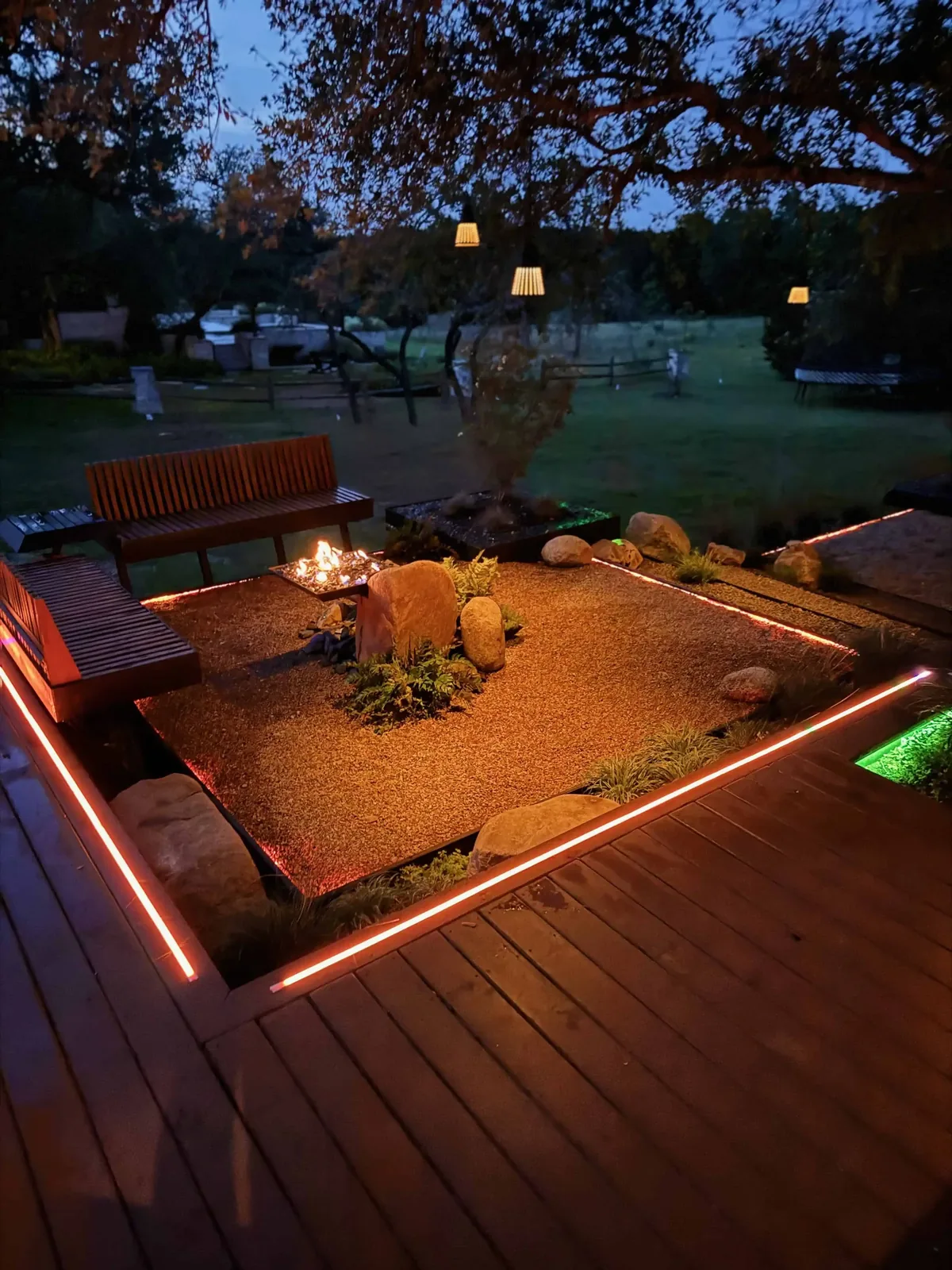
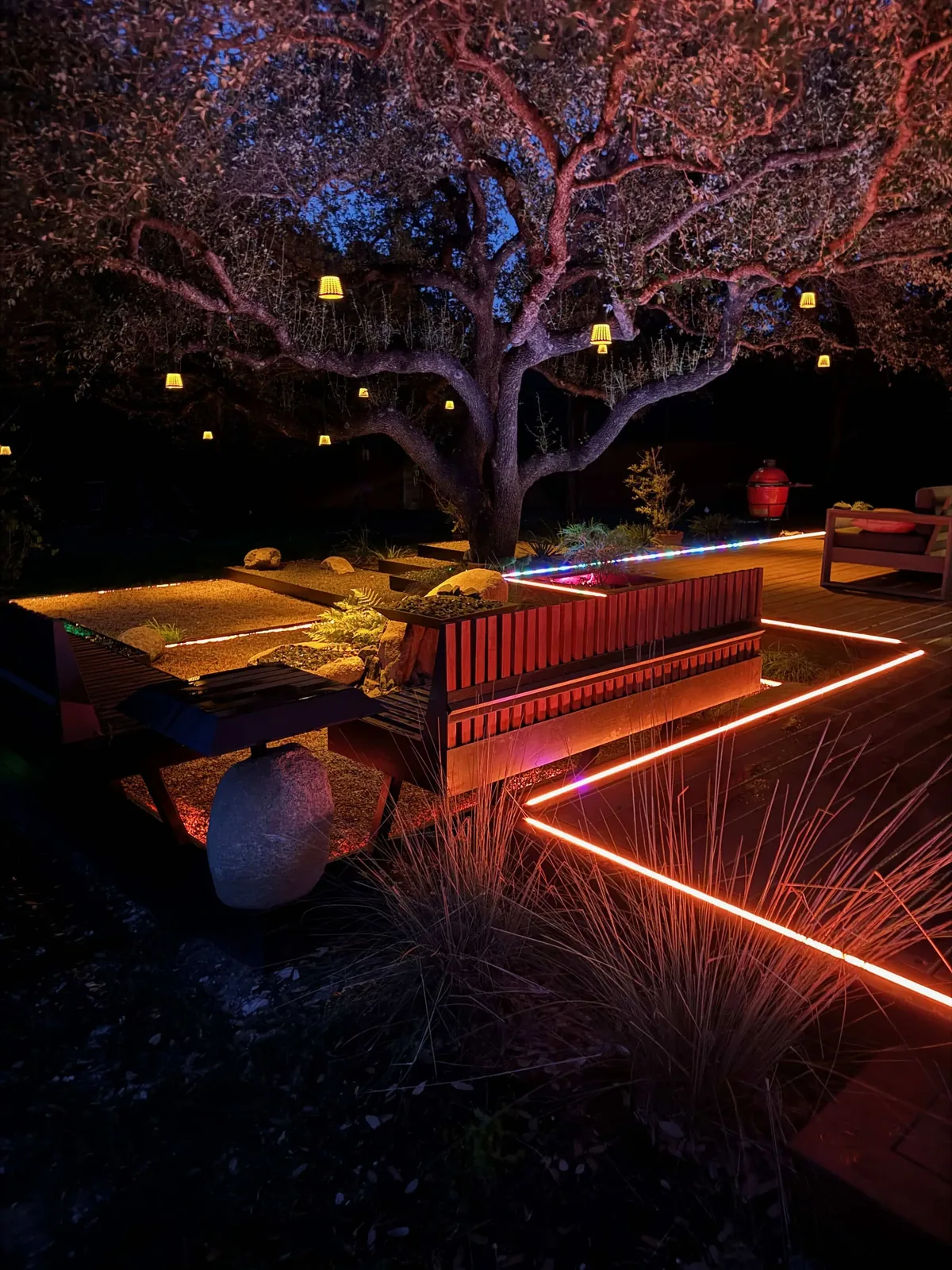
FCOB ribbon lighting tracing the edges of steel terraces and a wood deck at night
Low-glare FCOB lines along terrace and deck edges at night beneath an oak canopy
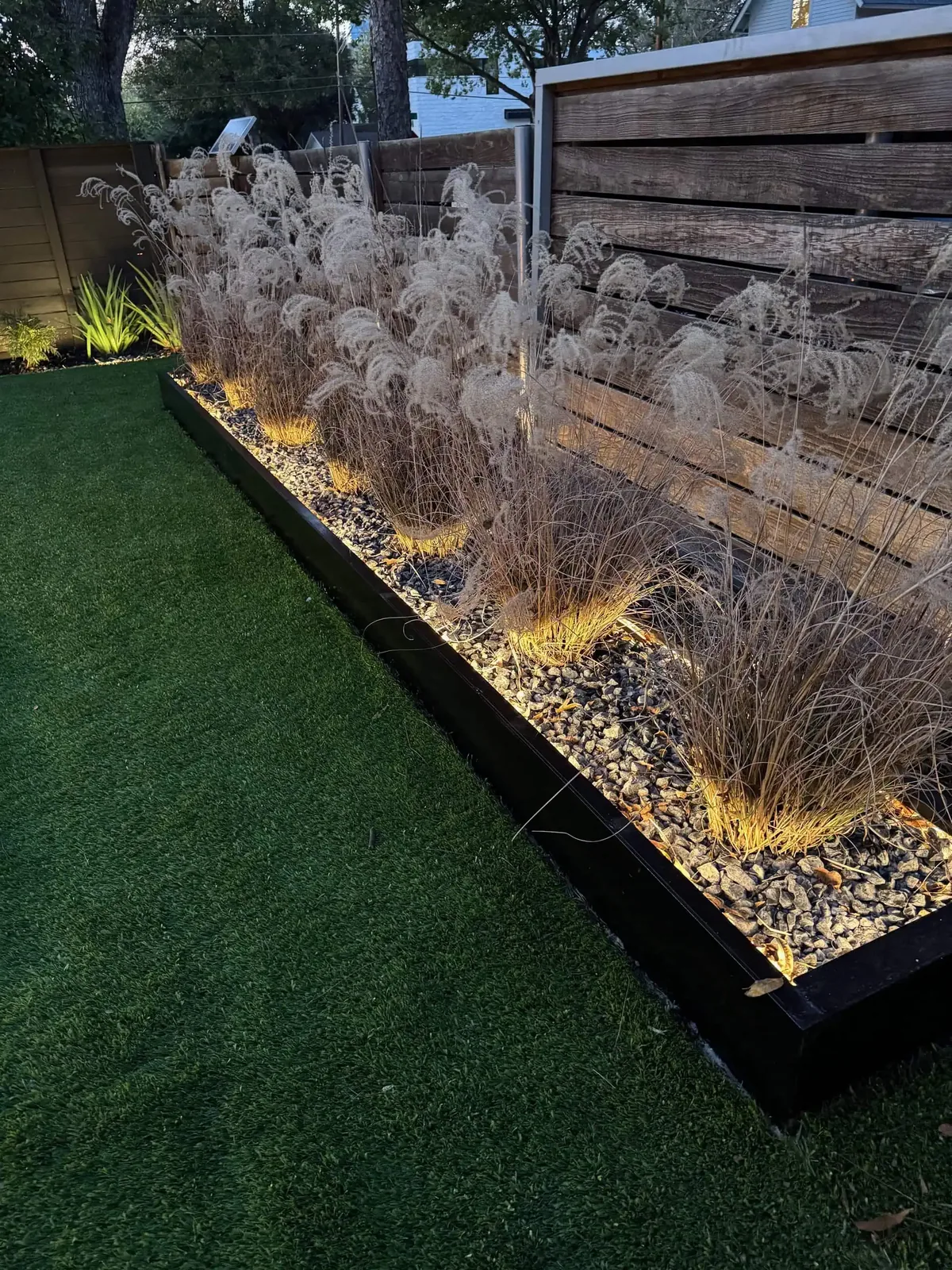
Steel planter bed with native grasses lit from under its rim by a hidden FCOB strip

Read the full Tarrytown Glow case study →

Planting

Plants That Live
Under Live Oaks

Dry shade is the Tarrytown condition. Live oaks take the water first, and anything beneath them has to accept what is left. Inland sea oats, Turk's cap, cedar sage, American beautyberry, and Texas sedge all do, and all of them are on our native plants list for Austin.

For sun at the edges of the canopy, agaves in steel planters give structure without a bed cut into the roots. Our cold-hardy agave guide covers the species that take a Central Texas winter in a container.

Featured Plant · Tarrytown

Twistleaf Yucca

Yucca rupicola

Twistleaf yucca is found only on the Edwards Plateau, and the Wildflower Center calls it great for dry, shady spots. That is the hardest ground in Tarrytown: the dry shade under the live oaks, where grass gives up. Set it in loose groups among the leaf litter instead of fighting for a lawn.

SizeAbout 2 ft, about 6 ft in bloom
SunSun or part shade
WaterLow
Deer resistanceModerate: deer leave the leaves but eat the blooms
SoilRocky limestone, also clay
BloomWhite, April to June

Plant data: Lady Bird Johnson Wildflower Center.

Questions From Tarrytown

Oaks, Roots, and Light

Can I remove a large oak in Tarrytown?
Any tree 19 inches or larger at 4.5 feet is protected and needs a City Arborist permit. Oaks 24 inches and larger are heritage trees under Austin's code, and removal is prohibited except as the code allows. We design around them instead.
Will landscape lighting damage tree roots?
It shouldn't. 24V low-voltage wiring needs far less digging than line-voltage work, so the route can be planned to stay out of the critical root zone.
What is the difference between FCOB and COB lighting?
FCOB is a flexible continuous ribbon that gives an unbroken line of light with no hot spots, used along paths, steps, and edges. COB is a point fixture used for uplighting trunks and walls. Both run on 24V.
How is the lighting controlled?
ESP32 WLED controllers driven from a phone app. The Tarrytown project runs six independent zones with programmed scenes.
How long did Tarrytown Glow take?
10 days for 420 feet of ribbon, 14 COB uplights, 4 steel light boxes, pathway lighting, and six zones of control, by one in-house crew.
Explore

Nearby Areas & Related Services

Ready to Start?

Tell us about your Tarrytown lot and its trees. We'll design for the canopy and the roots beneath it.

Get a Free Quote →