Rollingwood requires a city permit for any tree trimming or removal inside city limits. Oaks cannot be trimmed from February 1 through June 30, the months when oak wilt spreads most easily, and violations carry a fine. The city adopted an updated Residential Landscaping and Tree Canopy Management Ordinance in April 2025.
Rollingwood runs its own water utility but buys its water from Austin under an agreement that dates to 1963, and its watering schedule follows Austin’s stages. Under Conservation Stage rules, automatic irrigation runs one day a week by address, midnight to 5 a.m. or 7 p.m. to midnight.
Rollingwood incorporated as a village in 1955 and became a city in 1963. Its City Hall Waterwise Garden, watered from a rainwater cistern, names the conditions that decide what grows here: soil, sunlight, and deer resistance.
On a Rollingwood lot the trees come first, because the city decides what happens to them. A poured slab covers the ground a tree feeds through; a deck on a few footings leaves most of it open to air and water. That is why the outdoor room here is usually a deck: IPE, Western Red Cedar, or composite on a mild steel frame, set around the trunks. Our custom decks service covers the materials and framing.
Around the deck, native beds fill the sunny gaps, and lighting follows the trees: warm 24V FCOB along the deck edge and COB uplights into the canopy. Our landscape lighting service explains the system, and the Tarrytown page shows the same oak-canopy approach.
Any trimming the plan needs goes through the city’s permit first, and oak pruning waits until after June 30. It all starts with a landscape design drawn around the trees you have.
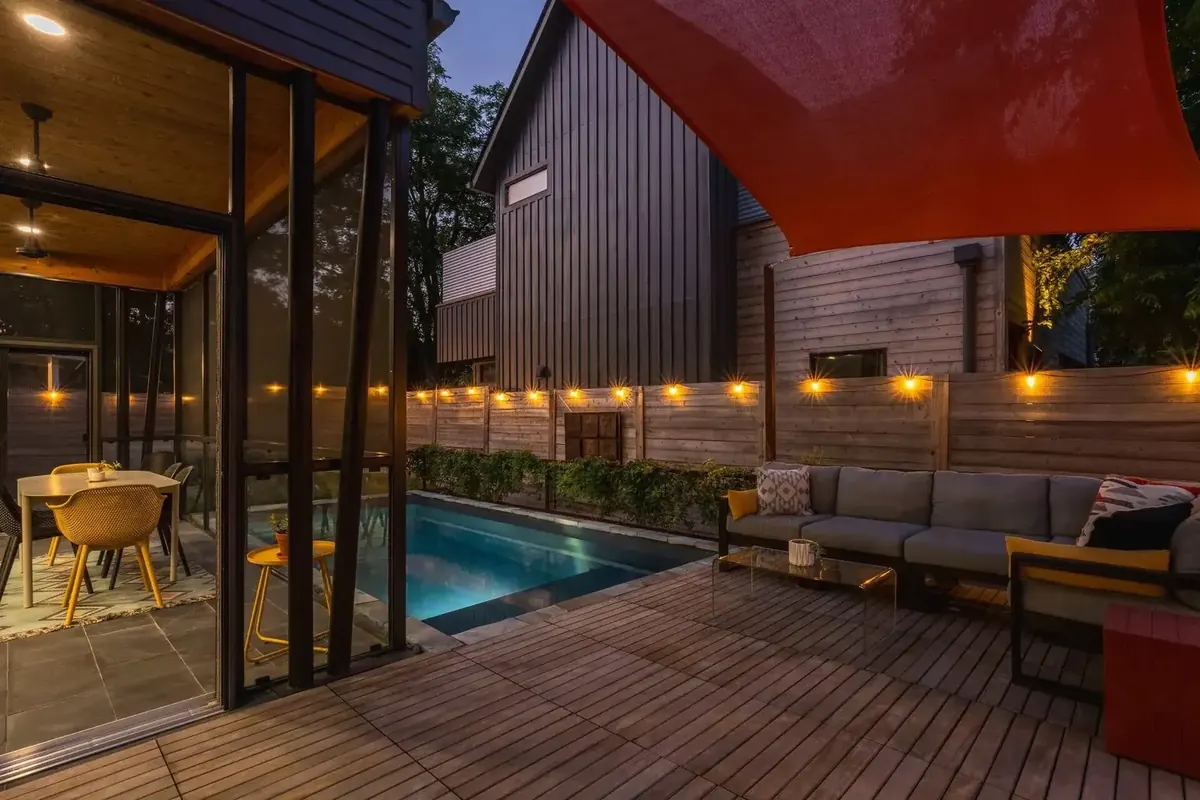
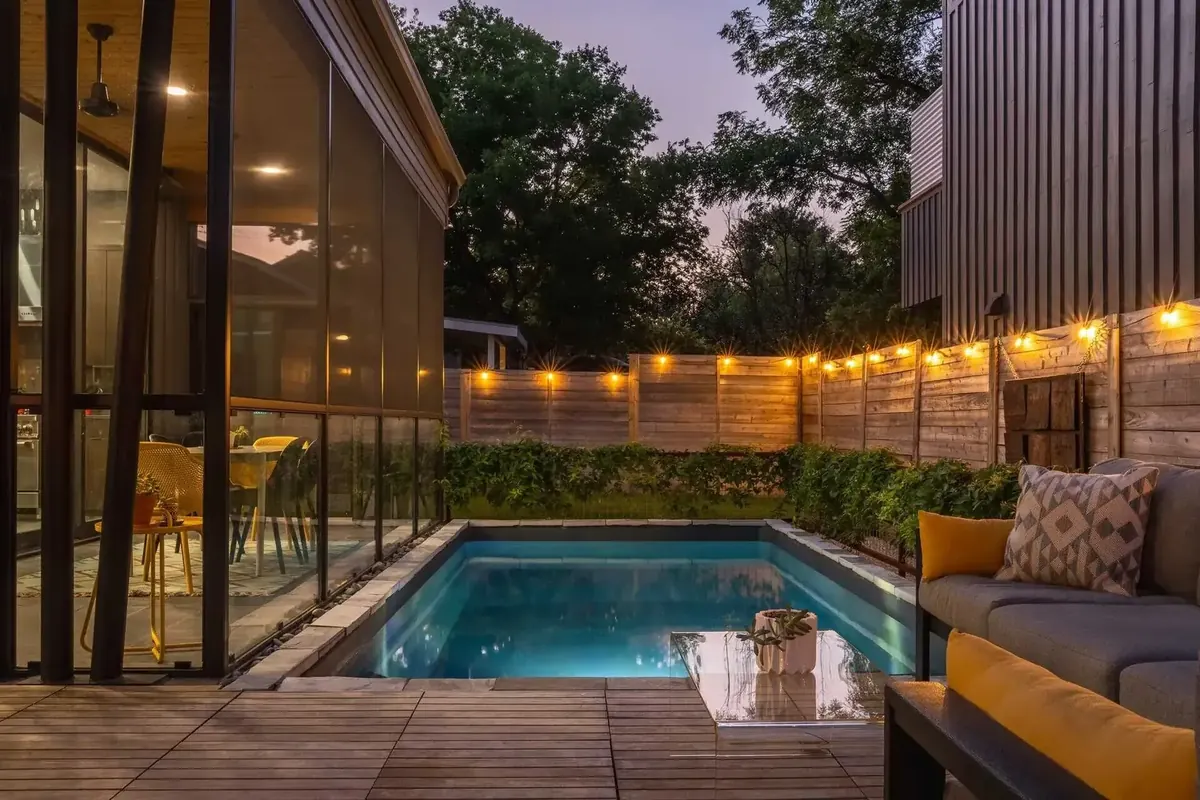
These photos are from our Ulit project in East Austin: a teak deck along an inground pool, a glass-screened porch, and an outdoor kitchen with a backlit Corten steel screen. Photography by Kieran Reeves.


Under the oaks, the shade natives that work in Tarrytown work here: inland sea oats, Turk’s cap, cedar sage, and American beautyberry. In the sunny gaps between canopies, agaves and Texas sage take the heat. Our cold-hardy agave guide covers the agaves.
The city’s own garden names deer resistance as a local condition, so lean on the plants deer leave alone, like Texas sage and agaves. Our native plants guide has the full list.
Ungnadia speciosa
A small native tree that blooms pink in spring and turns gold in fall, sized to sit under Rollingwood’s big oaks without competing with them. The city’s own Waterwise Garden names deer resistance as a neighborhood condition, and this one rates high. Its seeds are poisonous, so keep it away from where small children play.
Plant data: Lady Bird Johnson Wildflower Center.
Tell us about your Rollingwood lot and its trees. We’ll design the outdoor room around them.
Get a Free Quote →