Lakeway's water comes from Lakeway Municipal Utility District, formed in 1972, which serves parts of the city and the Village of the Hills. A district that size watches every gallon. Lakeway beds work best on drip irrigation, or none at all once established.
Lakeway has run a formal deer-management program for years, complete with a city deer census. Where the city counts deer, the plant list has to assume browsing. Agaves, yuccas, sotol, and the aromatic natives go untouched; anything soft and green gets eaten.
After the 2011 Central Texas fires, Lakeway began working toward Firewise Community status in November 2012. Hardscape against the house, gravel and decomposed granite instead of bark mulch, and open spacing between shrubs all follow Firewise practice, and they look better in this landscape anyway.
Lakeway sits in the Hill Country on the south shore of Lake Travis, and the ground is rarely level or soft. That favors a poured patio over a laid one. A marbled concrete slab goes down over a compacted base in one piece, follows the grade, and has no sand joints for weeds or ants. Board-formed edges give it a crisp architectural line. Our concrete vs. paver comparison covers the trade-offs; on rocky ground, concrete wins. See the marbled concrete service.
Where the slab ends, 1/4-inch mild steel edging takes over, holding a clean line between decomposed granite paths and planting beds. Steel edging doubles as a Firewise detail: it keeps a gravel strip against the structure and keeps bark mulch away from it. Read more in our decomposed granite guide.
The fire pit is the social center of a Lakeway yard. The Lakeway project used a floating boulder fire pit on propane: no wood pile and no embers, which matters in a Firewise community. See our fire pit service and the gas vs. wood comparison.
A Lakeway back yard of bare caliche and patchy Bermuda, baking in full sun and draining nowhere. The homeowners wanted one surface that could handle a 12-person dinner party, a fire pit gathering, and daily family use. Red Agave poured 1,800 square feet of marbled concrete patio with board-formed edges, ran 240 linear feet of 1/4-inch mild steel edging to separate patio, path, and bed, and set a floating boulder fire pit with propane plumbing at the center. 24V FCOB perimeter lighting on an ESP32 WLED controller outlines the slab at night. Native xeriscape beds finish the edges.
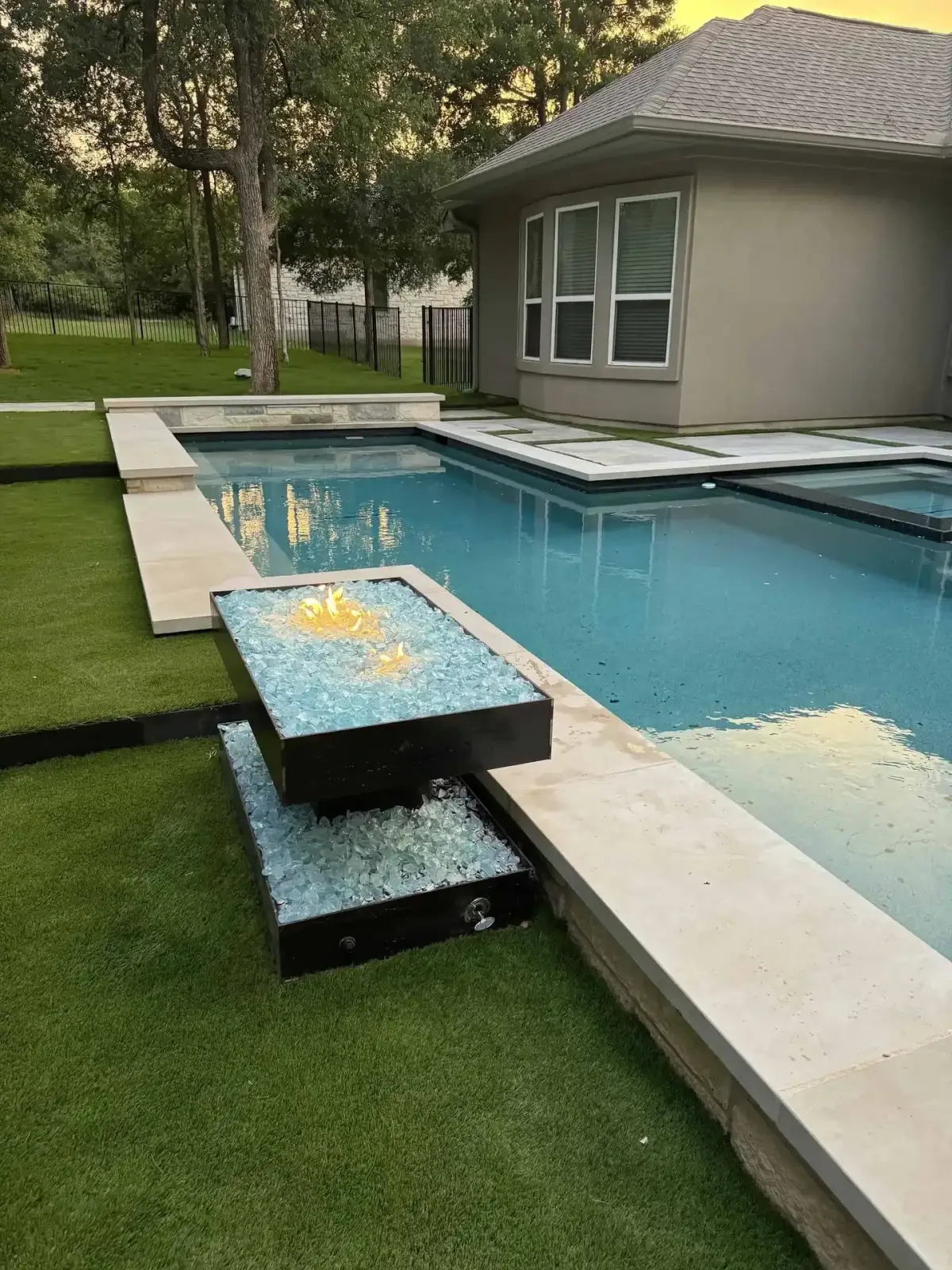
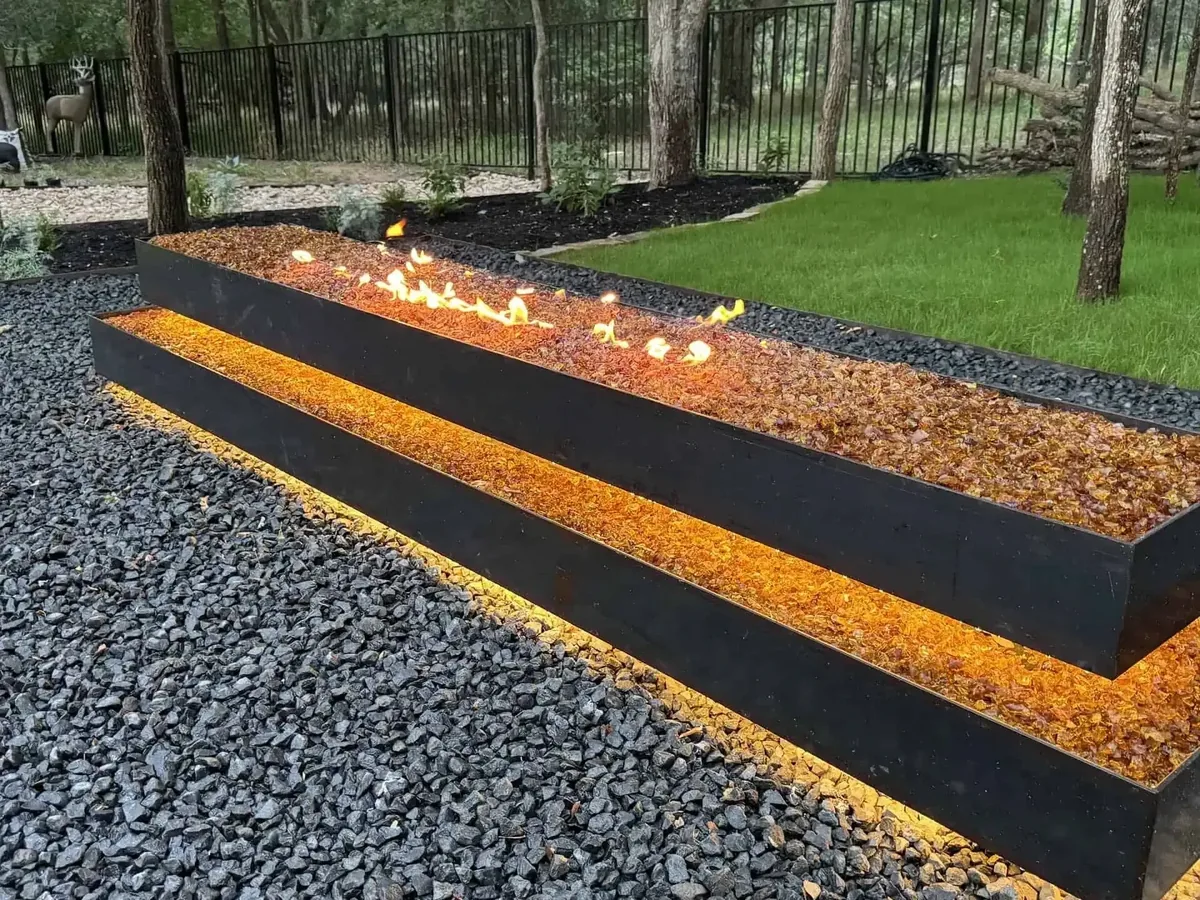
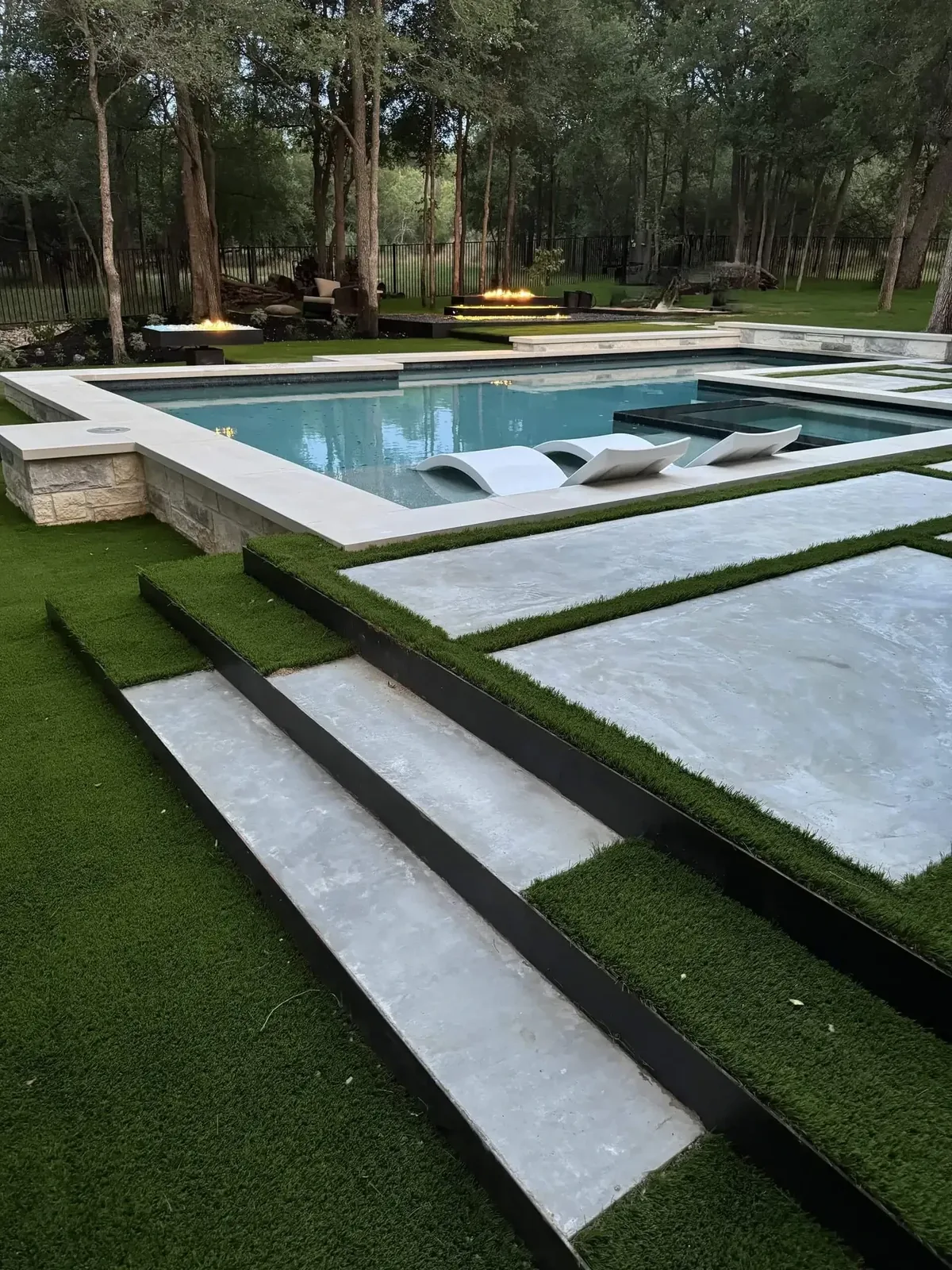
Photos: large-format concrete pads set in turf, steel fire troughs, and a pool edge from our hardscape work.
The Lakeway palette starts with structure the deer ignore: Whale's Tongue and Artichoke agave, softleaf yucca, and sotol. Our cold-hardy agave guide lists the ones that also shrug off a Hill Country freeze.
Around them go the aromatics and the tough natives: Texas sage, autumn sage, Mexican feathergrass, and blackfoot daisy. Deer avoid the scented leaves, and every one of these runs on rainfall once established, which suits a Lakeway MUD water bill. Spacing stays open and mulch is decomposed granite, both Firewise practice. Full lists in native plants for Austin and plants that survive an Austin summer.
Chrysactinia mexicana
Damianita grows wild on caliche and limestone outcrops in the southern half of the Hill Country, the same rock and caliche under many Lakeway yards. Deer leave it alone, and it blooms yellow for most of the year on almost no water. Plant it in drifts at the edge of a slab or along steel edging.
More in our xeriscape guide. Plant data: Lady Bird Johnson Wildflower Center.
Tell us about your Lakeway lot and we'll design for the rock, the deer, and the lake schedule.
Get a Free Quote →