The Ground You're Working With

Why Barton Creek Yards
Are Measured in Permeable Feet

Red Agave designs Barton Creek landscapes that add outdoor room while keeping slab to a minimum: decomposed granite patios and paths, gravel terraces held by 1/4-inch steel edging, steel-walled terraces on the slopes, and native planting that drinks only rain. Barton Creek sits in the Barton Springs Zone of the Edwards Aquifer, where Austin's Save Our Springs rules cap impervious cover at 15 to 25 percent of a site. Owner-designed, built by our own crew. 5.0 stars across 86 Google reviews.
15–25%

Over the Aquifer

Barton Creek lies in the Barton Springs Zone, the part of the Edwards Aquifer that feeds Barton Springs; more than 90 percent of Austin's southwest council district sits in that zone. Austin's Save Our Springs ordinance caps impervious cover at 15 percent of net site area in the recharge zone and 20 to 25 percent in the contributing zone, and it allows no variances.

4,000 ac

A Preserve Next Door

The Barton Creek Habitat Preserve covers more than 4,000 acres with four miles of creek frontage, protected for the golden-cheeked warbler and held under a City of Austin conservation easement. The creek your lot drains toward is the one the preserve exists to protect.

Estate

Big Lots, Deer, and Lawn

Barton Creek lots are large, wooded, and browsed by deer, and many came with more irrigated lawn than anyone uses. Every square foot of lawn converted to native beds is water the aquifer keeps.

What That Means for the Design

Build With Gravel and Steel,
Keep the Slab Small

A poured slab sheds every drop of rain that hits it. A decomposed granite patio, compacted over a base and held by 1/4-inch steel edging, lets rain soak in where it falls. So in Barton Creek, start the outdoor rooms in DG and gravel and keep concrete to the footprint that truly needs it, which keeps the lot's hardscape small and its runoff slow. Steel edging holds a crisp architectural line between gravel, bed, and lawn; the decomposed granite guide and steel edging guide cover the materials.

On the slopes, 1/4-inch steel retaining walls hold terraces on drilled footers with drainage behind each tier, so runoff moves through the lot instead of carrying soil toward the creek. See steel retaining walls.

Lighting is 24V FCOB and COB, low and warm under the oak canopy, and planting is native and unirrigated. The whole package is the xeriscape service.

The Work

The Work:
Decomposed Granite, Steel, Natives

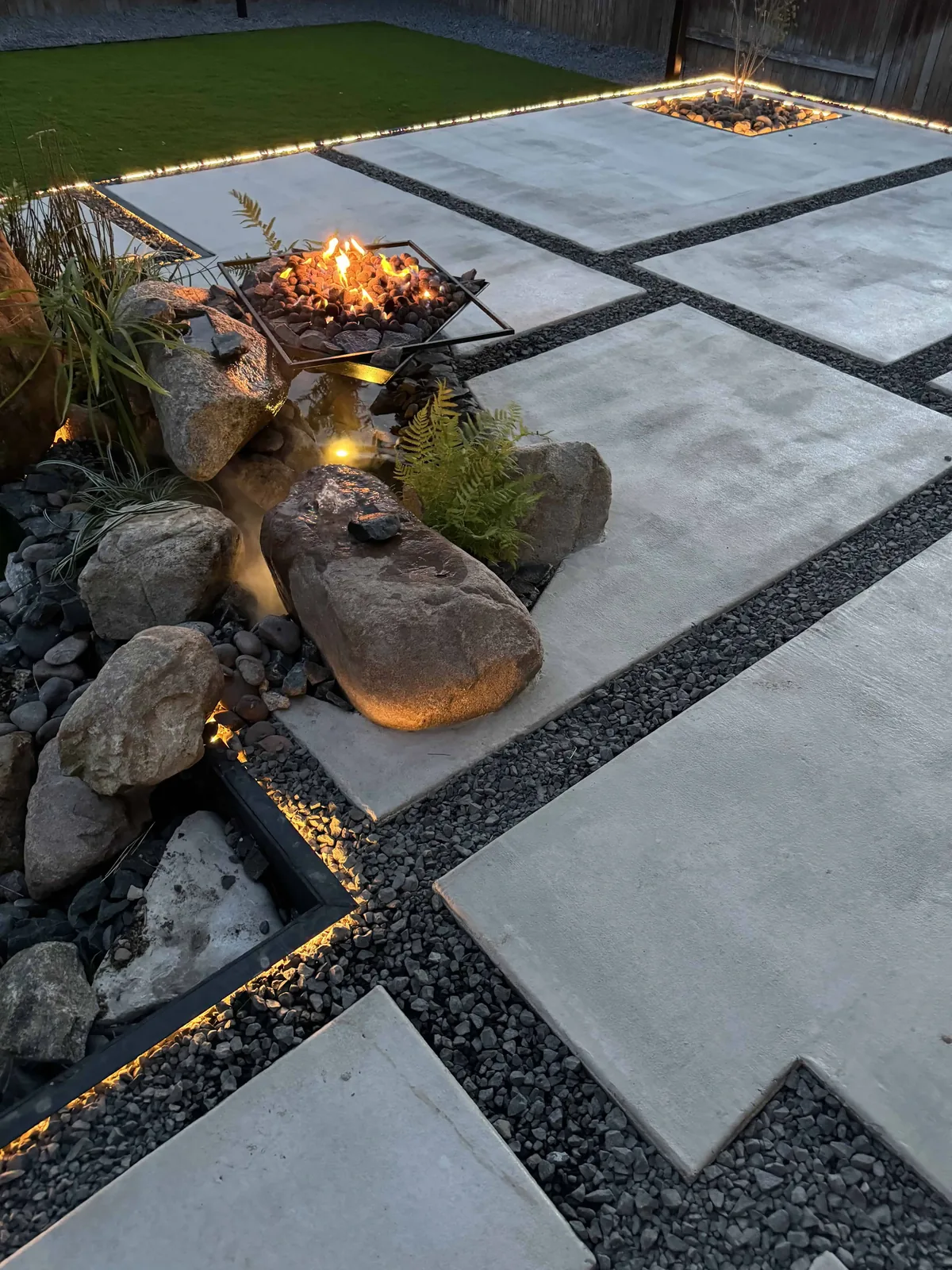
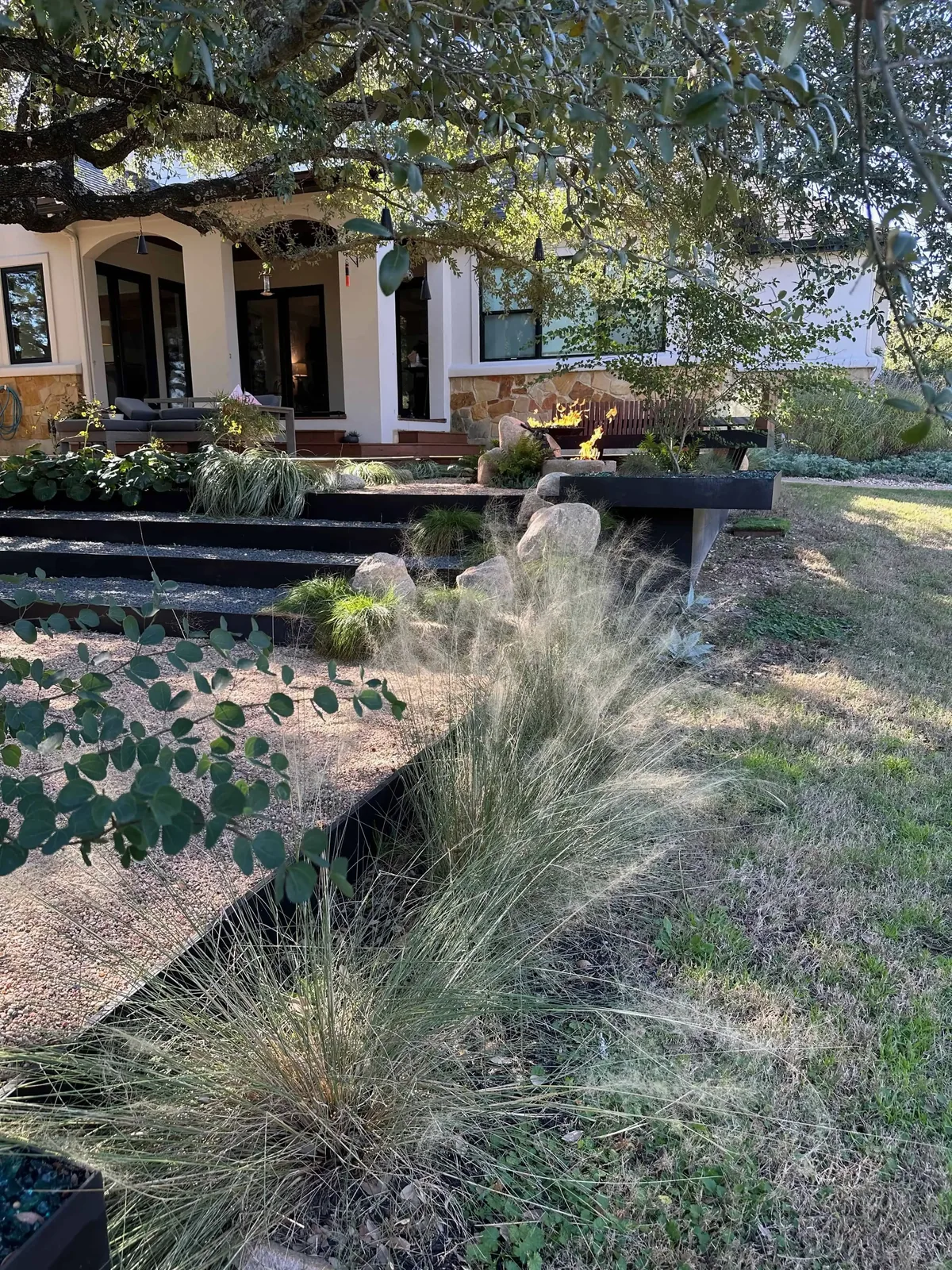
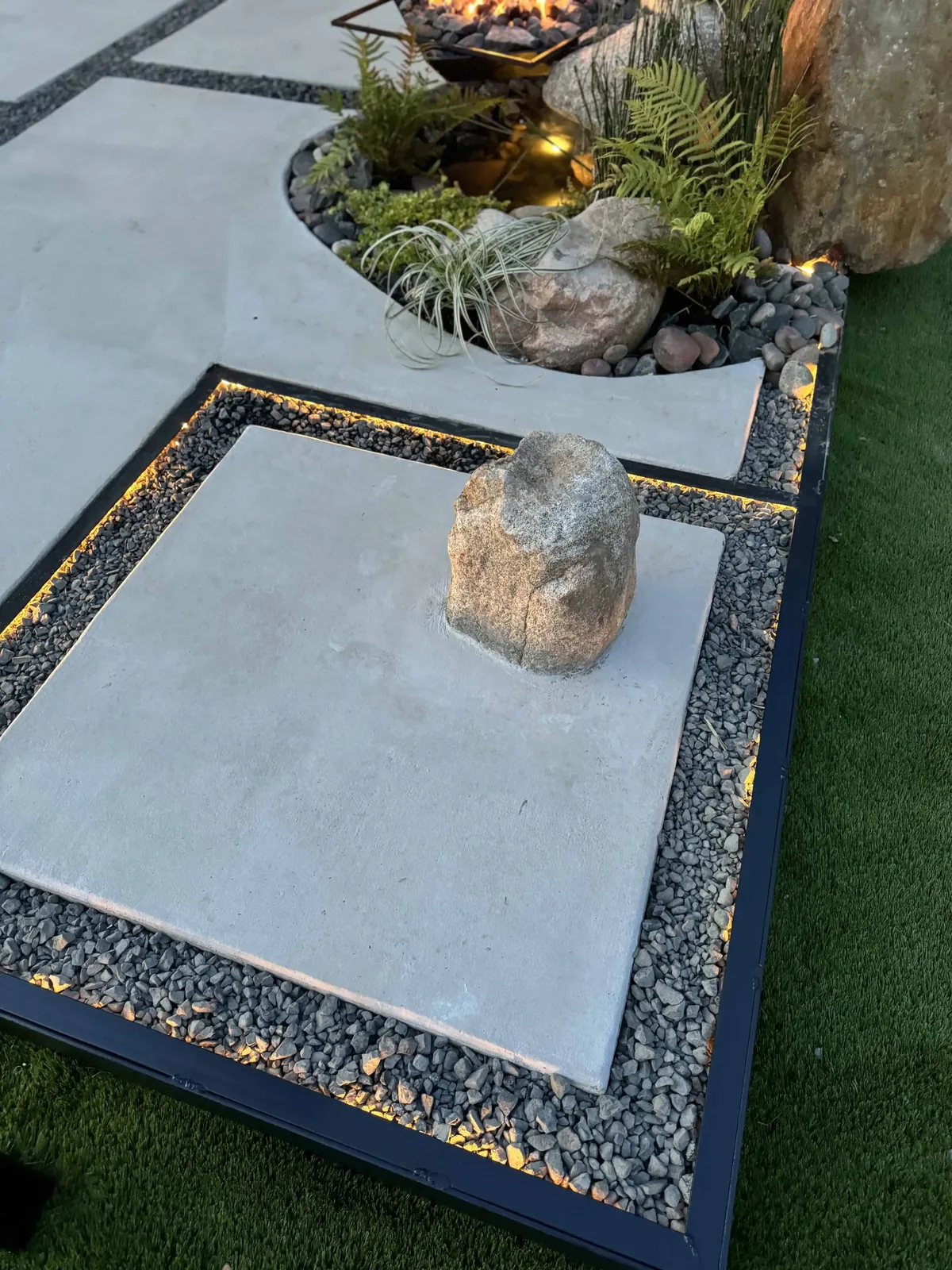
These photos show the material system: the first two are our Pflugerville build, large-format concrete pads set in gravel with 1/4-inch steel edging, limestone boulders, native grasses, and a steel fire bowl, the slab kept to the pads and the rest of the ground open gravel. The third is a gravel terrace on our Circle C steel-terrace build. Gravel ground, steel lines, native plants: the same approach we bring to Barton Creek.

Large-format concrete pads set in gravel with steel edging, boulders, and a lit fire bowl
Concrete pads and gravel with boulders, grasses, and a fire bowl at dusk, the steel edges lit
Native grasses and limestone boulders on a steel-edged gravel terrace in dappled oak shade

Read the Pflugerville Xeriscape case study (Pflugerville) →

Planting

Natives Under the Oaks,
Agaves in the Sun

Barton Creek's oak canopy sets the shade palette: inland sea oats, Turk's cap, cedar sage, American beautyberry, Texas sedge. In the sun, agaves and yuccas the deer ignore: Whale's Tongue, Artichoke, softleaf yucca, with our cold-hardy agave guide for the freeze-proof list.

Lawn-to-native conversion is the biggest single move on a Barton Creek lot. Our how to xeriscape in Austin guide walks it step by step, and native plants for Austin has the full list.

Featured Plant · Barton Creek

Texas Sacahuista

Nolina texana

Sacahuista grows wild in woods openings and borders, which is exactly the edge between a Barton Creek lawn and the trees. Deer pass it by, and it needs no irrigation once established over the aquifer. Travis County AgriLife’s Firewise guidance lists it among plants to keep 30 feet or more from the house where wildfire is a concern.

Common nameBeargrass
SizeAbout 30 in, evergreen, grass-like
SunPart shade
WaterLow
Deer resistanceHigh
SoilRocky limestone, caliche, sand to clay
BloomWhite, March to July

Plant data: Lady Bird Johnson Wildflower Center, Texas A&M AgriLife.

Questions From Barton Creek

Cover, Creek, and Canopy

What is the impervious cover limit in Barton Creek?
Under Austin's Save Our Springs ordinance, 15 percent of net site area in the Edwards Aquifer recharge zone, 20 percent in the Barton Creek portion of the contributing zone, and 25 percent in the rest of the contributing zone, with no variances. Your lot's zone is shown on the City of Austin property profile.
How do you add outdoor space without pouring more slab?
Decomposed granite patios and paths, compacted over a base and held by 1/4-inch steel edging. They walk and furnish like a patio, let rain soak in where it falls, and keep the concrete footprint to the places that truly need it.
Why does runoff matter more in Barton Creek?
Your lot drains toward Barton Creek, which feeds Barton Springs and runs past a 4,000-acre preserve held under a city conservation easement. Gravel ground and steel-held terraces slow water and keep soil on the lot instead of in the creek.
Which plants do Barton Creek deer leave alone?
Agaves, yuccas, sotol, Texas sage, autumn sage, rosemary, and Mexican feathergrass. Deer skip spines and scented foliage. Soft, broad-leafed plants get browsed, so they stay off the list.
Do you work on sloped Barton Creek lots?
Yes. 1/4-inch steel retaining walls on drilled concrete footers hold the terraces, with deadman anchors and a French drain behind every tier. The Westlake Steel case study, in Westlake Hills, shows the system on an 8-foot drop.
Explore

Nearby Areas & Related Services

Ready to Start?

Tell us about your Barton Creek lot and how much lawn you'd rather not water. We'll design the rest.

Get a Free Quote →