A pergola is an open frame of posts, beams, and rafters that gives partial shade, and a pavilion is a frame with a solid roof that gives full shade and keeps the rain off. A shade sail is fabric pulled tight between posts: it blocks most of the sun and lets the breeze through, and it is not a roof. Red Agave Landscape designs and builds all three in Austin, TX. This post compares them in one table and shows each on a real build.
Pergola, Pavilion, or Shade Sail: What Is the Difference?
The roof. Everything else follows from it.
| Question | Pergola | Pavilion or patio cover | Shade sail |
|---|---|---|---|
| What is overhead? | Open rafters or slats | A solid roof | Knitted fabric under tension |
| How much sun does it block? | Part of it, set by the spacing and direction of the rafters | All of it from above | Fabric is rated at 80, 90, or 95 percent UV block |
| Does it keep rain off? | No | Yes | No. It is a mesh, not a roof |
| Does air move through it? | Yes | Through the open sides, and a ceiling fan can hang from it | Yes, through the fabric |
| Can it hold a fan, lights, and a TV? | Lights hang from the beams | Yes, in the ceiling | No |
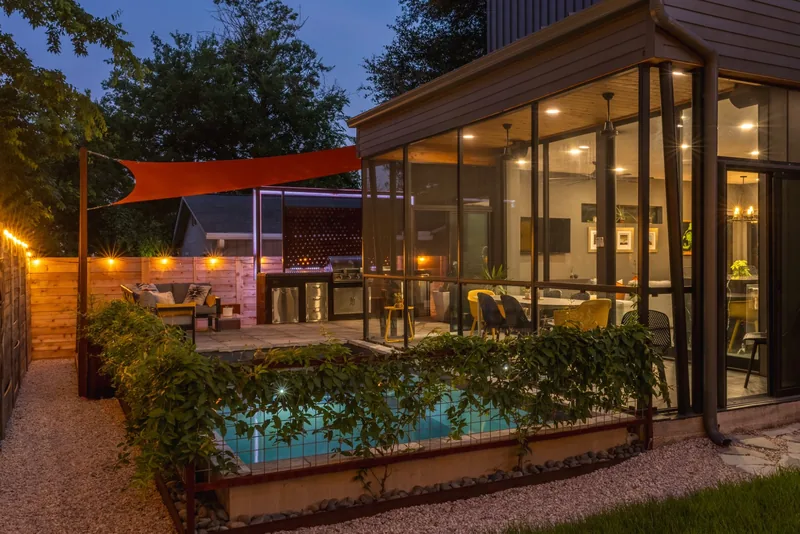
| Our example | Steel pergola, Cedar Park | Roofed kitchen, West Lake Hills | Red sail, East Austin |
How Much Shade Does an Austin Yard Need?
A lot, for a long season. The National Weather Service’s temperature records for Austin put the 1991 to 2020 average at 29 days a year at 100 degrees or hotter. Austin had 80 of those days in 2023 and 90 in 2011, and 45 of them came in a row in 2023.
The hours matter too. The Environmental Protection Agency says the sun’s UV rays are strongest between 10 a.m. and 4 p.m. A shade structure earns its place by covering where you sit during those hours.
When Is a Pergola the Right Choice?
When you want shade and sky together. A pergola filters the sun and keeps the space open.
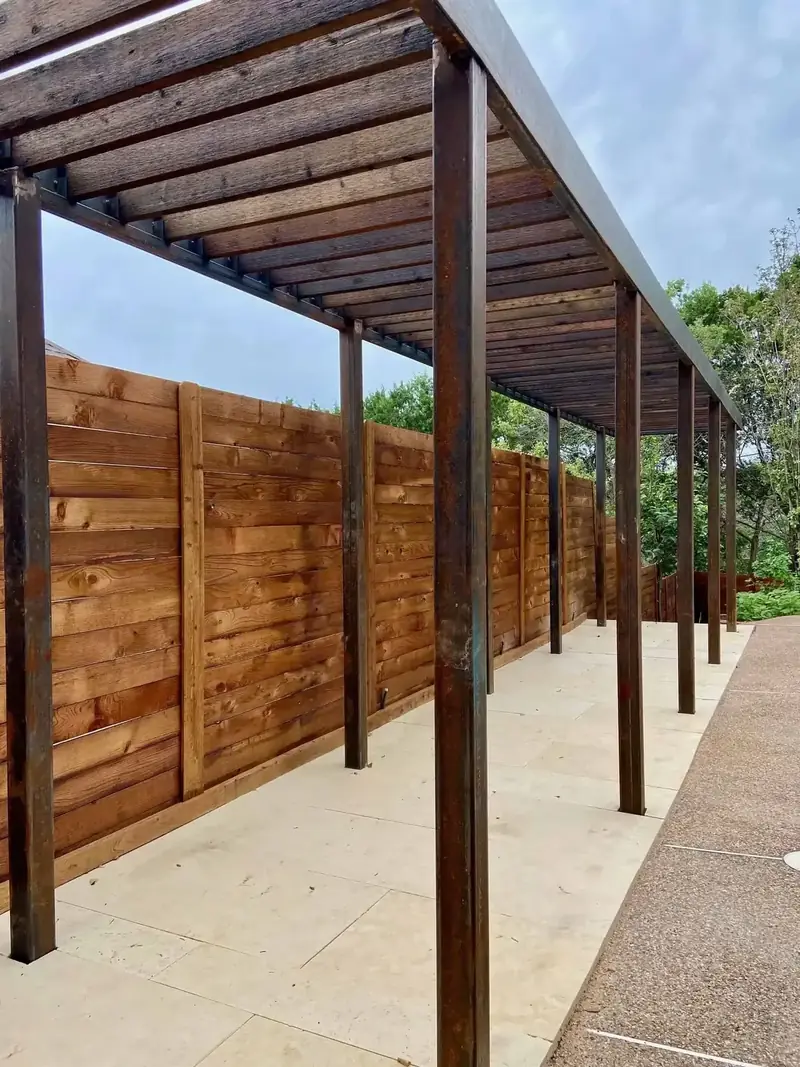
In Cedar Park we built a long steel pergola from scratch along a privacy fence. It has square steel posts, steel beams, and wood rafters set close together in steel clips. The owners wanted steel that rusts, so the frame was left to weather to a deep brown.
Two things decide how much shade a pergola gives:
- Direction: rafters that run east to west block the high midday sun. Rafters that run north to south block the morning and late-afternoon sun
- Spacing: close spacing blocks more sun in either direction
Low sun late in the day comes in under any roof. In Cedar Park the fence along one side handles it. See our post on choosing a pergola builder.
When Is a Pavilion or Patio Cover the Right Choice?
When the space under it is a room. A solid roof gives full shade, keeps rain off, and gives you a ceiling.
In West Lake Hills we built an outdoor kitchen under its own flat roof on black posts. The ceiling is tongue-and-groove wood, and it holds four recessed lights and a ceiling fan. A TV hangs on the back wall. Recessed lights and a fan need a ceiling, and a ceiling needs a roof.
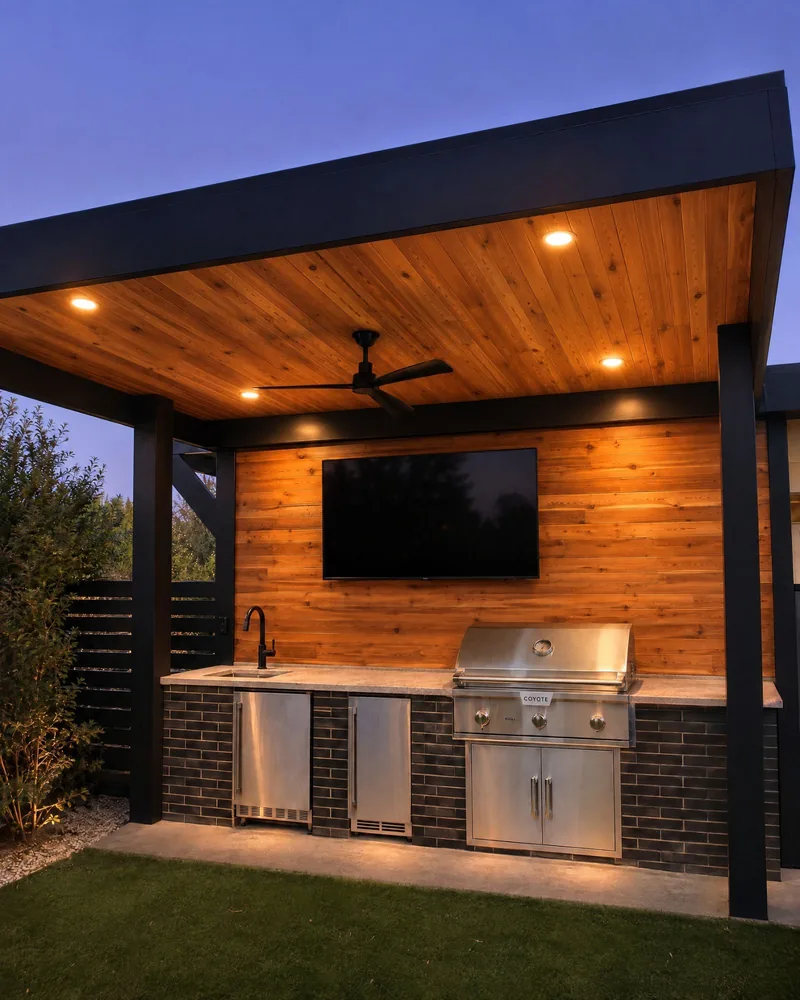
A solid roof also counts with the city. Austin Development Services lists rooftops among the surfaces that count as impervious cover, and the share a lot is allowed is set by its zoning. A new roof adds to that count. Our post on outdoor kitchens under a roof covers this build.
When Is a Shade Sail the Right Choice?
When you want shade over one spot and nothing heavy above it. In East Austin a red sail shade covers the outdoor kitchen and the seating end of a teak deck, beside the pool. The screened porch a few steps away has a solid roof. Each part of the yard got the shade that suits it. See the East Austin project.
The fabric does the work. Coolaroo, a maker of shade sails, rates its knitted shade fabrics at three levels of UV block: 80, 90, and 95 percent. Its shade sail page says the fabric lets cooling breezes pass through. The same FAQ says lighter colors reflect heat and keep the space cooler.
A sail asks for two things in return. It has to stay tight, and it has to be looked at. Coolaroo recommends inspecting a shade twice a year: check the tension, clean the fabric, and look for wear on the fittings.
Can One Frame Be More Than One of These?
Yes. Building in steel means the frame that makes the pergola also carries a roof and holds screens. In South Austin we welded a steel pergola frame on a concrete slab at the back doors of a house. Then we put ribbed metal roof panels over it and a cedar plank ceiling under it, with two skylights and a ceiling fan. Screens in black frames went in last.
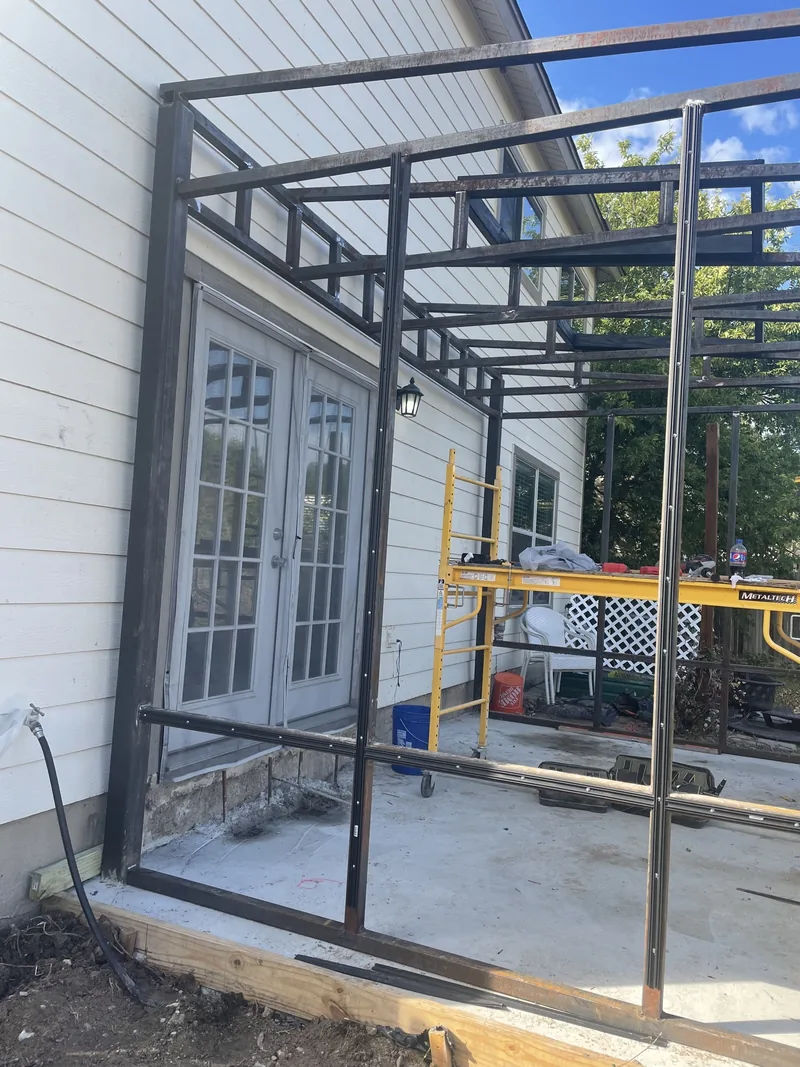
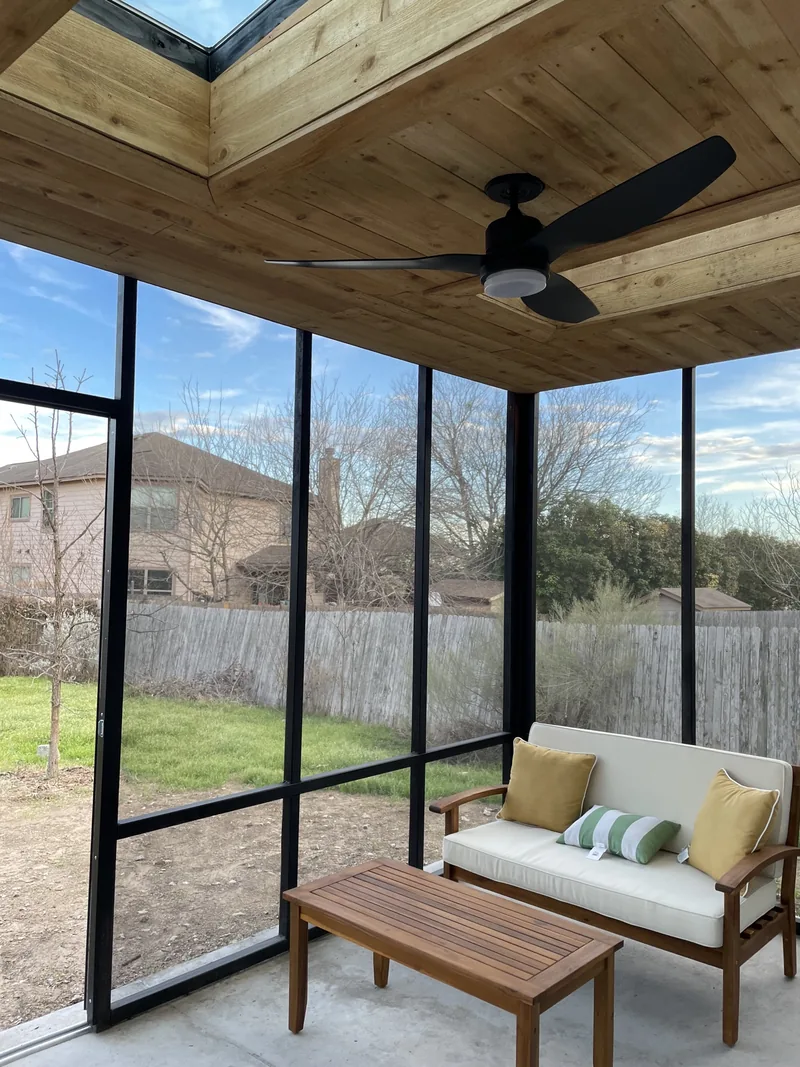
- Pergola: the open frame of posts and beams
- Patio cover: the same frame with a solid roof on it
- Screened room: the covered frame with screens and a door
See the full South Austin build and our pergolas and shade structures page.
Which Shade Structures Need a Permit in Austin?
Size and attachment decide it. Austin Development Services lists the work exempt from building permits. For a home, the list includes a one-story detached accessory structure that is no more than 200 square feet and no more than 15 feet tall, has no plumbing, does not create a dwelling, and sits outside a flood hazard area. Exempt work still has to meet the building code and city code.
A structure attached to the house is not a detached structure, so that exemption does not cover it. The city’s Do I Need a Permit tool walks through a project in about five minutes. We handle the permit and the plans, and our patio cover permit guide covers the details.
Every Red Agave project starts with a free consultation, and the CAD plan is included. For cost ranges, see our Austin pergola guide.
What Sources Did We Use?
We read each of these in November 2026.
- National Weather Service, Austin/San Antonio, Austin Area temperature rankings, updated July 2026
- U.S. Environmental Protection Agency, Sun Safety Tips
- City of Austin, Austin Development Services, Work Exempt from Building Permits, Do I Need a Permit, and Glossary of terms
- Coolaroo, manufacturer, Frequently Asked Questions and Shade Sails
Questions We Hear
What is the difference between a pergola and a pavilion?
The roof. A pergola has open rafters and gives partial shade. A pavilion has a solid roof, so it gives full shade, keeps rain off, and has a ceiling that holds a fan and lights.
Is a shade sail better than a pergola?
They do different jobs. A shade sail covers one spot with fabric that blocks most of the sun and lets air through. A pergola is a permanent frame of posts, beams, and rafters. In East Austin we used a sail over a lounge and a solid roof over the porch beside it.
Which shade structure keeps rain off?
A pavilion or patio cover, because it has a solid roof. A pergola has open rafters, and a shade sail is a knitted mesh.
Do I need a permit for a pergola or pavilion in Austin?
Austin Development Services lists a one-story detached accessory structure of no more than 200 square feet and 15 feet tall, with no plumbing and outside a flood hazard area, as exempt from a building permit. A structure attached to the house is not covered by that exemption.
Can a pergola be turned into a covered patio later?
Yes. In South Austin we put a metal roof, a cedar ceiling, and screens on a welded steel pergola frame.