Xeriscaping an Austin yard cuts the water it needs, cuts the mowing and upkeep, and fits the city’s one-day-a-week sprinkler schedule. Austin Water pays rebates toward it, and Texas law stops a property owners’ association from banning it. Those benefits come from the City of Austin, Texas A&M AgriLife Extension, the Lady Bird Johnson Wildflower Center, and the Texas Property Code. Red Agave Landscape designs and builds xeriscapes across Austin, TX, and the Tarrytown front yard below shows what one looks like on a high-end home.
What Are the Benefits of Xeriscaping in Austin?
Six, and each one has a source behind it.
| Benefit | What the source says | Source |
|---|---|---|
| Less water | About 25 percent of the water supply in urban Texas goes to landscape and garden watering, and turfgrass needs more frequent watering than most other landscape plants | Texas A&M AgriLife Extension |
| Less upkeep | A well-designed water-saving landscape can cut maintenance by as much as 50 percent | Texas A&M AgriLife Extension |
| Fits the watering schedule | Automatic sprinklers run one day a week. Hand watering is allowed at any time | Austin Water |
| Rebates | Rebates for turning turf grass into native plant beds, for rain-capturing landscape features, and for mulch, compost, and aeration | Austin Water |
| Protected from an HOA ban | An association cannot prohibit drought-resistant landscaping, though it can ask to review a plan | Texas Property Code 202.007 |
| Habitat and cooler ground | Native plants give wildlife a home, protect soil, and lower temperatures in urban areas | Lady Bird Johnson Wildflower Center |
How Much Water Does a Xeriscape Save?
Start with where the water goes. Texas A&M AgriLife Extension’s Earth-Kind guide to landscape water conservation reports that about 25 percent of the water supply in the urban areas of Texas is used on landscapes and gardens. It adds that most lawns get twice the water they need, and that turfgrass needs more frequent watering than most other landscape plants.
A xeriscape goes after all three. It shrinks the lawn to the part you use, replaces the rest with plants that need less, and covers the soil with mulch so less water evaporates.
Austin Water puts a number on watering less often: 7,000 to 14,000 gallons a month for an average household that waters one day a week where it had watered two or three.
One caution from AgriLife: new plants need more water at first. Trees and shrubs need more frequent watering from planting until they are well rooted, and that can take two growing seasons. The savings come after.
Does a Xeriscape Mean Less Yard Work?
Yes. AgriLife’s guide says a well-designed water-saving landscape can cut maintenance by as much as 50 percent. It names four reasons: less mowing, mulching once a year, no weak plants that do not suit the site, and more efficient watering.
The Wildflower Center’s page on why native plants matter lists the same gains. Native plants lower mowing costs and save money on fertilizer and pesticides, because they are hardy and less open to pests and disease.
What Do Austin’s Watering Rules Mean for a Xeriscape?
They are the strongest local reason to build one. Austin Water has kept the city in its Conservation Stage since September 2, 2025. For a home, the schedule is:
- Automatic irrigation systems: one day a week, before 10 a.m. or after 7 p.m.
- Drip irrigation and hose-end sprinklers: two days a week, in the same hours
- Hand-held hose or a watering can: any time, any day
- Trees on a soaker hose or tree bubbler: any time, any day
A lawn that needs water three times a week in August cannot get it under that schedule. A bed of agaves and gravel on drip does not notice.
Austin Water also lists a variance for a newly installed xeriscape that needs a special schedule while it roots in. Our guide to Austin’s water restrictions covers the stages.
What Rebates Does Austin Water Offer?
Austin Water’s rebates page lists four landscape rebates and three for irrigation. The ones that pay toward a xeriscape:
- WaterWise Landscape: for converting turf grass to a native plant bed
- WaterWise Rainscape: for landscape features that capture and hold rainwater
- Landscape Survival Tools: for mulch, compost, and core aeration
- Irrigation Upgrade: for making an irrigation system more water efficient
The current amounts are on that page. Austin Water also lists qualifying water providers outside its own system, and the list includes the City of Rollingwood and the City of West Lake Hills.
Can an HOA Stop You From Xeriscaping in Texas?
No. Section 202.007 of the Texas Property Code says a property owners’ association cannot enforce a rule that prohibits or restricts an owner from using drought-resistant landscaping or water-conserving natural turf. The same section protects drip irrigation and rain barrels.
The association keeps some say. It can require a detailed plan for review, and it can regulate gravel, rocks, and cacti. The law also says it cannot unreasonably deny the plan. The section does not apply to one kind of association: one in certain large cities that manages a development with at least 4,000 acres set aside for commercial use, multifamily housing, or open space. This is where a drawn plan earns its keep: every Red Agave project starts with a free consultation, and the CAD plan is included.
What Does a Xeriscape Look Like on a Luxury Home?
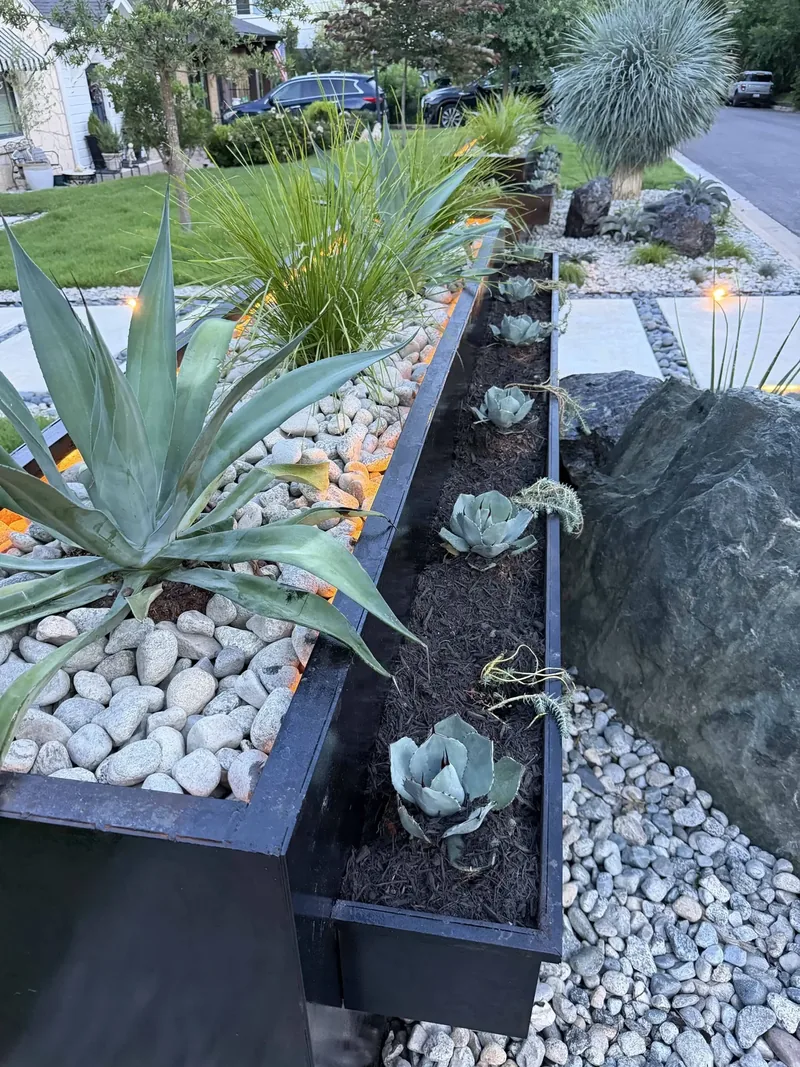
Like a design, not a compromise. In Tarrytown we built a front entry around steel and agaves.
- Planters: two cantilevered steel planters, stacked and offset, on welded steel legs
- Ground: gravel and Mexican beach pebbles, with boulders
- Plants: Agave weberi, artichoke agave, and blue spruce sedum
- Light: angle iron along the top rim of the planters holds the lighting
- Steel: darkened and sealed
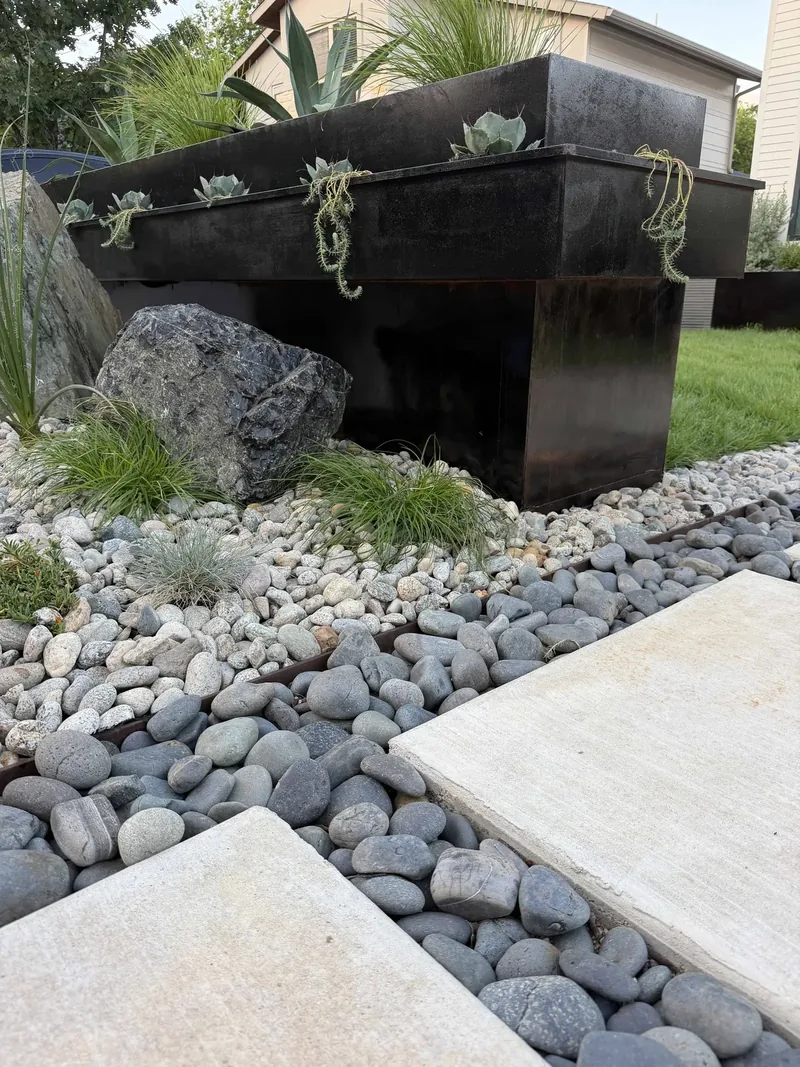
The benefits show in the photos. An agave holds its shape all year and takes full sun. The Wildflower Center lists Parry’s agave, the artichoke agave, as a low water use plant for full sun and dry, rocky soil. Rock covers the ground between the plants, so there is nothing to mow around them. Lawn remains beside the beds.
See the Tarrytown project, our xeriscape service, and our notes on artichoke agave. For pricing, see our xeriscaping cost guide.
What Sources Did We Use?
We read each of these in November 2026.
- City of Austin, Austin Water, Find Your Watering Day
- City of Austin, Austin Water, Rebates, Tools and Programs
- Texas A&M AgriLife Extension, Earth-Kind, Water Conservation
- Lady Bird Johnson Wildflower Center, Why Native Plants and Agave parryi
- Texas Property Code, Section 202.007, Certain Restrictive Covenants Prohibited
Questions We Hear
What are the main benefits of xeriscaping in Austin?
Less water, less upkeep, and a yard that fits Austin Water’s one-day-a-week sprinkler schedule. Austin Water pays rebates toward it, and Texas law stops a property owners’ association from banning drought-resistant landscaping.
Does Austin Water pay you to remove grass?
Austin Water lists a WaterWise Landscape rebate for converting turf grass to a native plant bed, along with rebates for rain-capturing landscape features, mulch and compost, and irrigation upgrades. The current amounts are on its rebates page.
How often can you water in Austin?
Under the Conservation Stage in effect since September 2, 2025, a home with an automatic irrigation system waters one day a week, before 10 a.m. or after 7 p.m. Drip irrigation and hose-end sprinklers get two days. Watering with a hand-held hose is allowed at any time.
Can my HOA make me keep a lawn in Texas?
Section 202.007 of the Texas Property Code says a property owners’ association cannot prohibit or restrict drought-resistant landscaping or water-conserving natural turf. The association can require a plan for review, and it cannot unreasonably deny it.
Does a xeriscape need any water?
Yes, at first. Texas A&M AgriLife Extension says trees and shrubs need more frequent watering from planting until they are well rooted, which can take two growing seasons. After that they are watered less often.