Red Agave Landscape installs landscape lighting in Austin, TX as part of the structure: under pergola beams, under the rims of steel planters, and along steel and deck edges. The light lands on the table, the step, and the plants, and the source stays out of sight. Our FCOB and COB systems run on 24V low voltage, are planned in zones, and are controlled from a phone. Every system is designed and installed by our own crew.

Why Put the Light Under the Beams?
Because that is where it does a job. On our Circle C pergola project, a group of black dome pendants hangs under the beams at staggered heights. Each shade opens downward, so the light falls on the dining table and the deck, and nothing shines up past the pergola.
That is also what the lighting profession recommends. DarkSky International and the Illuminating Engineering Society adopted Five Principles for Responsible Outdoor Lighting: light should be useful, targeted, low level, controlled, and warm-colored. A warm pendant over a table, on a dimmer and a timer, meets all five.
Light that is aimed down and hidden from view also suits towns with strict outdoor lighting rules, including Dripping Springs, the first International Dark Sky Community in Texas.
Where Does the Light Go When There Is No Roof?
Into the steel and the deck. Three builds show how.
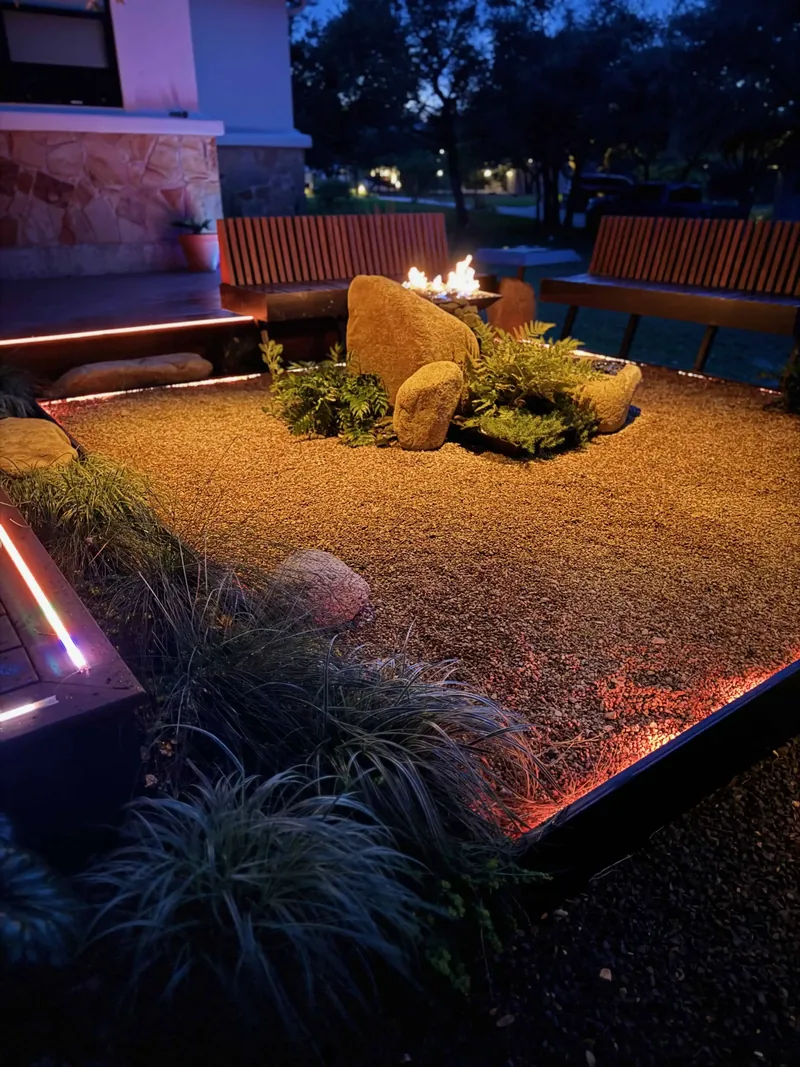
- Under a planter rim: on the Circle C pergola project, each steel planter carries a light strip under its lip. The strip lights the soil and the plants from inside the rim. You see lit leaves and never a bulb.
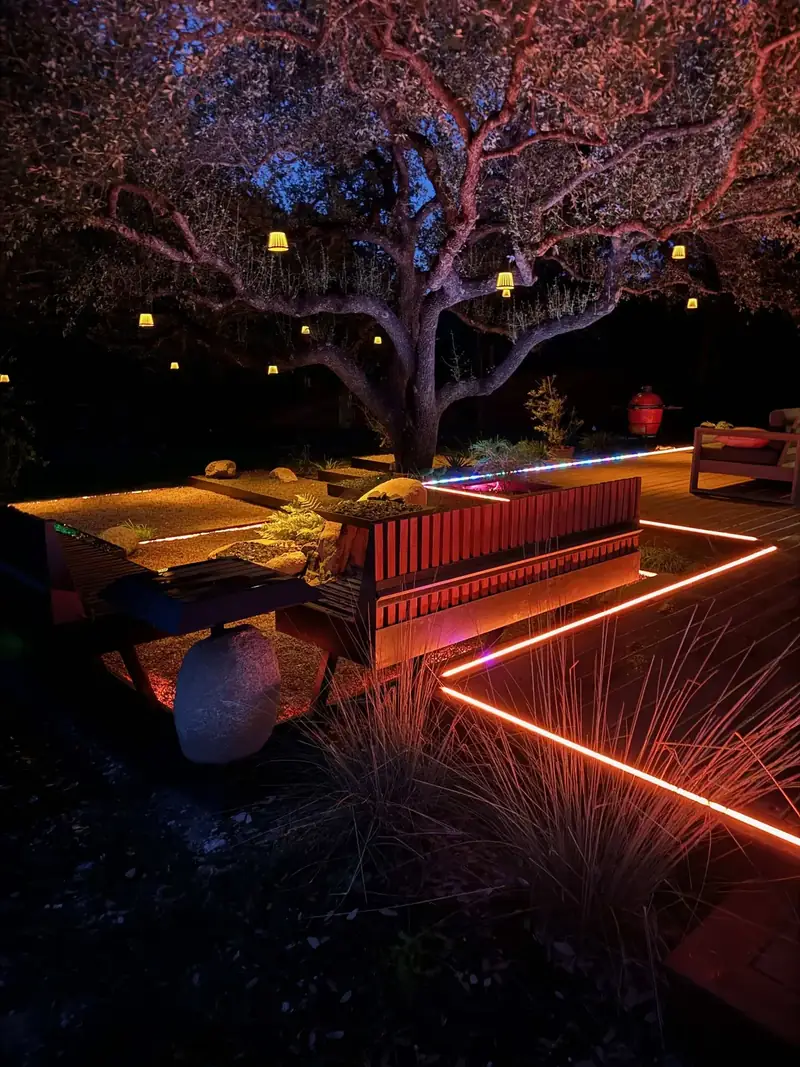
- Along an edge: on our steel terraces at the Overlook at Lewis Mountain in Southwest Austin, LED strips trace the steel edges and the deck transitions. At night the lines draw every level of the slope, and lanterns hang in the live oak above.
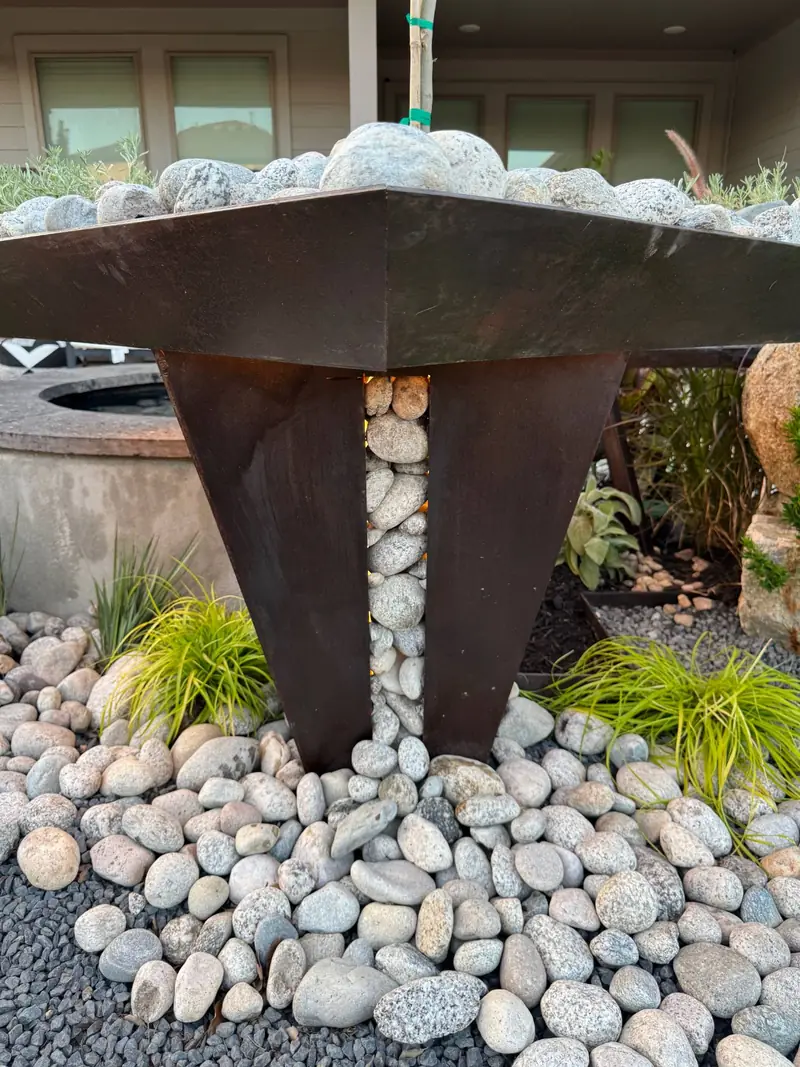
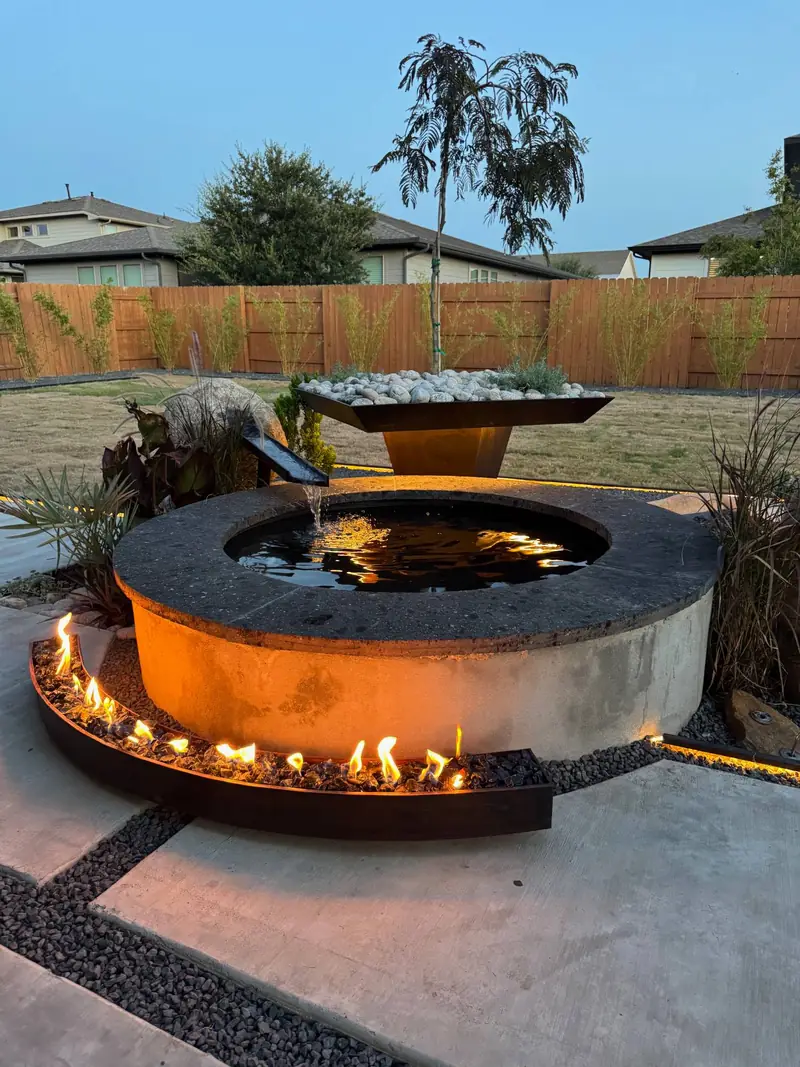
- Inside the steel: on our Southeast Austin water feature, the tapered base of a steel planter has a slot packed with river rock and lit from inside. Light strips run along the steel edging beside it.
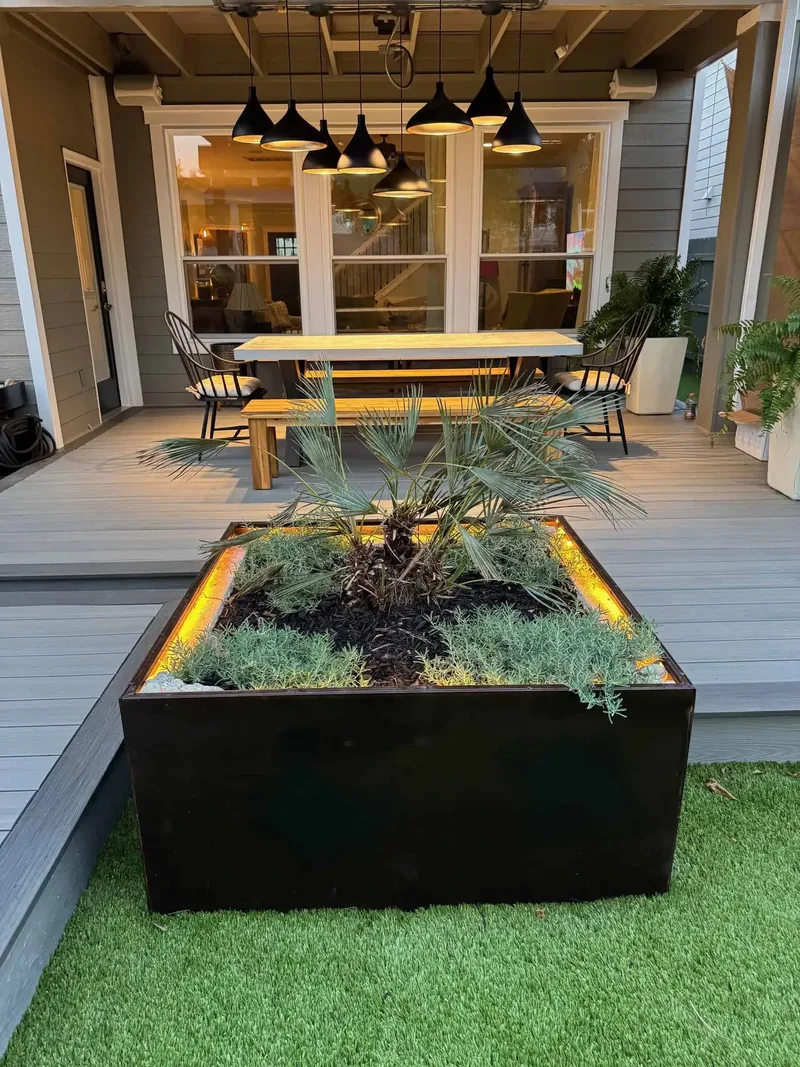
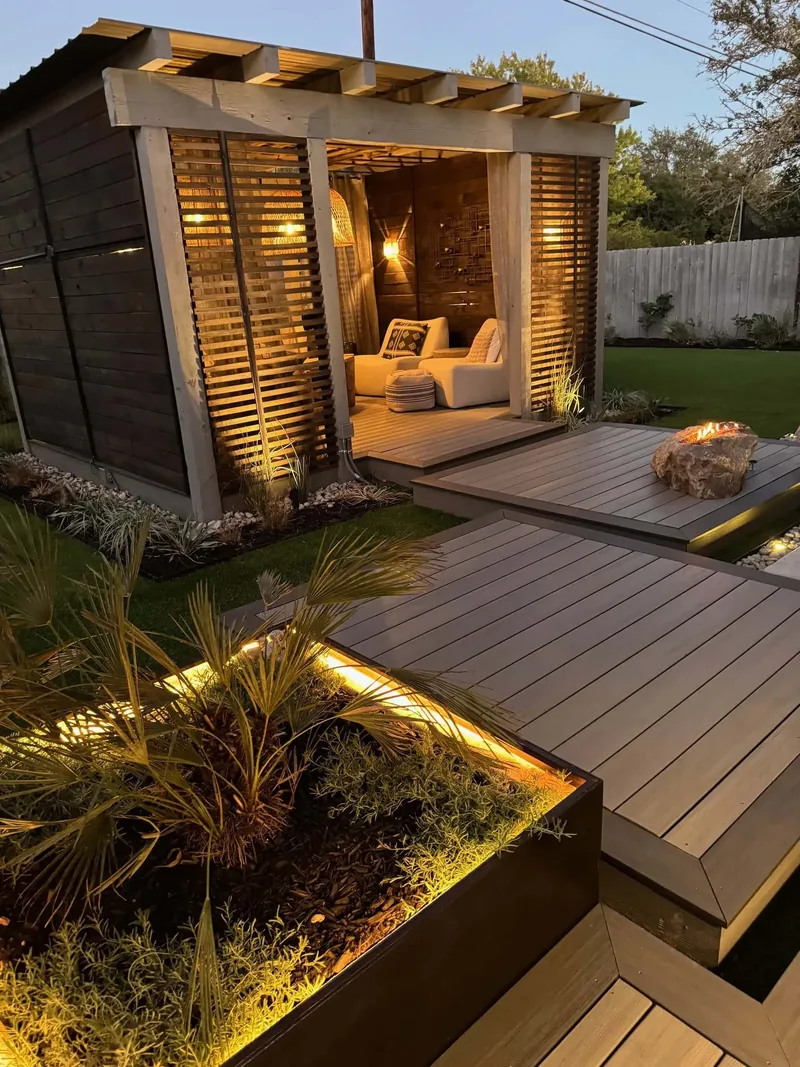
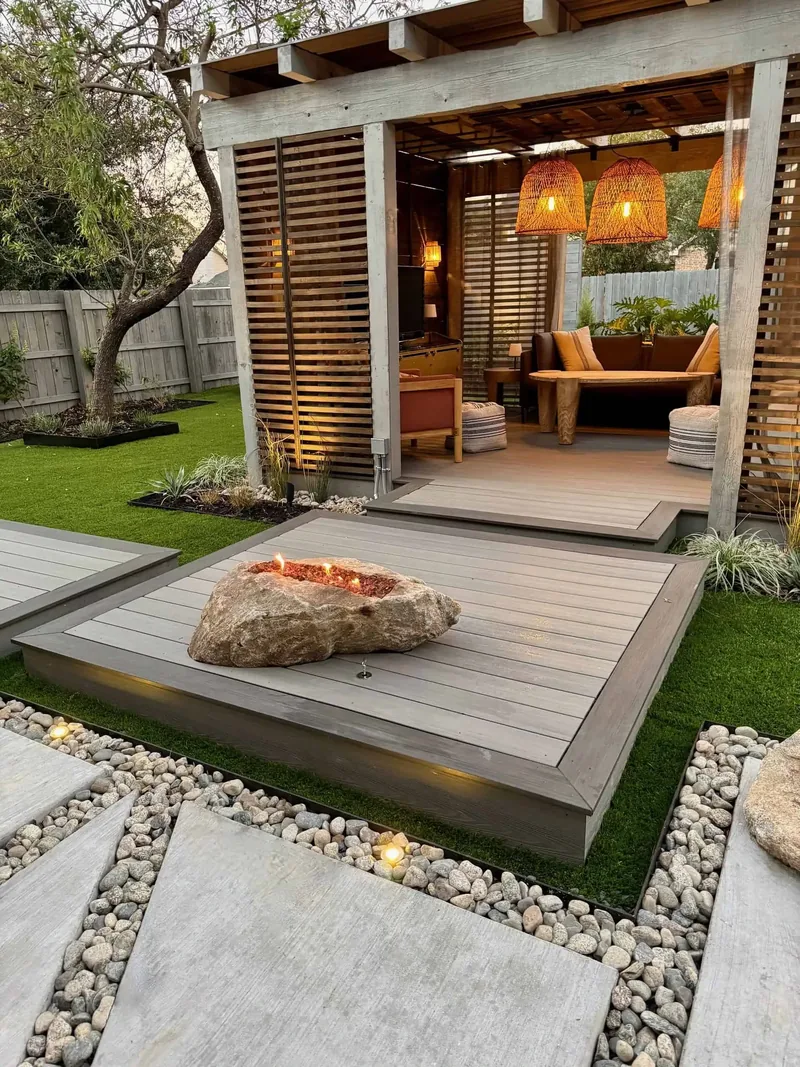
In all three, the light is part of something we were already building. See our custom steel planters and our pergolas.
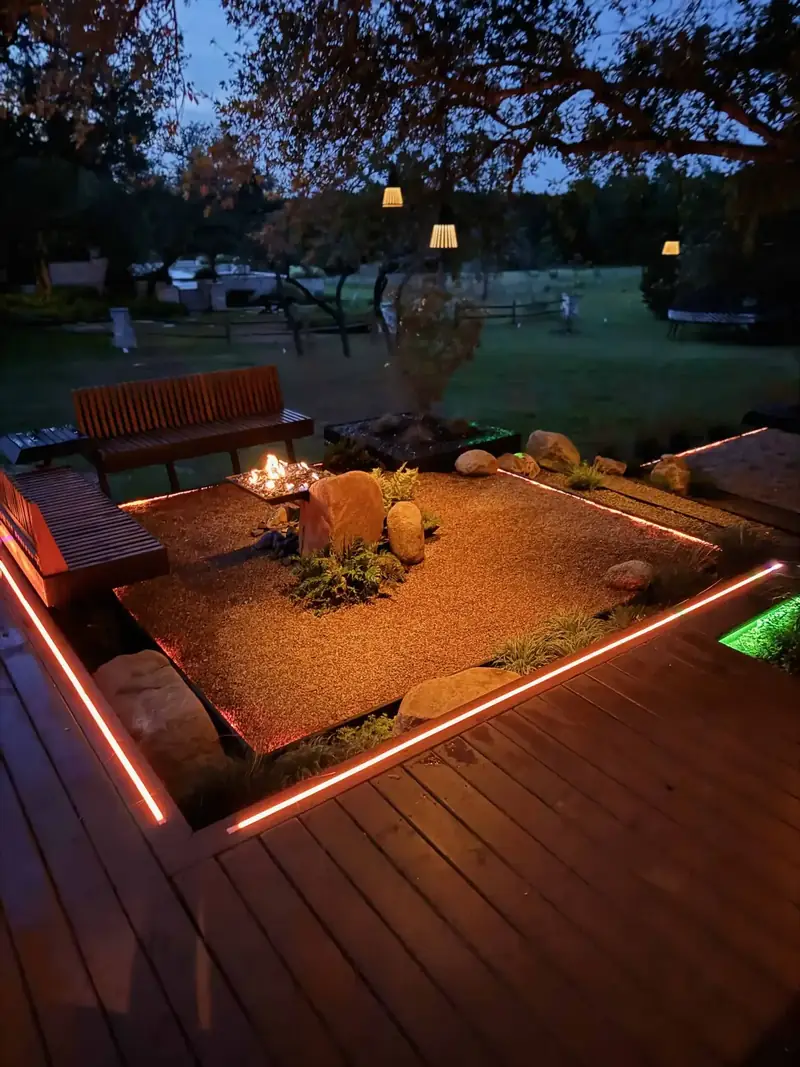
How Does the Cable Get Through a Finished Yard?
Along lines the yard already has. Low-voltage 24V wiring needs far less digging than line-voltage work, so lighting is one of the easiest upgrades to add to a finished landscape.
The wiring runs three ways:
- Through planting beds, where the ground is already soft
- Along hardscape edges, where a patio, a walk, or a steel edge meets the ground
- Through conduit, where the cable has to pass a hard surface
Before we draw the plan, we assess the existing electrical capacity. Then we install with as little disturbance as possible to established plantings and hardscape.
Mature trees are another reason to stay low voltage. Less digging makes lighting one of the gentlest upgrades around a mature live oak. Our Tarrytown page covers how Austin’s tree rules shape a lighting plan.
The cleanest route is the one planned with the build. On the Circle C, Lewis Mountain, and Southeast Austin projects the light sits inside the steel and under the deck edges, so it was drawn with them.
What Powers the System, and What Keeps It Aimed?
Power comes from 24V weatherproof transformers. They feed zoned circuits with dimmable drivers, and an app-based controller runs the zones: scenes, sunset triggers, timers, and a manual override.
Aim is the easier half, because most of our light has no aim to lose. A pendant hangs where the beam holds it. A ribbon under a steel rim or in an edge channel stays in the steel. There is no stake to straighten.
Uplights are the fixtures that do get aimed. Ours are concealed, ground-mounted COB fixtures with adjustable beam angles, so each one is matched to the tree or the wall in front of it.
What Does Austin Heat Do to a Lighting System?
Heat is the first test. Fixtures here sit through 100-degree summers, so we use IP67-rated hardware, silicone-sealed connections, and UV-stable housings.
The ribbon itself handles heat well. FCOB stands for flip chip on board: the LED chips are mounted face down, directly on the strip, so the heat they make passes straight into the strip. Our COB vs LED lighting guide explains the technology and lists FCOB at more than 50,000 hours of rated life.
What Gets Decided Before the First Fixture?
The plan. A lighting system is a set of zones, and we plan it zone by zone, so you can start with what matters most and add to it later.
- Walk the property: we mark what should be seen after dark: trees, walls, paths, steps, and seating
- Map the zones: fixture types and color temperature for each zone. 2700K warm white is the usual starting point.
- Install: 24V wiring, weatherproof transformers, and concealed fixtures, built into pergolas, planters, steps, and hardscape
- Program: scenes, sunset triggers, timers, and manual override, set up on your phone before we hand it over
Light that is built into a structure is decided with the structure, so lighting is on the plan from the first meeting.
Every Red Agave project starts with a free consultation, and the CAD plan is included. See our landscape lighting service, and for budgets, our landscape lighting cost guide.
What Do We Install?
- FCOB ribbon: a continuous line of light with no dots, for steps, cap stones, pergola beams, planter rims, and steel edges
- COB uplights: a concentrated beam with accurate color, for trees, stone walls, and architecture
- Pendants and downlights: under pergola beams and roofs, over tables and counters
- Step and path lights: recessed step lights and bollards
- Controls: zones, scenes, and timers from an app
- Power: 24V weatherproof transformers and low-voltage wiring
For layout rules by fixture type, see our Austin landscape lighting guide. We serve the Austin area, from Circle C to Tarrytown and Dripping Springs.
Questions We Hear
Can you add landscape lighting to a finished yard in Austin?
Yes. Low-voltage 24V wiring needs far less digging than line-voltage work. It runs through planting beds, along hardscape edges, and through conduit, with little disturbance to established plantings and hardscape.
What is FCOB lighting?
FCOB stands for flip chip on board. It is a ribbon that gives a continuous line of light with no dots. We use it under planter rims, along steel edges, on steps, and under pergola beams.
What color temperature do you use?
2700K warm white is the usual starting point. It brings out stone, wood, and natural materials. 3000K suits modern homes that want a slightly crisper look.
How is the lighting controlled?
From your phone. Each system is divided into zones, with scenes, timers, sunset triggers, and a manual override.
Does built-in lighting suit dark-sky rules?
Yes. Hidden ribbon light and shielded, downward fixtures suit towns with strict outdoor lighting rules, including Dripping Springs, the first International Dark Sky Community in Texas.