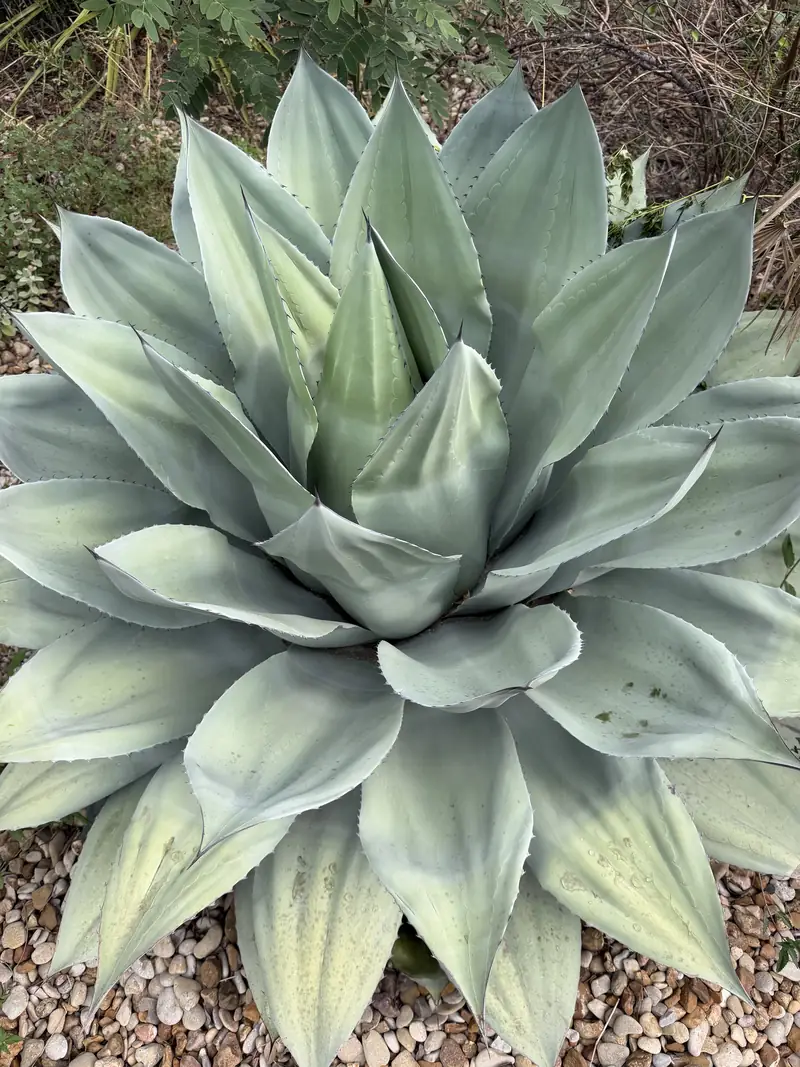
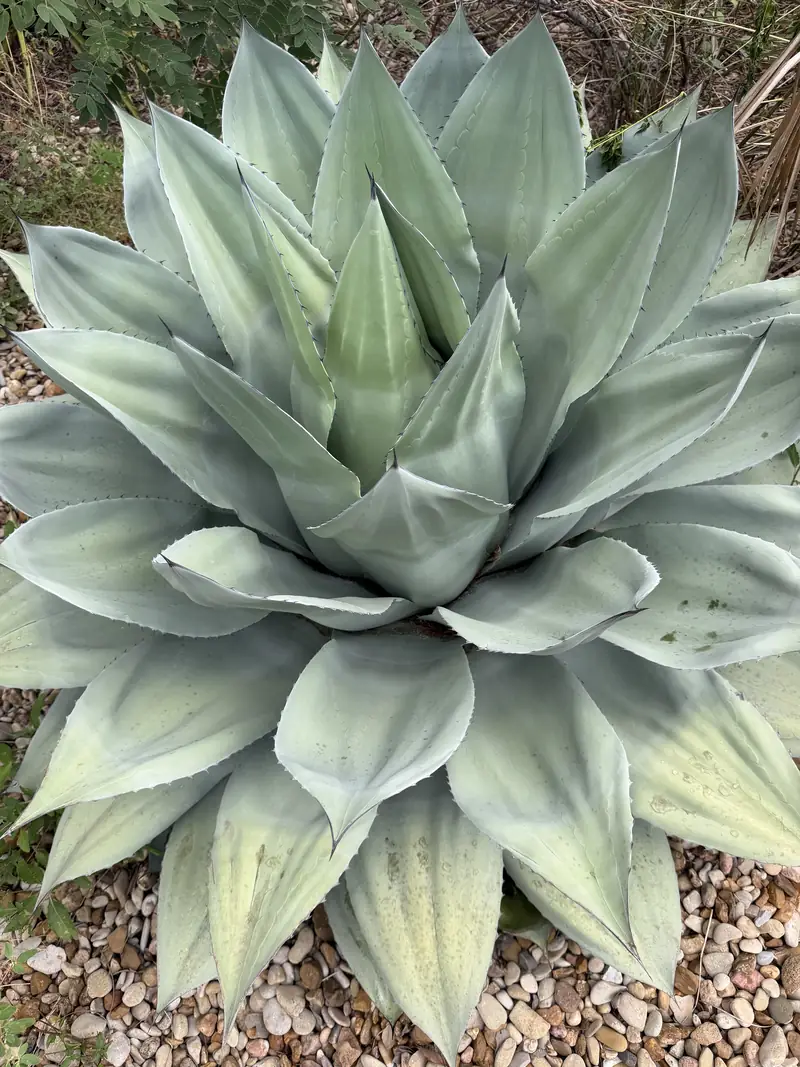
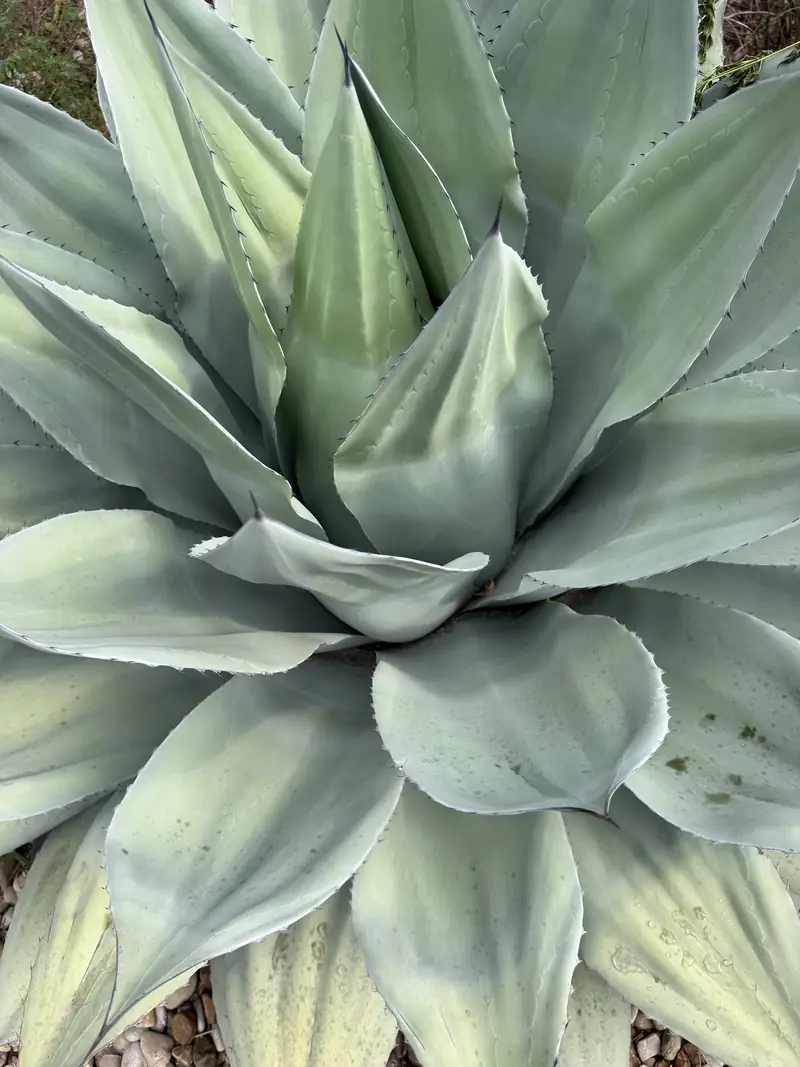
Whale’s tongue agave (Agave ovatifolia) is a single, powder-blue rosette of wide, cupped leaves that grows 3 to 4 feet tall and 4 to 6 feet wide. It makes no pups, takes full sun or dappled shade, and Texas SmartScape lists it as cold hardy to 0°F. It is in the planting palette of our terraced slope project at the Overlook at Lewis Mountain in Southwest Austin, and the one in these photos grows in river gravel in far South Austin.
What Does Whale’s Tongue Agave Look Like?
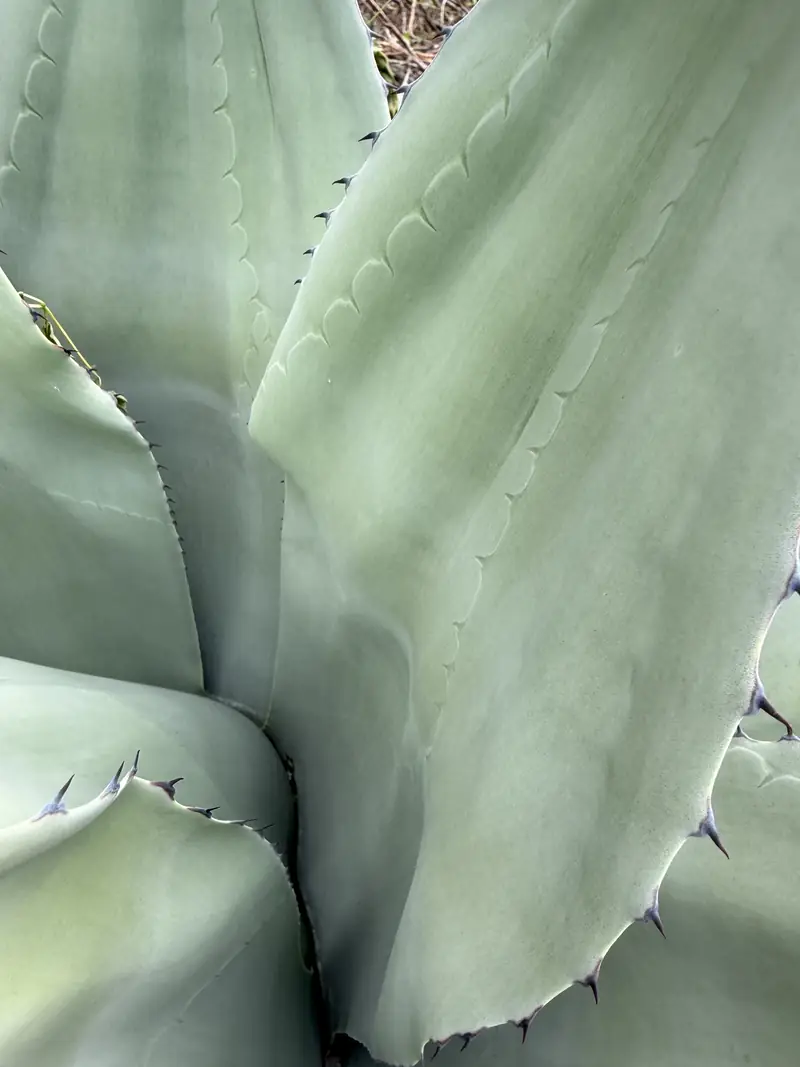
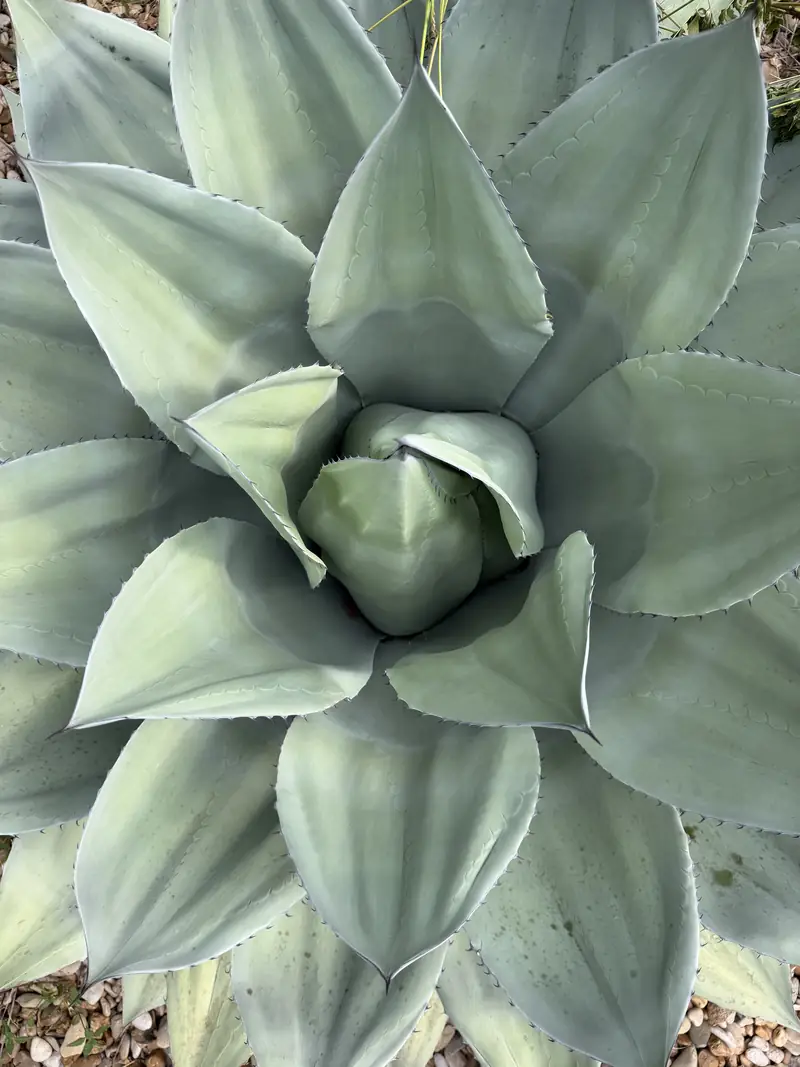
The University of Tennessee’s UT Gardens describes blue, cupped leaves in a single symmetrical rosette, edged with curved mahogany teeth and ending in a terminal spine 1 to 2 inches long. The leaves are wide and short for an agave, shaped like the tongue in its name.
Look closely and each leaf carries a faint print of the leaves that were pressed against it in the bud. Those bud imprints, and the powdery blue surface, are the details that make the plant worth a spot where people walk past it.
It is a young plant in garden terms. UT Gardens notes that it was found in the mid-1980s in the Sierra de Lampazos of Mexico, at 3,700 to 7,000 feet, and was named in 2001.
How Big Does It Get, and How Much Room Does It Need?
UT Gardens lists whale’s tongue agave at 3 to 4 feet tall and 4 to 6 feet wide in 5 to 8 years, and faster with summer water. Texas SmartScape lists the spread at 3 to 5 feet.
Plan for the 6 foot plant. A rosette 6 feet across reaches 3 feet from its center, and every leaf ends in a spine, so set the center at least 4 feet back from the edge of a walk, a step, or a patio. Planted from a nursery pot, that looks like too much room. In a few years it looks exactly right.
It makes no offsets, so it stays one clean rosette and never crowds the bed with pups. It also has a life cycle. UT Gardens gives it 10 to 20 years, after which it sends up a 10 to 15 foot stalk of chartreuse flowers and dies. Plan it as a specimen with a long run, and enjoy the stalk when it comes.
Does It Handle Austin Winters and Summers?
Yes. Texas SmartScape lists it as cold hardy to 0°F. For scale, the USDA’s 2023 hardiness map puts most of the Austin area in zone 9a, where the coldest night of an average winter falls between 20 and 25°F, and Camp Mabry’s low in the February 2021 freeze was still in the single digits above zero.
It takes full sun to dappled shade, and UT Gardens names drainage as the key to growing it. Texas SmartScape rates its water needs as very low and lists it as deer resistant.
Drainage is the part to get right in Austin. Gravel on top of a low spot does not fix the low spot. If a bed collects water from a downspout, a driveway, or a slope, move the water first, then plant. Keep the agave on its own low-water zone as well, so a drip line set for thirstier plants never keeps its crown wet.
Where Does Whale’s Tongue Agave Fit in a Design?
Use one. A single rosette in a clear field of gravel does more than three crowded into a bed, and our cold-hardy agaves guide makes the same point: a large agave should stand alone, well back from the walk.
- In gravel: the centerpiece of a xeriscape, with low, fine-textured plants kept outside its mature spread
- In steel: our custom steel planters page lists Agave ovatifolia as a sculptural focal point for a specimen box or an entry column in full sun
- At night: one low light that grazes the cupped leaves shows the form better than a flood of light over the whole bed. See our landscape lighting work.
For a smaller rosette that fits a planter trough, see artichoke agave. For a far larger one, see Agave salmiana ‘Green Giant’. We design and build plantings like these across Austin, including Circle C.
Questions We Hear
Does whale’s tongue agave make pups?
No. UT Gardens and Texas SmartScape both list it as an agave that makes no offsets. It stays a single rosette for its whole life.
How cold hardy is whale’s tongue agave?
Texas SmartScape lists it as cold hardy to 0°F. Most of the Austin area is in USDA zone 9a, where the coldest night of an average winter is 20 to 25°F.
How long does whale’s tongue agave live?
UT Gardens gives it 10 to 20 years. It then sends up a flower stalk 10 to 15 feet tall with chartreuse flowers, and the plant dies after flowering.
Do deer eat whale’s tongue agave?
Texas SmartScape lists it as deer resistant.
How much water does whale’s tongue agave need?
Very little once established. Texas SmartScape rates its water needs as very low, and UT Gardens notes that summer water speeds its growth. Fast drainage matters more than the watering schedule.