The best retaining wall material in Austin, TX is the one that fits the height of the wall, the soil under it, and the house behind it: quarter-inch steel for tight lots and modern houses, limestone for low Hill Country walls, and block or poured concrete for tall walls. Red Agave Landscape builds retaining walls in steel, Texas limestone, CMU block with a stone or stucco face, poured concrete, and boulders, and we have built gabions as seat walls. Every wall stands on a footing sized for the soil and has a drain behind it. Every one is built by our own crew.
Which Retaining Wall Materials Work in Austin?
Six. The slope picks the material as much as the look does.
| Material | Typical height | Best for | From our work |
|---|---|---|---|
| Structural steel, 1/4 inch | Any height, engineered | Modern houses, steep slopes, tight lots | Three terraces at the Overlook at Lewis Mountain |
| Limestone chop block | 3 to 4 feet dry stacked, 4 to 6 feet in mortar on a footing | Low and mid-height walls, a Hill Country look | A block wall with a stone cap behind a paver patio |
| CMU block with a stone or stucco face | 6 to 8 feet, engineered | Tall walls that match the house | Block faced in black cantera in Holly, East Austin |
| Poured concrete | Tall walls, engineered | Modern lines, walls under a driveway | We form, pour, and finish our own concrete |
| Boulders | Under 4 feet | Low banks, natural planting | Large native boulders, set by machine |
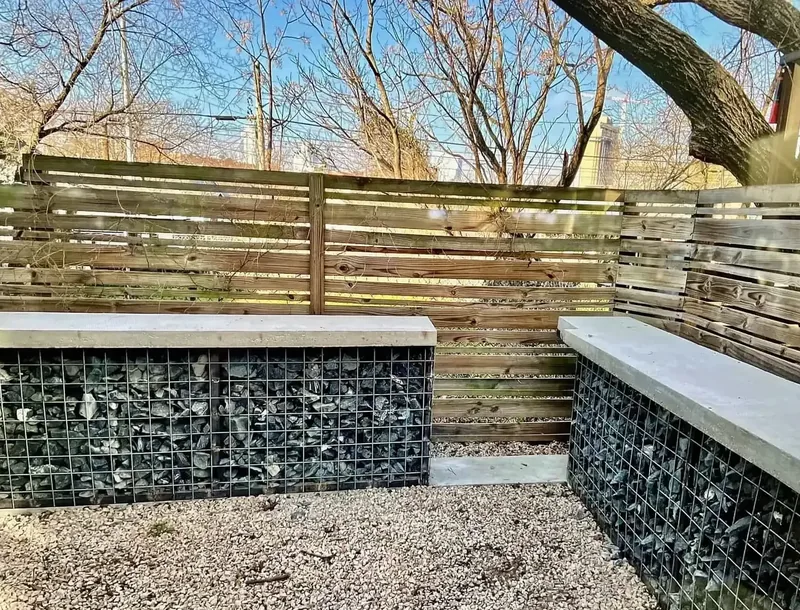
| Gabion | Sitting height on ours | Seat walls, as we built them | Two seat walls with concrete tops |
For the full build of each, see our retaining walls page.
Why Do We Build So Many Walls in Steel?
Because steel is the thinnest wall we build, so it gives the most level ground back on a tight lot. A steel wall is quarter-inch plate, welded on site to I-beam posts that stand in a reinforced concrete footing. Steel develops a rust patina over 6 to 12 months, or it is finished in a color. Our welded steel work carries a 10-year structural warranty.
Four of ours:
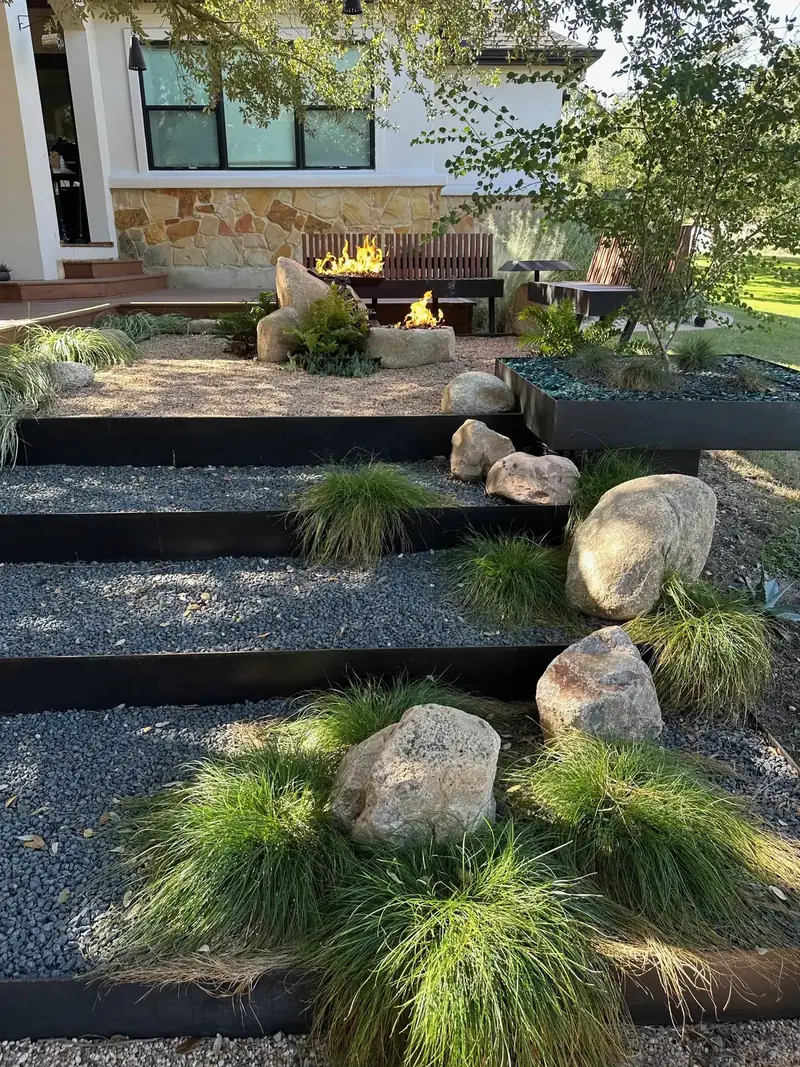
- Overlook at Lewis Mountain, Southwest Austin: three low steel walls terrace a slope that was bare ground under a live oak. The job used 260 linear feet of quarter-inch steel, and our crew built it in 18 days. See the project.
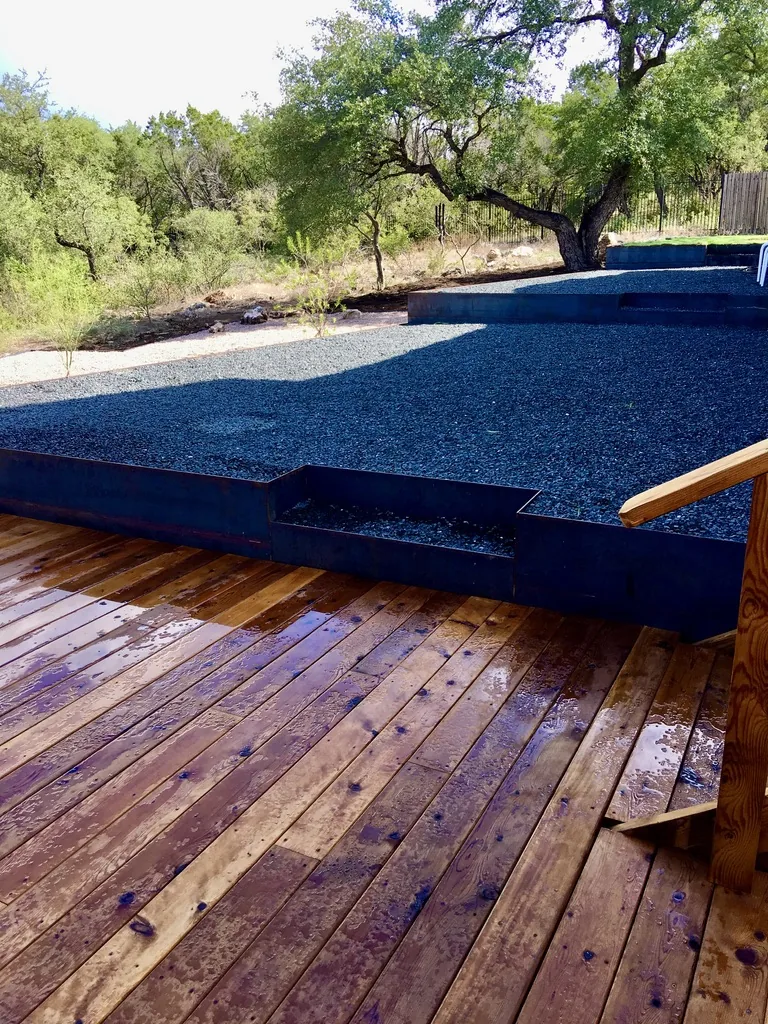
- Bee Cave: steel walls hold level terraces of dark gravel that step along a slope beside a wood deck
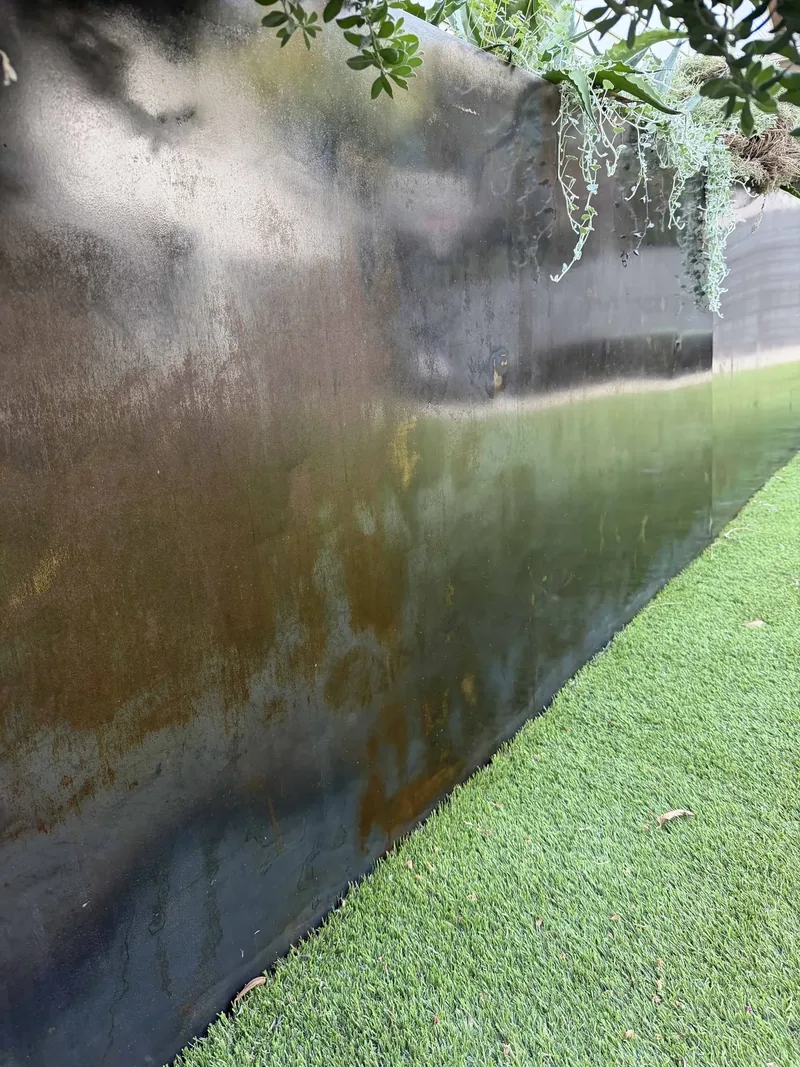
- Tarrytown: a steel retaining wall holds the grade change in a backyard. The steel is darkened and sealed with our own process. See Dormarion.
- Easton Park, Southeast Austin: three terraces of black steel took the slope out of a front yard. The finish is a black penetrating sealer. See Chrysler Bend.
See our steel retaining walls page and our post on three low walls in place of one tall one.
When Is Stone or Block the Better Wall?
When the wall should match the house. Limestone is quarried in Central Texas, and it suits a Hill Country house. Dry stacked, chopped limestone block makes a low garden wall. Set in mortar on a footing, it goes taller.
For a tall wall, block does the structural work and the face is chosen to match the house. We face block in limestone, chopped stone, ledgestone, and Austin stone, or finish it in stucco.
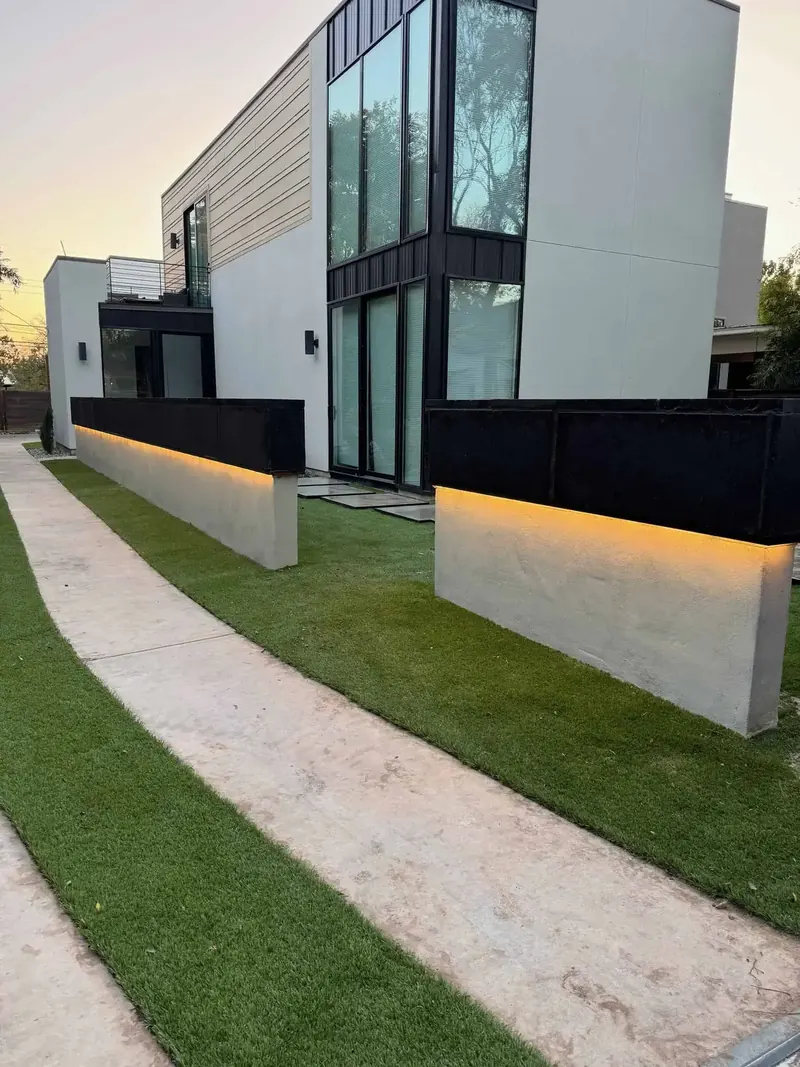
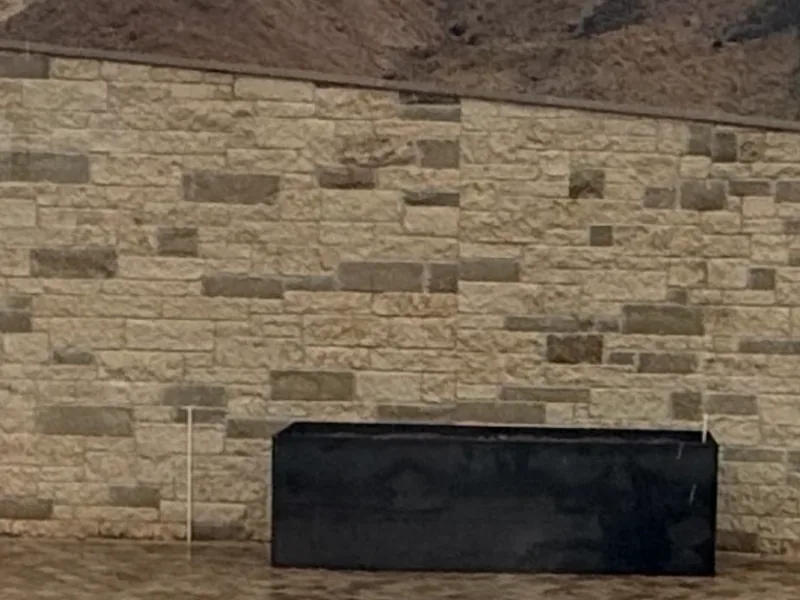
Our wall in Holly, East Austin, shows the method. It is a freestanding CMU block wall, so it holds no soil. We welded an angle steel ledge to the top of the block and mortared 2-by-4-foot pieces of black cantera onto it. COB strip light runs under the steel. See Riverview and our masonry and concrete page.
What Is a Gabion Wall?
A wall of wire baskets filled with rock. The Missouri Department of Transportation’s engineering policy guide describes gabions as rectangular units of welded wire fabric or twisted wire mesh. Filled with stone, they become large, flexible, permeable elements, and retaining walls and river bank protection are built from them. That guide’s own specification covers one or two tiers of baskets, about 4 feet tall or less.
We have built gabions at sitting height. Each of our two seat walls is wire mesh filled with dark rock and topped with a concrete slab as the seat. They stand in a gravel court along a horizontal board fence.
What Does Austin Soil Do to a Retaining Wall?
It moves, and it holds water. A plant guide by Texas AgriLife Extension and the City of Austin, Native and Adapted Landscape Plants, describes the two soils of Austin: shallow limestone or caliche on the west side, and deeper, dark clay on the central and east side. Clay swells when it is wet and shrinks when it is dry.
So the same two things go with every material:
- A footing: we trench below the active soil zone, typically 18 to 24 inches in Austin, and pour a continuous concrete footing with steel reinforcing
- A drain: a perforated pipe wrapped in filter fabric at the base of the wall, clean gravel between the pipe and the wall, and an exit for the water. Stone and concrete walls also get weep holes, 4 to 6 feet apart.
Water that collects behind a wall pushes on it. That pressure is the main reason retaining walls bow and fail in Central Texas clay. See our drainage page and our retaining wall engineering guide.
When Does a Retaining Wall Need a Permit in Austin?
Height decides it, in any material. Austin Development Services lists work exempt from building permits. A residential retaining wall is on the list when it is not over 4 feet tall, measured from the bottom of the footing to the top of the wall, unless it supports a surcharge or sits in a flood hazard area. The same page says exempt work still has to meet the building codes and city codes.
A surcharge is load on the soil behind the wall, such as a driveway, a pool, or a structure. Our retaining wall permit guide covers the details, and when a wall needs a permit, we handle it.
What Drives the Price of a Retaining Wall?
Height, material, soil, and access. Our retaining wall cost guide explains each one. Every Red Agave project starts with a free consultation, and the CAD plan is included.
What Sources Did We Use?
We read each of these in November 2026.
- City of Austin, Austin Development Services, Work Exempt from Building Permits
- Missouri Department of Transportation, Engineering Policy Guide, 611.4 Gabions
- Texas AgriLife Extension and City of Austin, Native and Adapted Landscape Plants, the soils of Austin
Questions We Hear
What is the best material for a retaining wall in Austin?
The one that fits the height, the soil, and the house. Structural steel suits modern houses and tight lots. Texas limestone suits a Hill Country house. Block with a stone or stucco face and poured concrete suit tall walls and walls that carry a driveway.
What is a gabion wall?
A wall of wire baskets filled with rock. The Missouri Department of Transportation describes filled gabions as large, flexible, permeable elements used to build retaining walls. We have built gabions as seat walls with concrete tops.
How tall can a retaining wall be without a permit in Austin?
Austin Development Services lists a residential retaining wall as exempt from a building permit when it is not over 4 feet tall, measured from the bottom of the footing to the top of the wall, unless it supports a surcharge or sits in a flood hazard area.
What goes behind a retaining wall?
A perforated drain pipe wrapped in filter fabric at the base of the wall, clean drainage gravel between the pipe and the wall, and an exit for the water. We use both rigid PVC and corrugated pipe.