A concrete patio in Austin, TX lasts when three things are right: a compacted base under it, planned joints in it, and a cure that keeps water in the slab for its first days. Red Agave Landscape pours patios in a 4,000 PSI mix with fiber mesh and rebar, over 6 to 8 inches of compacted crushed limestone. On the four patios in this post we poured the concrete as separate pads with steel at the edges, in Crestview, Holly, Central Austin, and Pearson Ranch. Every one was built by our own crew.
What Does Austin Weather Do to a Concrete Patio?
It heats it, soaks it, and now and then freezes it. The National Weather Service’s Austin climate summary gives the numbers:
- Heat: normal highs reach 90 degrees by May 26 and stay above 90 until September 23. The record high is 112 degrees.
- Storms: thunderstorms here have dropped more than 5 inches of rain in several hours.
- Cold: freezing temperatures come about 12 days a year at Camp Mabry and 33 days a year at the airport.
Heat matters most on the day of the pour. The National Ready Mixed Concrete Association’s sheet on hot weather concreting says concrete sets quicker at higher temperatures, and that fast evaporation from the surface cracks a slab before it has set. Its rules are plain: place concrete outside the hottest part of the day, start curing as soon as the finishing is done, and keep curing for at least 3 days. The same sheet lists synthetic fibers as a way to cut that early cracking. Our mix carries fiber mesh and rebar.
Storms are answered by grade. Every patio we build slopes so water moves away from the house.
What Goes Under a Concrete Patio in Austin?
A base that does not move with the soil. A plant guide by Texas AgriLife Extension and the City of Austin, Native and Adapted Landscape Plants, describes the two soils of Austin: shallow limestone or caliche on the west side, and deeper, dark clay on the central and east side. Clay swells when it is wet and shrinks when it is dry, and a slab poured straight on it moves with it.
- Excavation: we dig to the depth the slab and its base need
- Subgrade: the soil at the bottom is compacted
- Base: 6 to 8 inches of crushed limestone, compacted
- Grade: the base slopes so water moves away from the house
- Concrete: a 4,000 PSI mix with fiber mesh and rebar, in a standard slab 4 inches thick
See our patios page and our masonry and concrete page. Our Buda and Kyle page covers patios on clay.
Should a Patio Be One Slab or Separate Pads?
Either way, the concrete needs joints. NRMCA’s sheet on joints in concrete slabs describes a joint as a crack that was planned ahead. It states that cracks in concrete cannot be prevented entirely, and that joints control where they go. For a slab 4 inches thick it puts the joints about 10 feet apart, and never more than 15 feet. It also notes that wire mesh does not prevent cracking. Mesh keeps cracks from opening up.
Separate pads put those lines where the design wants them. Each pad is its own piece of concrete, and what runs between the pads becomes part of the pattern. We have built each of these:
| Patio | Finish | Edge | Between the pads |
|---|---|---|---|
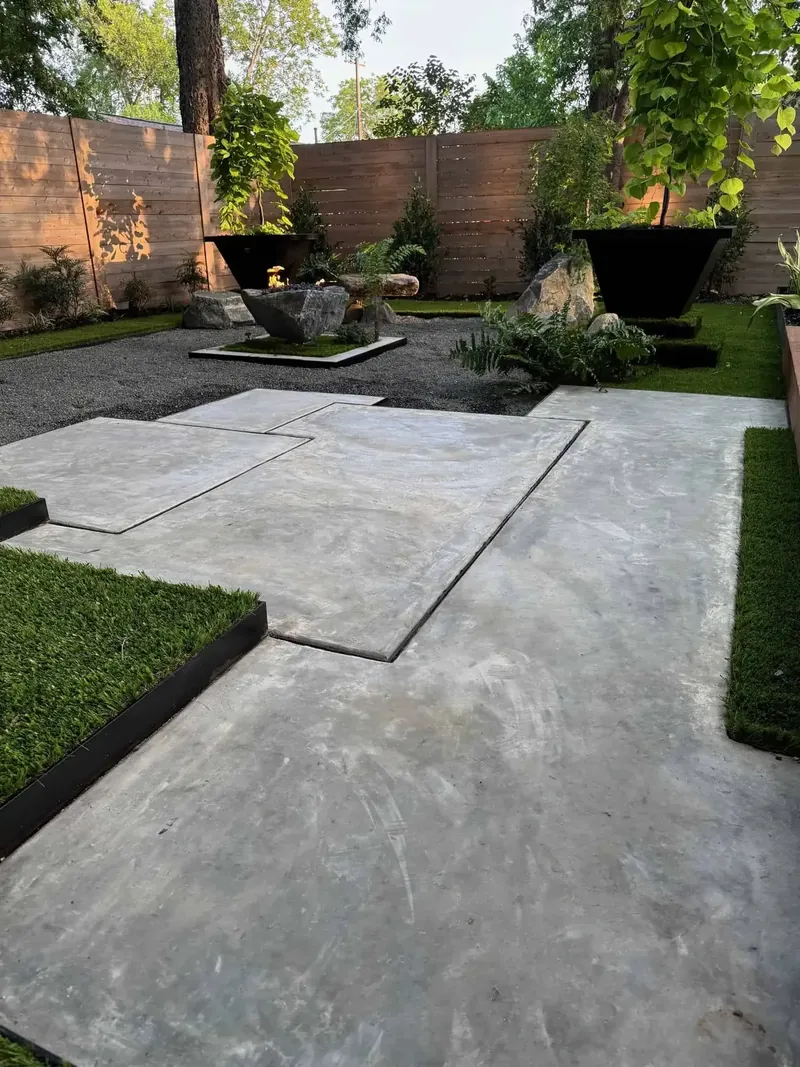
| Madison, Crestview | Smooth, with a marbling effect | 1/4-inch by 4-inch steel, left in place | A line of steel |
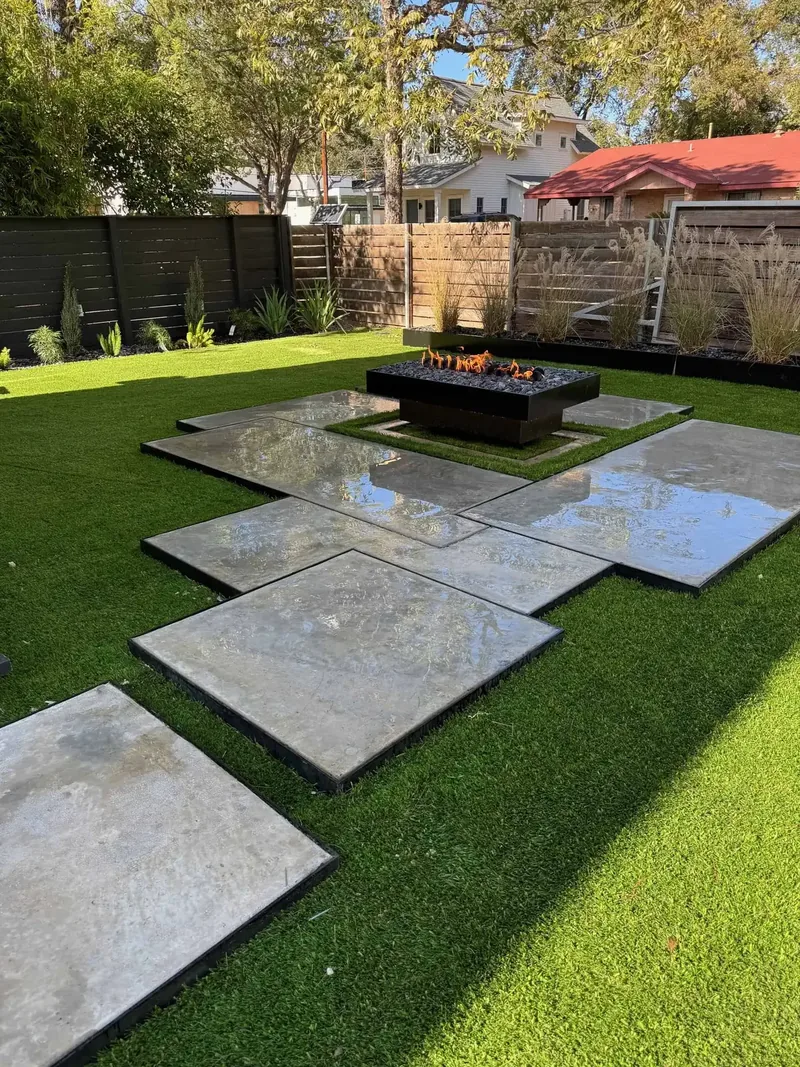
| Riverview, Holly | Poured to look like marble, sealed with Clemons sealer | 1/4-inch welded steel on every slab | Artificial turf |
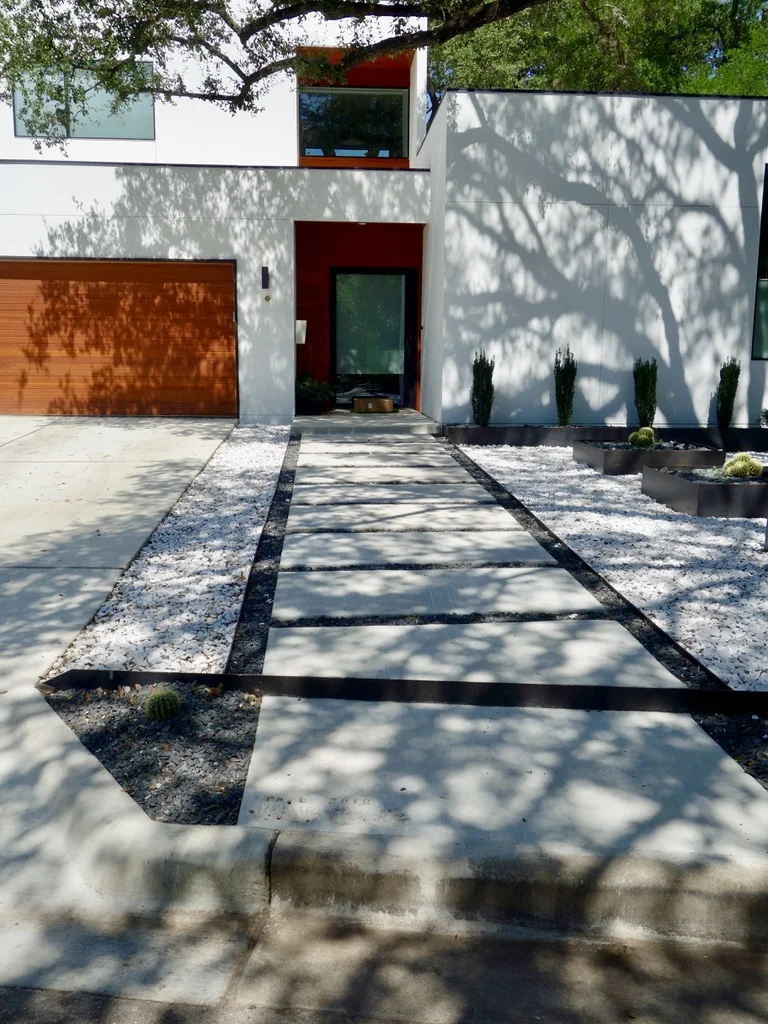
| Strass Drive, Central Austin | Oversized poured pavers | Welded quarter-inch steel around the walk | Basalt gravel |
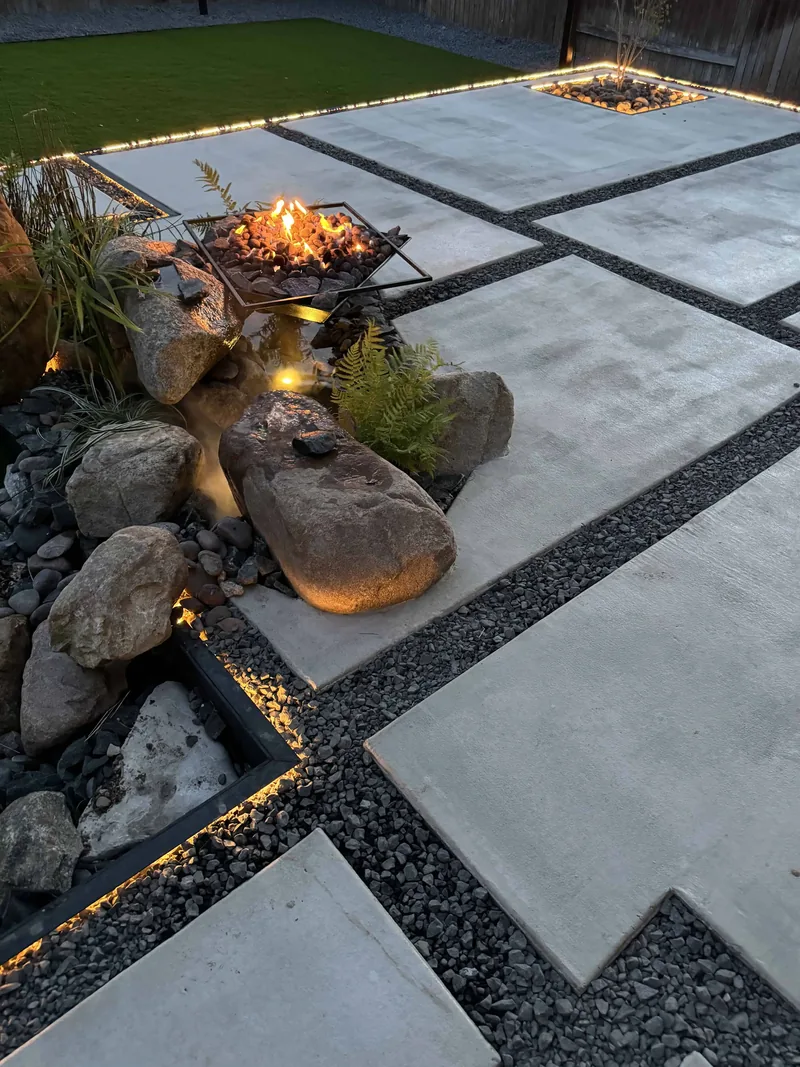
| Axehandle, Pearson Ranch | SureCrete Shure Broom, a brushed texture | Steel on every edge | Gravel, lit with COB light |
Gravel joints do one more job. Rain soaks in between the pads.
Why Leave the Steel in the Concrete?
Because the form becomes the edge. A wood form is stripped after the pour. This steel stays. On Madison in Crestview we formed the concrete with 1/4-inch by 4-inch steel, and the steel remains in place. It shows as a thin dark line between the pads and along the turf. The concrete was finished smooth with a marbling effect.
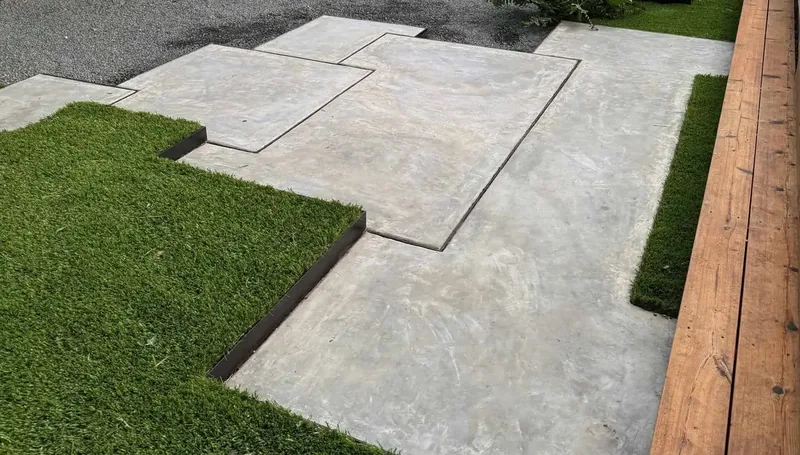
On Riverview in Holly, East Austin, large slabs were poured to look like marble. Every slab edge is framed in 1/4-inch welded steel, and the whole field is sealed with Clemons sealer. The slabs sit in artificial turf around a floating fire pit. See our marbled concrete patios page.
Steel works at the front door too. On Strass Drive in Central Austin, oversized pavers of poured concrete run from the curb to the front door, with basalt gravel in the joints. Welded quarter-inch steel frames the walk and keeps the black basalt apart from the white marble gravel. We built it in 2018.
In Pearson Ranch in Northwest Austin we expanded an existing patio with poured pavers in a SureCrete Shure Broom finish. Every paver edge is framed in steel, and COB light runs through the gravel joints. For the steel itself, see our steel edging page.
Does a Concrete Patio Need a Permit in Austin?
Austin Development Services publishes a list of work exempt from building permits. The residential list includes a sidewalk, driveway, or concrete flatwork that is not in the public right-of-way. The same page says exempt work still has to meet the building codes and city codes, and that a property in a floodplain can still need a permit.
Cover is the second question. The City’s glossary defines impervious cover as any human-made surface that does not absorb rainfall, and the share a lot is allowed is set by its zoning. Concrete does not absorb rainfall, so a new slab counts toward it.
What Does a Concrete Patio Cost in Austin?
The size, the finish, the base, and the access to the yard drive the price. Our patio cost guide explains each one, and our guide to concrete and paver patios compares the two surfaces. For pavers laid or poured in place, see our post on paver patio installation.
Every Red Agave project starts with a free consultation, and the CAD plan is included.
What Sources Did We Use?
We read each of these in November 2026.
- National Weather Service, Austin/San Antonio, Austin Climate Summary
- National Ready Mixed Concrete Association, Concrete in Practice, CIP 6, Joints in Concrete Slabs on Grade and CIP 12, Hot Weather Concreting
- City of Austin, Austin Development Services, Work Exempt from Building Permits and Glossary of terms, impervious cover
- Texas AgriLife Extension and City of Austin, Native and Adapted Landscape Plants, the soils of Austin
Questions We Hear
What base goes under a concrete patio in Austin?
We excavate, compact the subgrade, and lay 6 to 8 inches of compacted crushed limestone, graded so water moves away from the house. The concrete is a 4,000 PSI mix with fiber mesh and rebar.
Do concrete patios crack in Austin?
The National Ready Mixed Concrete Association states that cracks in concrete cannot be prevented entirely, and that joints control where they go. We pour patios as separate pads on a compacted base, so the lines fall where the design puts them.
What is marbled concrete?
Concrete finished to look like marble. On our Crestview patio the concrete was finished smooth with a marbling effect. On our patio in Holly, East Austin, large slabs were poured to look like marble and sealed with Clemons sealer.
Does a concrete patio need a building permit in Austin?
Austin Development Services lists a sidewalk, driveway, or concrete flatwork outside the public right-of-way as work exempt from a building permit. Exempt work still has to meet the building codes and city codes, and a property in a floodplain can still need a permit.
Can the steel forms stay in a concrete patio?
Yes. On our Crestview patio the concrete is formed with 1/4-inch by 4-inch steel, and the steel remains in place as the edge of every pad.