In Circle C, the Architectural Control Committee (ACC) of the Circle C Homeowners Association reviews hardscape, structures, fence changes, pools, and substantial changes to a front yard before work starts, and it has 30 days to review a submission. Ordinary planting needs no approval. This guide gives the steps, the paperwork, and the landscape rules, taken from the association’s own documents as they were posted on November 25, 2026. Red Agave Landscape designed and built a backyard in Circle C in 2024, and we draw the plans a committee reviews.
Who Reviews a Landscape Project in Circle C?
The ACC. The Declaration gives the association a committee of three members, appointed by the board. Reach it at acc@circlecranch.info, or at the Circle C Community Center, 7817 La Crosse Ave.
Seven gated communities sit inside Circle C and belong to the master association: Park West, Muirfield, the Enclave off La Crosse, Fairway Estates, the Enclave off Spruce Canyon, Avana Estates, and Hillside Estates. Each has its own sub-association. The ACC’s submission page says: "If you live in a gated community you may be required to submit your plans to your sub-association management company." That makes two submissions for some lots.
What Needs ACC Approval, and What Does Not?
The association’s ACC FAQ draws the line.
| Needs review | Needs no review |
|---|---|
| Hardscape landscape improvements | Trees, flowers, shrubs, and general landscaping |
| Substantial alterations to front yard landscape | Replacing a fence with one identical in materials, orientation, location, and height |
| Decks, arbors, gazebos, and patio covers | |
| Fencing changes, fence relocation, and walls | |
| Swimming pools, hot tubs, and fountains | |
| Storage sheds, play equipment, and tree houses | |
| Front yard patios | |
| Converting a front yard to a water-wise landscape | |
| Removing a tree |
The word that decides most yard projects is "substantial." The ACC’s review form spells it out: improvements "that deviate from the original landscape plan (such as installing hardscape or native plants) do require a fee and an ACC review." Adding shrubs to a bed is planting. Replacing the lawn with beds, gravel, and a path is a new plan.
How Do You Apply?
Four ways. The submission page lists them: the website form, fax, email to acc@circlecranch.info, or a drop-off at the Community Center, which has a drop box by the main doors for after hours.
Two things go with every submission:
- A drawing: "a detailed drawing, blueprint or picture of the proposed alteration"
- The review fee: "No projects will be reviewed until the CCHOA has received your review fee." The fee varies by project type, and the ACC FAQ lists each one
The review form asks for the homeowner’s email, and the answer comes back by email. Each kind of project has its own list:
| Project | What to send with the form |
|---|---|
| Water-wise front yard | A plan showing the sidewalks, driveway, and house, with every turf area, bed, rock or granite area, tree, path, and hardscape. A plant list keyed to the plan. A list of the stone, rock, and granite areas |
| Deck, patio, patio cover, pergola, or arbor | A plot plan showing the structure against the property lines and the house. A drawing with dimensions. The height from the ground. The materials and colors. The existing trees and any planned for removal |
| Pool | The pool form. A survey with setbacks, easements, and hardscape. The contractor’s drawing. A construction access plan |
| Fence change | A description of the materials, location, and height. Written permission from the neighbors for a shared fence |
Those lists come from the ACC’s guidelines page, which has one sheet for each kind of project.
How Long Does Circle C ACC Approval Take?
Thirty days. The ACC FAQ says: "The Architectural Control Committee has 30 days to review any plans submitted to the committee." The form adds that you get an email when the project is entered, and the approval form by email when the review is done.
| Step | What the documents say |
|---|---|
| Review starts | When the association has the review fee |
| Review period | 30 days |
| No answer in 30 days | The 1988 Declaration says approval "shall be presumed" |
| Changes after approval | Submitted again for approval |
| Starting | Work starts after all governmental approvals are in hand, and is pursued to completion |
Do not build on silence. The presumed-approval clause is in the Declaration recorded in 1988, and the association’s current pages do not repeat it. Wait for the emailed approval form.
A denial has a next step. Under the Texas Property Code, Section 209.00505, an association with more than 40 lots has to put a denial in writing, describe the reason and the changes that would win approval, and tell the owner about the right to a hearing before the board. The owner has 30 days from the mailing of the notice to ask for one.
What Are Circle C’s Water-Wise Front Yard Rules?
The ACC’s Design Guidelines for Water Wise Landscapes cover a front yard with less lawn. A homeowner who wants one submits a plan for approval before construction.
| Topic | Rule |
|---|---|
| Plants | "All plants and trees must be on the City of Austin Grow Green List" |
| Shade trees | Two in every front yard |
| Turf | No more than 50 percent of the front yard, and no St. Augustine |
| Beds | Defined, with an edge. Steel edging is accepted when it is set properly below ground. Mulch 2 to 3 inches deep |
| Rock | No front yard "exclusively or predominately rock without plants, trees, and turf" |
| Gravel | No small pea gravel. Minimum size 2 inches. Tan to brown in color |
| Glass | No recycled glass in the front yard |
| Paths | Flagstone, decomposed granite, decomposed granite and rock, or concrete if approved. Professionally built, and edged where they are decomposed granite |
| Artificial materials | No artificial grass, plants, or flowers in the front yard |
Two notes on how these rules work. The association’s front yard guideline says its guidelines "are legally non-binding" and exist to assist owners, so the ACC decides each plan on its own drawing. And the same guideline says a standard front yard needs permanent turf, which makes the water-wise plan the route to a yard with less lawn.
Texas law backs that route. The Texas Property Code, Section 202.007 says an association cannot prohibit drought-resistant landscaping or water-conserving natural turf. It can require a plan for review, and it can regulate gravel, rocks, and cacti. It cannot unreasonably deny the plan.
For the plants, see our xeriscape page and our Circle C page.
What Do the Guidelines Say About Decks, Pergolas, Fences, and Pools?
| Element | Guideline |
|---|---|
| Decks, patios, patio covers, pergolas, and arbors | At least 5 feet from any property line. A deck off the back of the house stands no higher than 18 inches from the ground |
| Materials for those | Cedar, redwood, wolmanized pine, concrete, composite wood, or stone |
| Lighting | Shown on the plan, and kept from spilling onto the property of others |
| Fences | Any alteration or relocation needs written approval. The standard is a six-foot privacy fence |
| Horizontal fences | Western Red Cedar, Ipe, or garden grade redwood. Gaps of no more than 3/4 inch. Posts no more than 6 feet apart |
| Pools | No above-ground pools |
| Trees | Not removed without prior approval |
What Does the City of Austin Add?
A second set of rules. Circle C is inside the Austin city limits, and the ACC FAQ says: "The City of Austin may require a building permit and inspection."
The City’s list of work exempt from building permits covers the small jobs:
- Fences: not over 7 feet high
- Retaining walls: not over 4 feet, measured from the bottom of the footing
- Decks: no more than 200 square feet, no more than 30 inches above grade, and not attached to the house
- Concrete flatwork: outside the public right-of-way
Exempt work still has to follow City code. Two parts of that code shape a Circle C design:
- Trees: a tree 19 inches or more in diameter is protected, and removing it takes a permit (City Arborist)
- Impervious cover: Circle C lies in watersheds that recharge the Edwards Aquifer, and the Declaration calls the land "environmentally sensitive" for that reason. Each lot has a cap on impervious cover. In the GreyRock Ridge sections, the Declaration’s own amendments set it at 45 percent of the lot. Find the number for your lot before adding a slab
What Did We Build in Circle C?
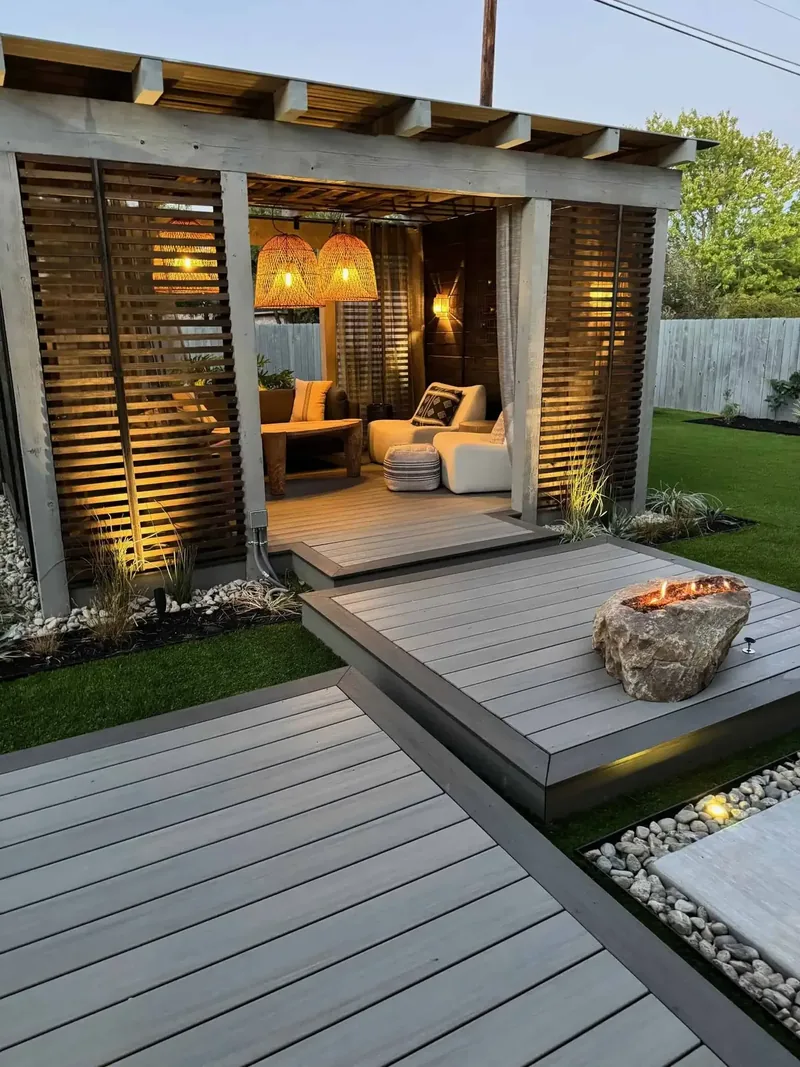
A backyard rebuilt without a new slab. In 2024 our crew kept a failing pergola where it stood, reframed it, and capped it with custom-cut steel triangles. Composite decking went over the old flagstone patio in one plane, and a low deck platform carries a boulder fire pit in front of a slatted cabana.
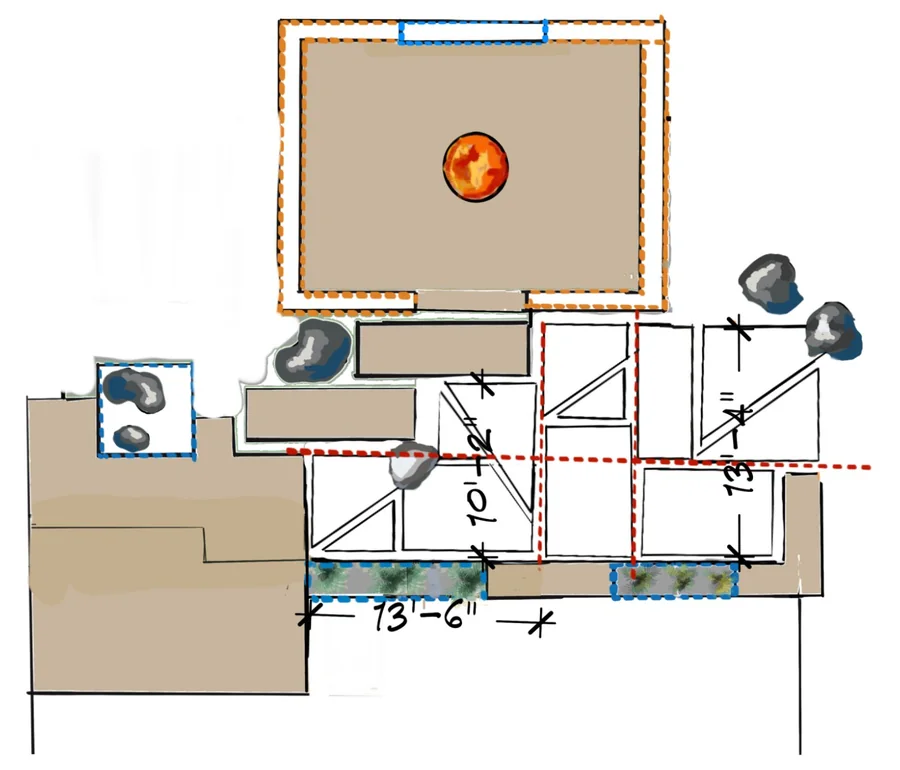
That plan is the kind of drawing an ACC submission needs. A Red Agave landscape design carries:
- Dimensions: every deck, slab, wall, and path drawn to scale, with the distance to each property line
- Heights: each structure and each steel edge marked by height
- Plants: a plant list keyed to the plan
- Materials: the stone, steel, decking, and gravel, selected with samples in hand
The owner of Red Agave draws every plan after a free on-site consultation, and the CAD plan is included. Our post on the Circle C pergola rebuild follows that yard from before to after, and the project page has the photos.
What Sources Did We Use?
Every rule above comes from the documents below, read on November 25, 2026. The association updates its documents, and many sections of Circle C have their own amendments to the Declaration, so check the current copy for your lot.
- Circle C Homeowners Association: ACC FAQ, submission page, guidelines, review form, water-wise guidelines, deck, patio, and pergola guidelines, fence guidelines, and the Declaration
- City of Austin: work exempt from building permits and the City Arborist
- Texas Property Code, Section 202.007 and Section 209.00505
Circle C HOA Approval
Do I need HOA approval for landscaping in Circle C?
For planting, no. The association says trees, flowers, shrubs, and general landscaping do not need approval. Hardscape, structures, fence changes, pools, front yard patios, and substantial changes to a front yard do.
How long does Circle C ACC approval take?
The committee has 30 days to review a submission, and it does not start until the association has the review fee. The answer comes by email.
Can I xeriscape my front yard in Circle C?
Yes, with a water-wise plan the ACC has approved. The guidelines call for plants from the City of Austin Grow Green list, two shade trees, turf on no more than half the yard, and a yard that is not mostly rock.
Is artificial turf allowed in Circle C?
Not in the front yard. The water-wise guidelines say artificial grass, plants, and flowers are not allowed there.
Do gated sections of Circle C have a second review?
They can. The seven gated communities have their own sub-associations, and the ACC’s submission page says owners there may be required to submit plans to the sub-association’s management company as well.
What happens if I build without ACC approval?
The association’s enforcement policy sets the fine for building without plan approval at ten times the fine for other curable violations. The Declaration also lets the association require an owner to remove an unapproved improvement, or remove it and bill the owner.