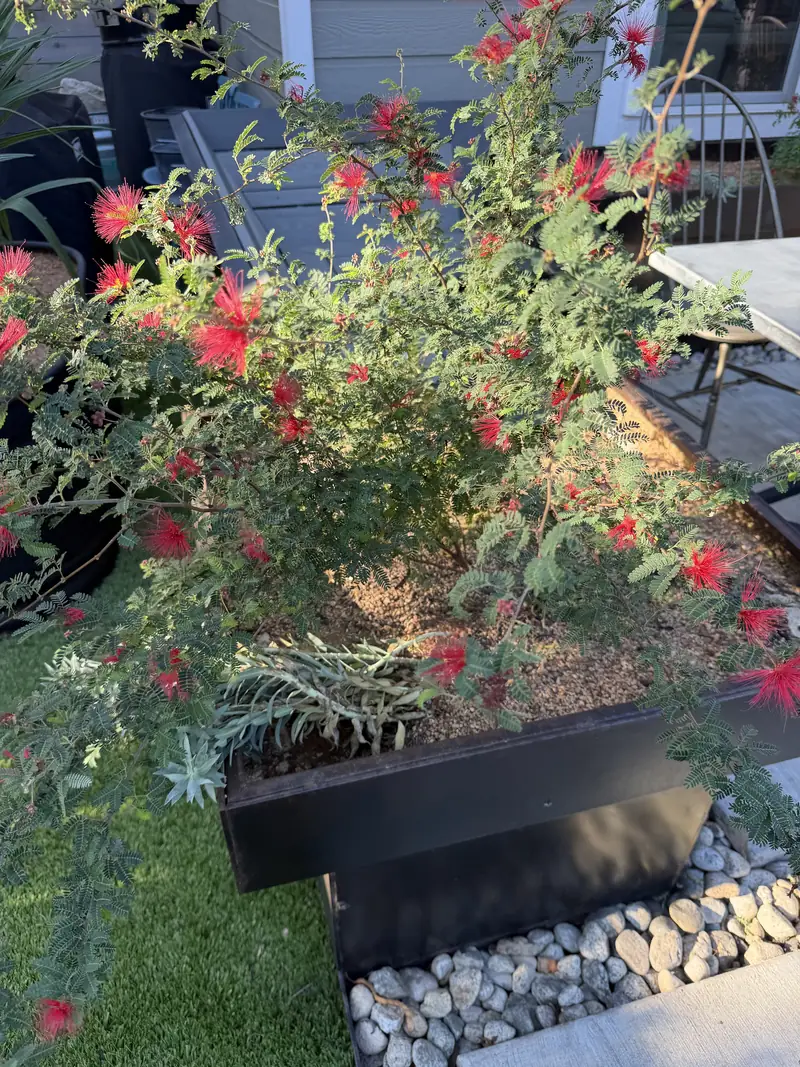
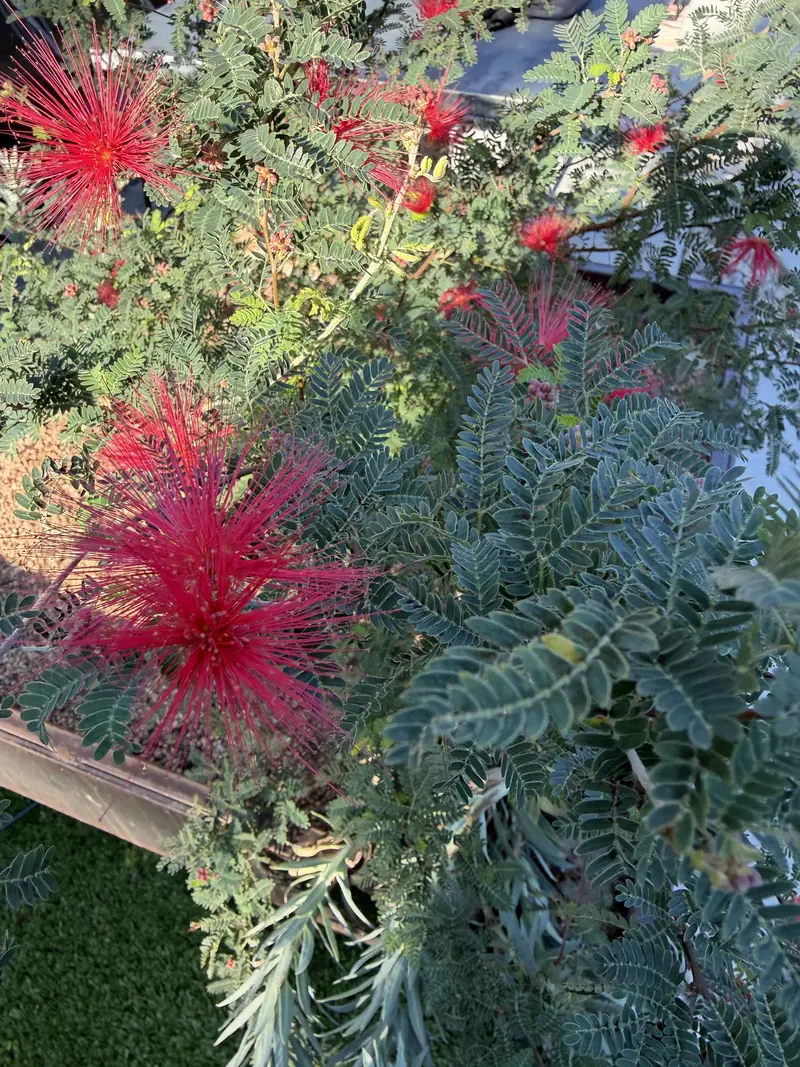
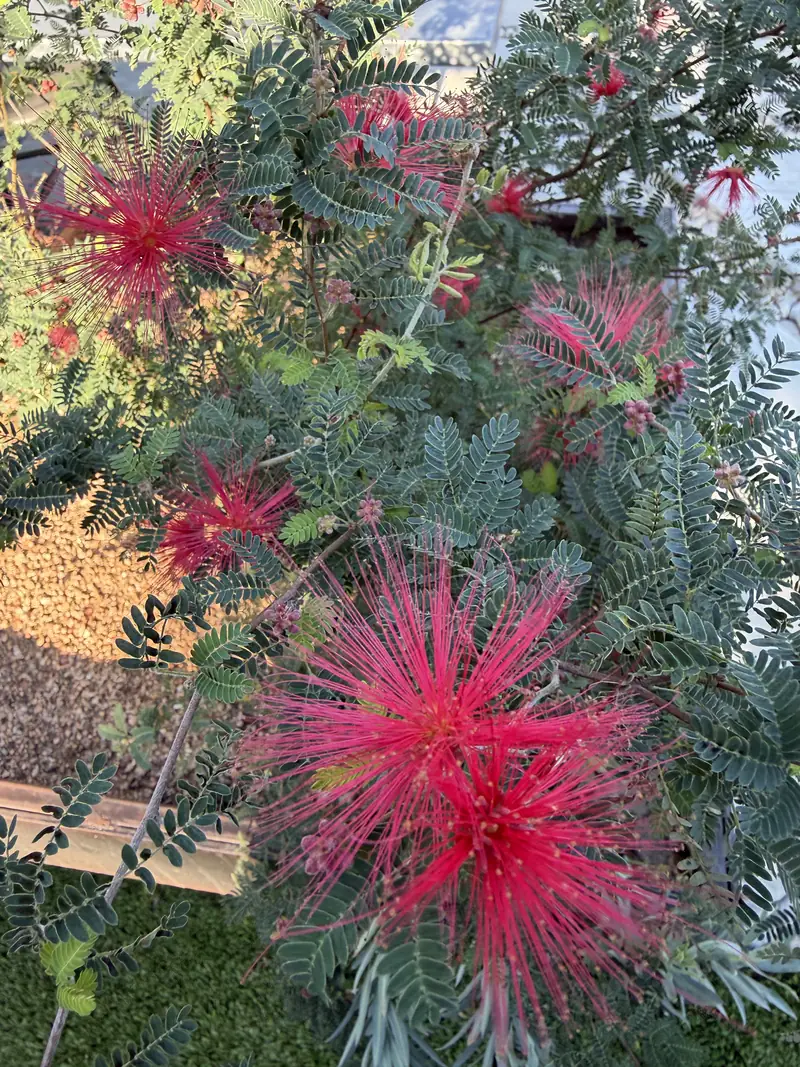
Red fairy duster (Calliandra californica), also called Baja fairy duster, is a desert shrub from Baja California with fine, ferny leaves and red starburst flowers. The Arizona-Sonora Desert Museum lists it at up to 6 feet tall and more than 6 feet wide, and it freezes back at about 23 to 25°F. The red fairy duster in these photos grows in a steel planter on our Circle C project.
What Is Red Fairy Duster?
It is a desert legume from Baja California. The Arizona-Sonora Desert Museum’s care sheet lists it as Baja fairy duster, and also by its Spanish name, tabardillo.
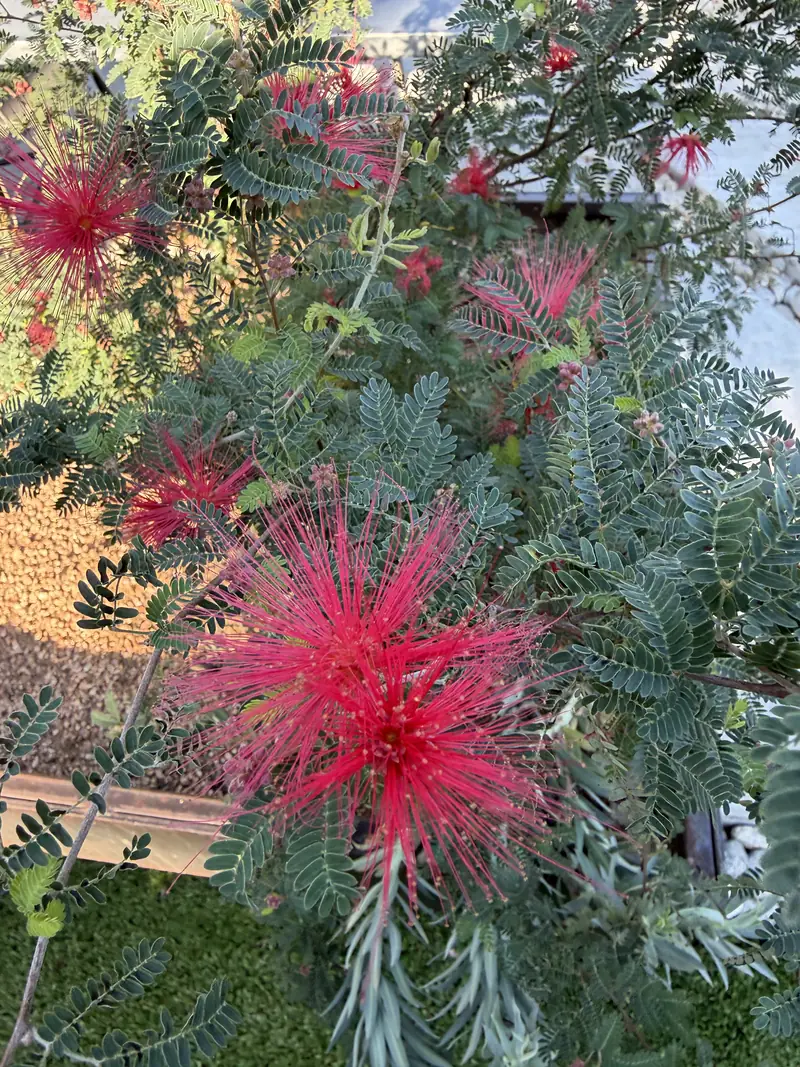
The flowers have no showy petals. Each one is a puff of long red stamens, which is where the duster in the name comes from. The leaves are just as fine: rows of tiny leaflets along thin stems, so the whole shrub reads as soft texture with points of red in it.
The Desert Museum records flowers from March through November at its site in Tucson, in response to watering or rainfall. It lists the plant as a nectar source for swallowtail and sulphur butterflies and as larval food for the Marine Blue butterfly.
Red Fairy Duster or Pink Fairy Duster?
They are two species, and nurseries also sell a hybrid of the two. The differences matter in Austin.
- Pink fairy duster (Calliandra eriophylla): the smaller one, about 3 feet tall and wide, with pink blooms in spring. It is the hardier of the two in a freeze. See our pink fairy duster notes.
- Red fairy duster (Calliandra californica): taller and wider, to 6 feet, with red blooms over a much longer season, and tender in a freeze.
- Sierra Starr, a hybrid of the two: the Desert Museum lists it at 4 to 5 feet tall and wide, denser than the red species, with bright red flowers on and off all year. It notes stems hardy to about 18°F and roots hardy to at least 15°F, and says hummingbirds cannot resist it.
A red flower alone does not tell you which plant you have. Keep the nursery tag, because the size and the cold tolerance follow the name on it.
What Does an Austin Winter Do to It?
The Desert Museum notes that the red species freezes at about 23 to 25°F, then resprouts in spring, with flowering delayed until summer.
Compare that with Austin. The USDA’s 2023 hardiness map puts most of the Austin area in zone 9a, where the coldest night of an average winter falls between 20 and 25°F. Camp Mabry went colder than that in December 2022, at 15°F, and into the single digits in February 2021.
So plan on it. In Austin, red fairy duster is a shrub that freezes back in a cold winter and returns from below, blooming later that year. That is the trade for its color, and it shapes where the plant goes:
- Give it the warm side of the yard: a spot in full sun near a wall or paving that holds heat. The Desert Museum notes that the Sierra Starr hybrid thrives in reflected heat.
- Do not ask it to carry the bed in January. Steel, stone, and evergreen plants hold the structure while it recovers.
Where and How Should You Plant It?
The Desert Museum’s care sheet is short and clear:
- Sun: full sun or light shade
- Water: very drought tolerant, and sparse when it is dry. Regular watering makes a fuller plant with more flowers.
- Soil: avoid heavy clay that drains slowly
- Pruning: occasional pruning gives a denser plant
Heavy clay is common in Austin, and a raised steel planter takes it out of the question. As our Circle C page puts it, in a steel planter the drainage is perfect and the roots never meet the clay. That is where this one grows: in a black steel planter beside synthetic turf and river rock, with the deck behind it. The planters on that project are custom steel, cantilevered, with lighting built in.
It also earns its place by contrast. Red flowers and fine green leaves stand out against dark steel, and the loose shape softens the straight lines of turf, curb, and deck. Give it room to reach its natural size, and shape it lightly. A shrub clipped into a small box loses the form that makes it worth planting.
In the ground, it belongs in a xeriscape bed with fast drainage, on a drip zone with other low-water plants.
Questions We Hear
How big does red fairy duster get?
The Arizona-Sonora Desert Museum lists Calliandra californica at up to 6 feet tall and more than 6 feet wide. Its Sierra Starr hybrid is listed at 4 to 5 feet tall and wide.
Does red fairy duster come back after a freeze?
Yes. The Desert Museum notes that it freezes at about 23 to 25°F and resprouts in spring, with flowering delayed until summer.
When does red fairy duster bloom?
The Desert Museum records flowers from March through November in Tucson, in response to watering or rainfall. The plant in these photos was in bloom in Circle C in October.
Does red fairy duster attract hummingbirds?
The Desert Museum says hummingbirds cannot resist its Sierra Starr hybrid, and it lists the red species as a nectar plant for swallowtail and sulphur butterflies.
Is red fairy duster native to Texas?
No. It is native to Baja California. Pink fairy duster, Calliandra eriophylla, is the smaller, hardier species.