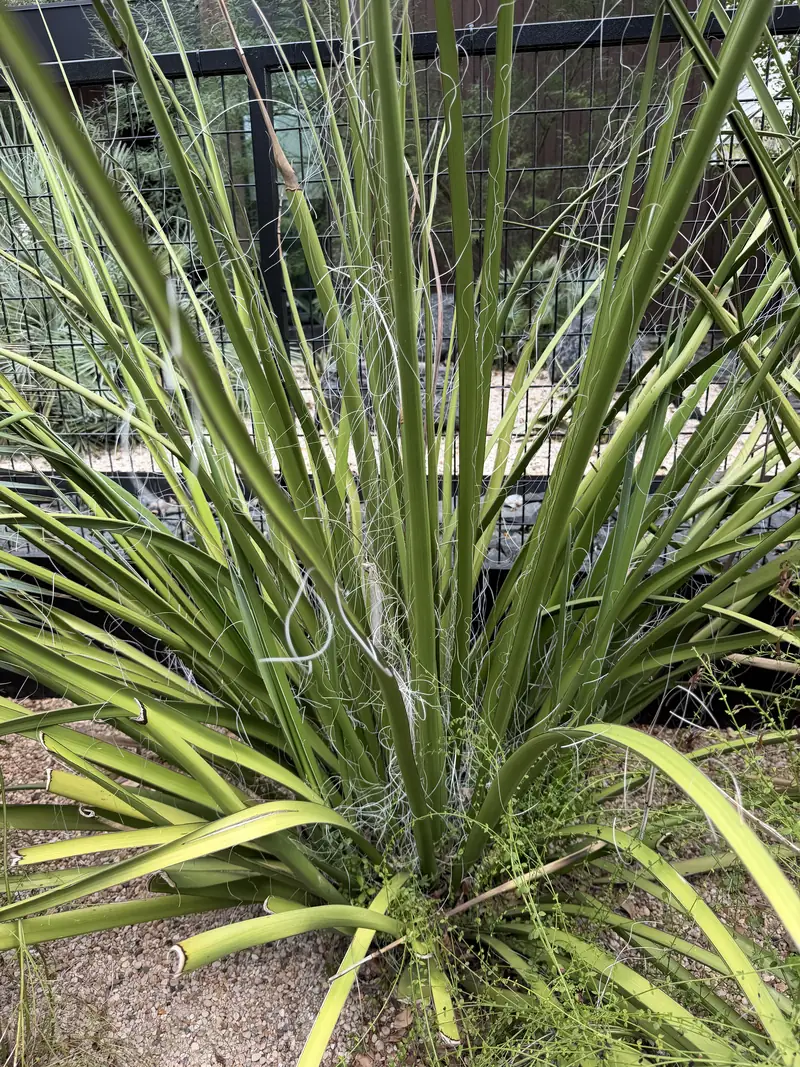
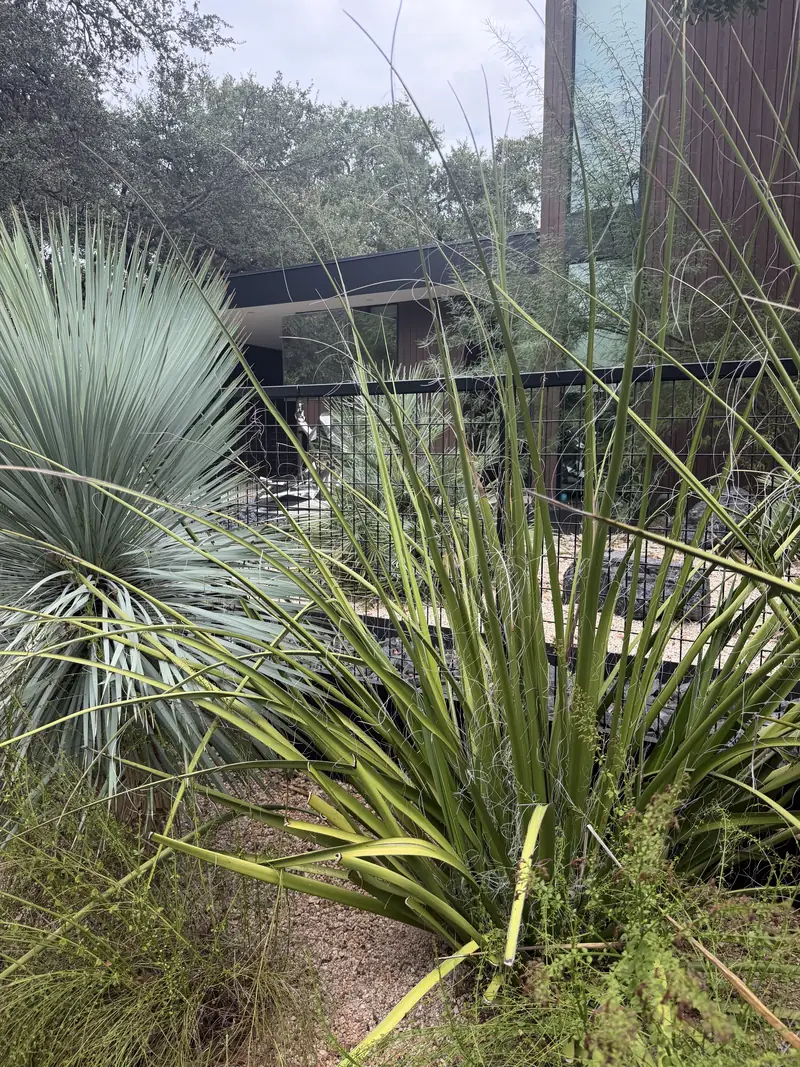
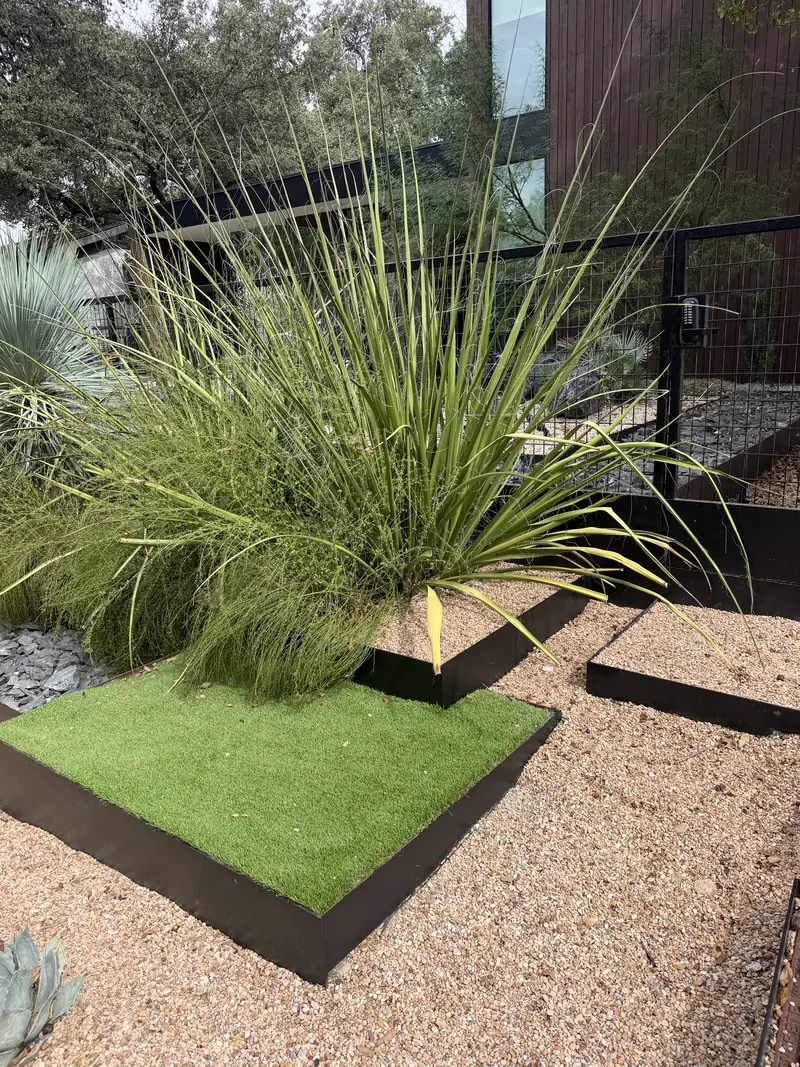
Giant hesperaloe (Hesperaloe funifera) is an upright, evergreen rosette of stiff, sword-shaped leaves, about 5 feet tall and wide, with no thorns. The Arizona Municipal Water Users Association (AMWUA) plant guide lists it as native to southern Texas and northeastern Mexico, for full or reflected sun, with very low water needs. The plants in these photos grow on a front-yard terrace in South Austin.
What Is Giant Hesperaloe?
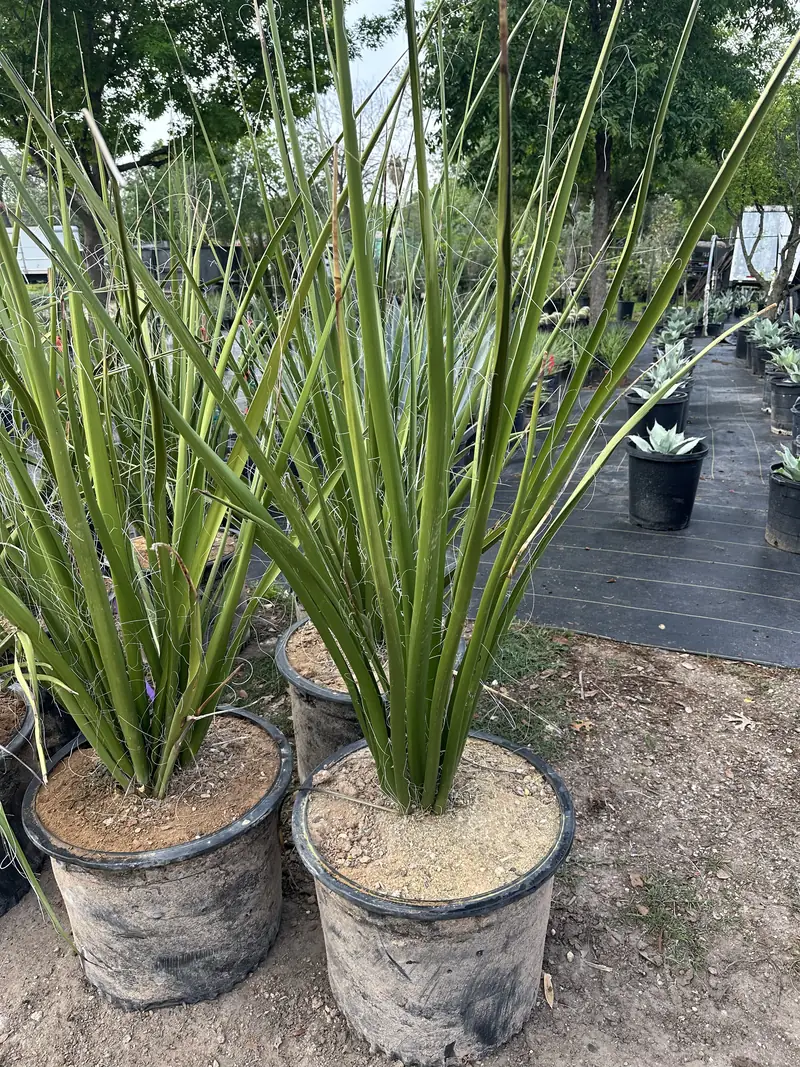
It is in the same genus as red yucca, and it is the larger of the two. The AMWUA plant guide lists Hesperaloe funifera as an evergreen with an upright rosette, about 5 feet tall and wide, with a moderate growth rate.
Look at a leaf edge and you find the detail in the first photo: white threads that peel away and curl. They catch the light, and they are the quickest way to recognize the plant.
It flowers too. AMWUA lists greenish-white flowers on tall stalks from late spring into summer, and notes that they draw bees, hummingbirds, and pollinators that fly at night.
How Is It Different From Red Yucca?
Both are hesperaloes. Red yucca (Hesperaloe parviflora) is the featured plant on our Georgetown page, which lists its leaves at 2 to 3 feet long and the plant at about 5 feet in flower. Giant hesperaloe is the larger plant: AMWUA lists it at about 5 feet tall and wide, with the leaves held upright.
That difference decides the job each one does. Red yucca fills the middle of a bed. Giant hesperaloe is tall enough to stand as the vertical accent on its own, in a spot where a plant with spines would be too close to people.
What Does It Need in Austin?
The AMWUA guide keeps it short:
- Sun: full sun or reflected sun
- Water: very low
- Cold: hardy to 10°F
- Growth: moderate
Reflected sun is worth a second look. A bed against a west wall, the edge of a driveway, or a strip beside pale gravel is hard on many plants, and this one is listed for it.
Now the cold number. The USDA’s 2023 hardiness map puts most of the Austin area in zone 9a, where the coldest night of an average winter falls between 20 and 25°F. Camp Mabry’s low of 15°F in December 2022 stayed above the 10°F mark. The February 2021 freeze, in the single digits, went below it. Giant hesperaloe is hardy through an Austin winter, and a freeze on the scale of 2021 is the one that tests it.
Match the irrigation to the plant. Keep it on a low-water drip zone, apart from lawn spray, so it gets the very low water it is listed for.
Where Does Giant Hesperaloe Fit in a Design?
Use it where you want height without spines. AMWUA lists it as having no thorns, so it can stand closer to a path, a lawn, or a seat than an agave or a yucca can.
On the South Austin terrace in these photos it does three jobs:
- Beside turf: one plant marks the corner of a steel-framed square of synthetic turf
- With a yucca: its green, upright leaves stand in front of the blue crown of a Yucca rostrata
- Above a spill: firecracker fern trails over the steel edge nearby, soft stems against stiff leaves
Give it a plain background. A dark fence, a smooth wall, or open gravel shows the outline and the white threads. A busy mix of plants behind it hides both. Give it the full 5 feet as well, so the leaves never need cutting back to clear a path.
At night, one low light set in front of the plant throws the upright leaves into relief against the wall or fence behind it. See our landscape lighting work.
Giant hesperaloe belongs in a xeriscape. For layouts, see our front yard xeriscape ideas and gravel landscaping ideas.
Questions We Hear
How big does giant hesperaloe get?
The AMWUA plant guide lists it at about 5 feet tall and wide, with a moderate growth rate.
Does giant hesperaloe have thorns?
No. AMWUA lists it as having no thorns. The white curls along the leaf edges are threads.
Is giant hesperaloe native to Texas?
Yes. AMWUA lists its native range as southern Texas and northeastern Mexico.
How cold hardy is giant hesperaloe?
AMWUA lists it as hardy to 10°F. Most of the Austin area is in USDA zone 9a, where the coldest night of an average winter is 20 to 25°F.
When does giant hesperaloe bloom?
AMWUA lists greenish-white flowers on tall stalks from late spring into summer. They draw bees, hummingbirds, and pollinators that fly at night.