A flagstone patio in Austin, TX is built one of two ways: set in mortar on a concrete slab, or laid dry on a compacted base with decomposed granite or gravel in the joints. Mortar makes one solid floor with tight joints. A dry-laid patio keeps its joints open to the ground, so rain soaks in between the stones. Red Agave Landscape builds both, and this post shows three flagstone patios from our work.
What Is Flagstone?
Rock that splits into flat slabs. Encyclopaedia Britannica describes flagstone as rock that breaks in smooth, even layers a few centimeters thick and is used in paving.
The pieces come in irregular shapes, so a flagstone patio is fitted stone by stone. We build in Oklahoma flagstone, Pennsylvania bluestone, and Texas limestone. The patios on this page show the range of color: tan and gold, blue-gray, and pale gray.
Should Flagstone Be Set in Mortar or Laid Dry?
Mortar where a level floor matters. Dry where the stone meets the garden.
| Compare | Set in mortar | Laid dry |
|---|---|---|
| What is under it | A reinforced concrete slab on a compacted base | A compacted base and a bed of sand |
| Joints | Mortar, struck tight | Decomposed granite or pea gravel |
| Rain | Runs off the surface, so the patio is graded to drain | Soaks in at the joints |
| On clay | Rigid, so the slab is built for the soil | Each stone moves on its own |
| Best for | Dining patios, outdoor kitchens, and fire pit areas | Walkways, garden patios, and stepping stones |
On a mortared patio the joints take the stress of Texas heat. Our guide to flagstone mortar covers the mix and the four steps under a mortared patio. Our comparison of travertine, flagstone, and pavers covers how each surface handles the sun.
What Goes Under a Flagstone Patio in Austin?
A base, and it is the same one under every patio we build.
- Excavation: we dig to the depth the stone and its base need
- Subgrade: the soil at the bottom is compacted
- Base: 6 to 8 inches of crushed limestone, compacted
- Grade: the base slopes so water moves away from the house
- Stone: set in mortar on a concrete slab, or laid dry with decomposed granite in the joints
The soil is the reason. A plant guide by Texas AgriLife Extension and the City of Austin, Native and Adapted Landscape Plants, describes the two soils of Austin: shallow limestone or caliche on the west side, and deeper, dark clay on the central and east side. Clay swells when it is wet and shrinks when it is dry. Stone laid on clay with no base moves with the clay. See our patios page.
What Do Three of Our Flagstone Patios Look Like?
Each one answers a different yard.
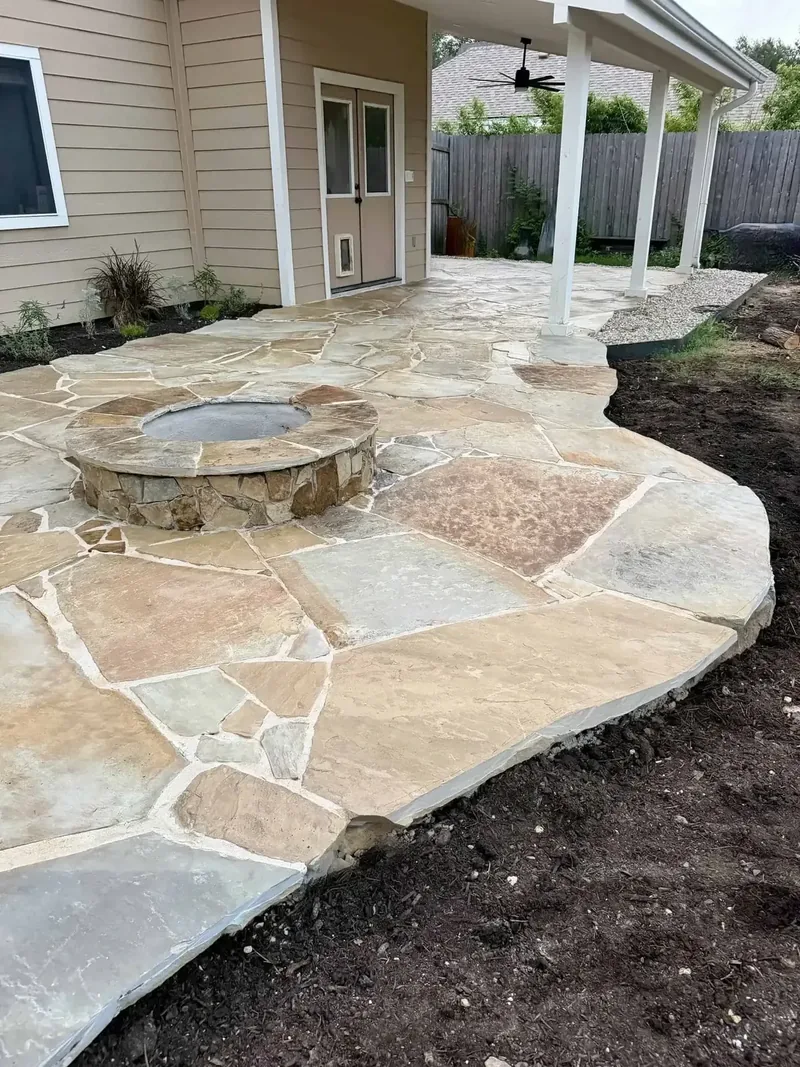
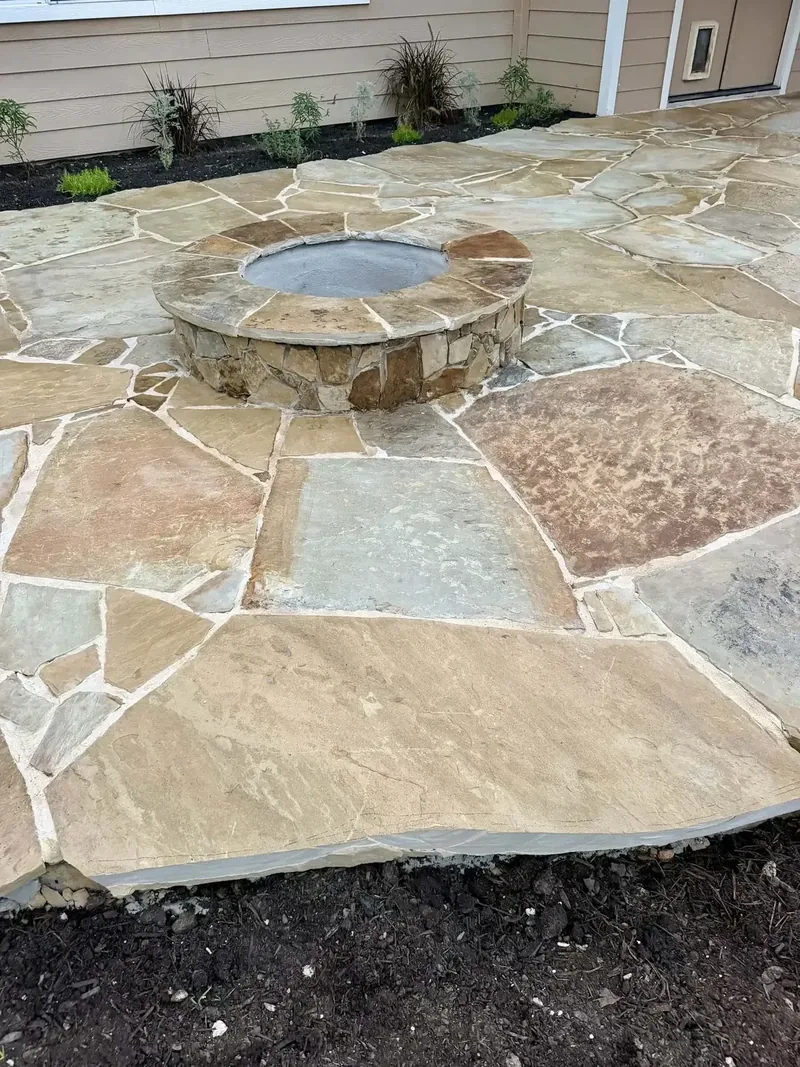
A patio with a stone fire pit. Flagstone in tan, gold, and gray runs from a covered porch out into the yard and ends in a curved edge. The joints are mortar. A round fire pit rises from the patio, with stone sides and a cap of the same flagstone. Steel edging holds a strip of gravel beside the porch, and a planting bed sits between the patio and the house.
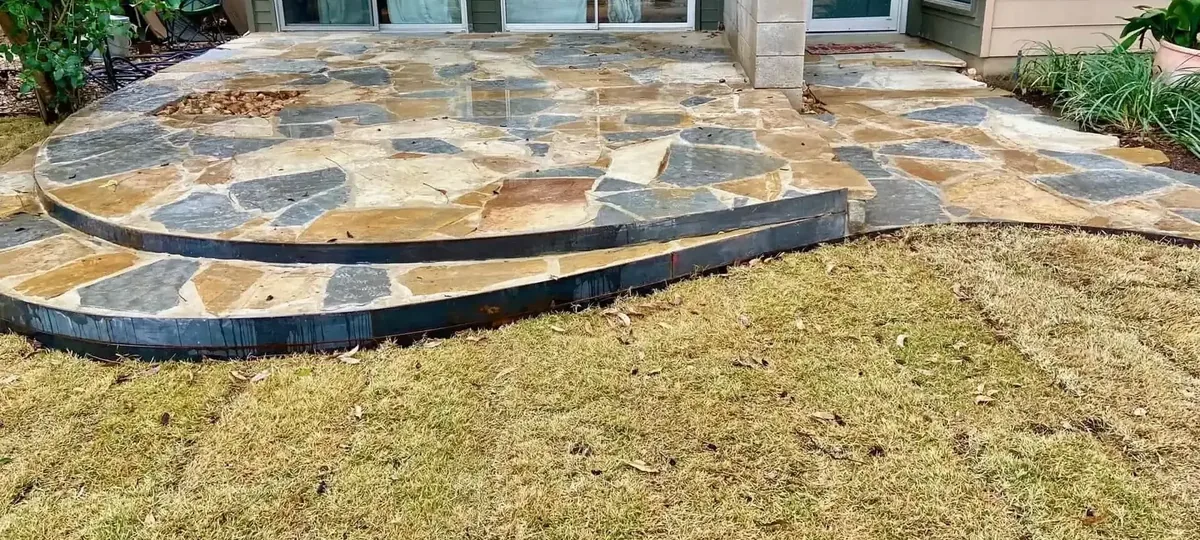
A patio with curved steel steps. This is the patio at the top of the page. Two colors of stone, blue-gray and tan, are set in mortar. Two curved steps lead down to the lawn, and each one is faced in a band of steel. One pocket in the patio was left open and filled with river rock.
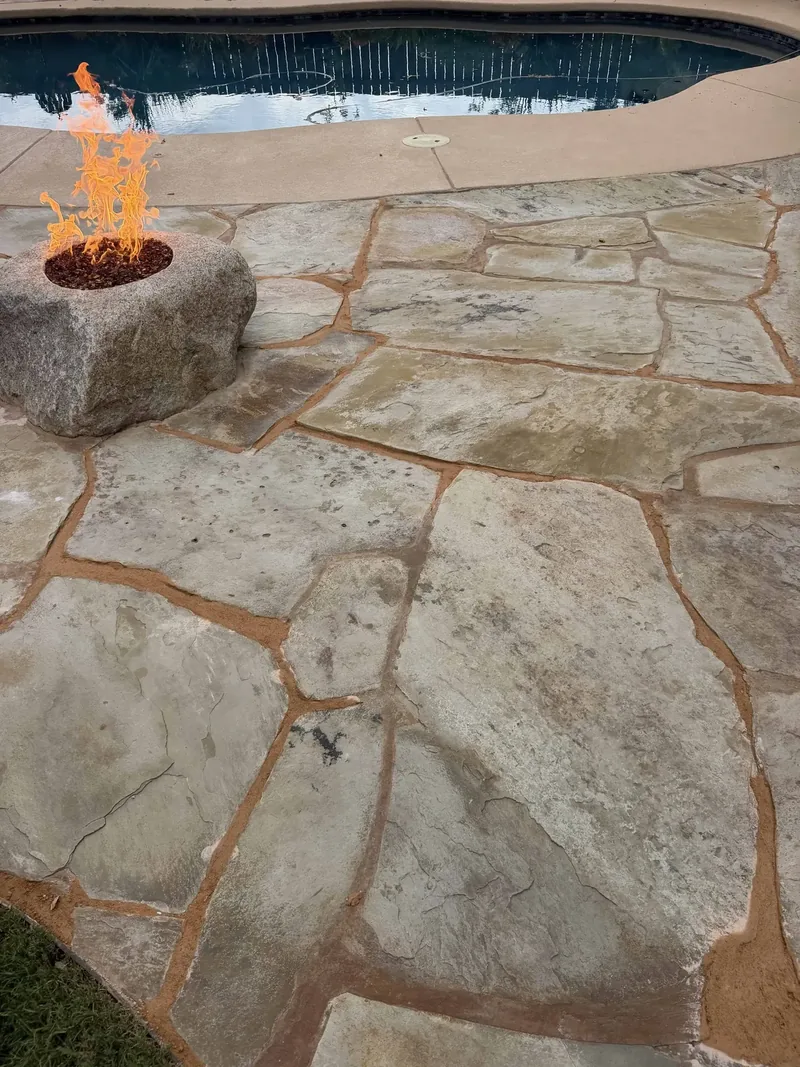
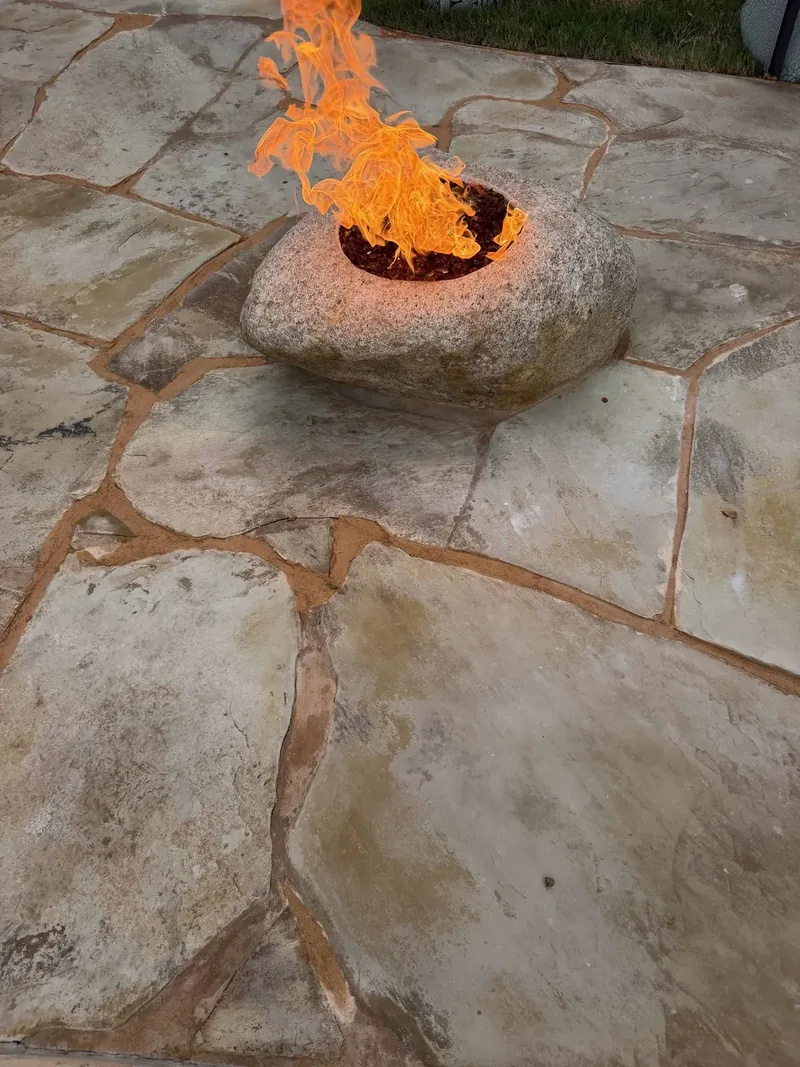
A patio beside a pool. Pale flagstone with tan joints runs to the concrete edge of the pool. A boulder fire pit sits on the stone, carved out at the top and burning over red fire glass.
How Is a Flagstone Patio Edged?
In stone or in steel. These three patios show both.
- The stone’s own edge: on the first patio the flagstone ends in a curve, with the natural edge of each stone left showing
- Steel on the steps: on the second patio a band of steel faces each curved step, so the edge of the step is one clean line
- Steel beside the patio: on the first patio steel edging keeps a strip of gravel apart from the stone and the lawn
Steel bends to a curve, which is why it suits flagstone. See our steel edging page.
Can a Fire Pit Sit on a Flagstone Patio?
Yes. Two of these three patios carry one.
On the first patio the fire pit is built up from the floor in stone and capped in the same flagstone, so the cap and the patio match. On the pool patio the fire pit is a boulder. We build boulder fire features with a gas burner set into the stone.
See our custom fire pits page and our post on how we design fire pits.
Does a Flagstone Patio Need a Permit in Austin?
Austin Development Services publishes a list of work exempt from building permits. The residential list includes a sidewalk, driveway, or concrete flatwork that is not in the public right-of-way, and the slab under a mortared patio is concrete flatwork. The same page says exempt work still has to meet the building codes and city codes, and that a property in a floodplain can still need a permit.
Cover is the second question. The City’s glossary defines impervious cover as any human-made surface that does not absorb rainfall, and the share a lot is allowed is set by its zoning. Stone set in mortar on a slab does not absorb rainfall, so it counts toward that share.
What If the Flagstone Is Already There?
An old patio can stay as the base for something new. In Circle C we laid composite decking over an old flagstone patio, so the new deck sits on ground that was already covered. See that project.
For what drives the price of a new patio, see our patio cost guide. Every Red Agave project starts with a free consultation, and the CAD plan is included.
What Sources Did We Use?
We read each of these in November 2026.
- Encyclopaedia Britannica, Flagstone
- City of Austin, Austin Development Services, Work Exempt from Building Permits and Glossary of terms, impervious cover
- Texas AgriLife Extension and City of Austin, Native and Adapted Landscape Plants, the soils of Austin
Questions We Hear
Is a flagstone patio better set in mortar or laid dry?
Set in mortar where a level floor matters, such as a dining patio, an outdoor kitchen, or a fire pit area. Laid dry for walkways, garden patios, and stepping stones, where rain soaks in at the joints and each stone moves on its own.
What goes under a flagstone patio in Austin?
We excavate, compact the subgrade, and lay 6 to 8 inches of compacted crushed limestone, graded so water moves away from the house. A mortared patio then gets a concrete slab, and the stone is set in mortar on the slab.
What stone is used for a flagstone patio in Austin?
Red Agave builds in Oklahoma flagstone, Pennsylvania bluestone, and Texas limestone. Flagstone is rock that breaks in smooth, even layers and is used in paving.
Can you build a fire pit on a flagstone patio?
Yes. On one of our patios a round stone fire pit rises from the flagstone and is capped in the same stone. On another, a carved boulder fire pit sits on the flagstone beside a pool.
Does a flagstone patio count as impervious cover in Austin?
The City of Austin defines impervious cover as any human-made surface that does not absorb rainfall. Flagstone set in mortar on a concrete slab does not absorb rainfall, so it counts.