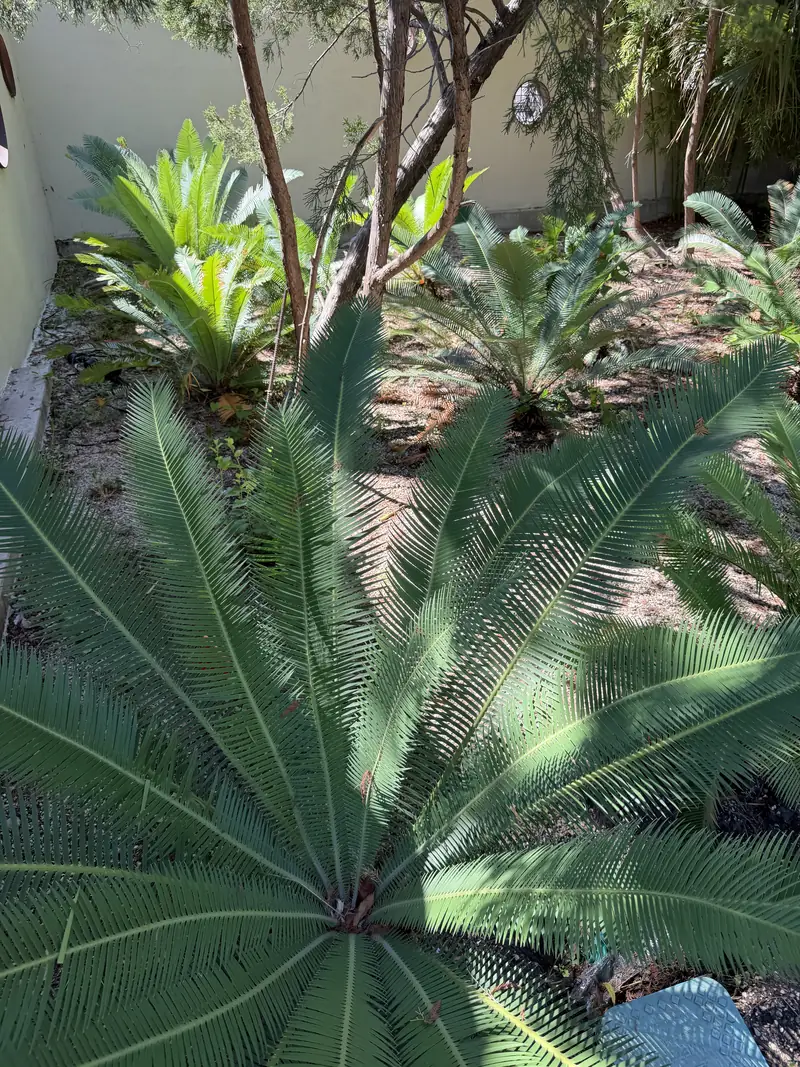
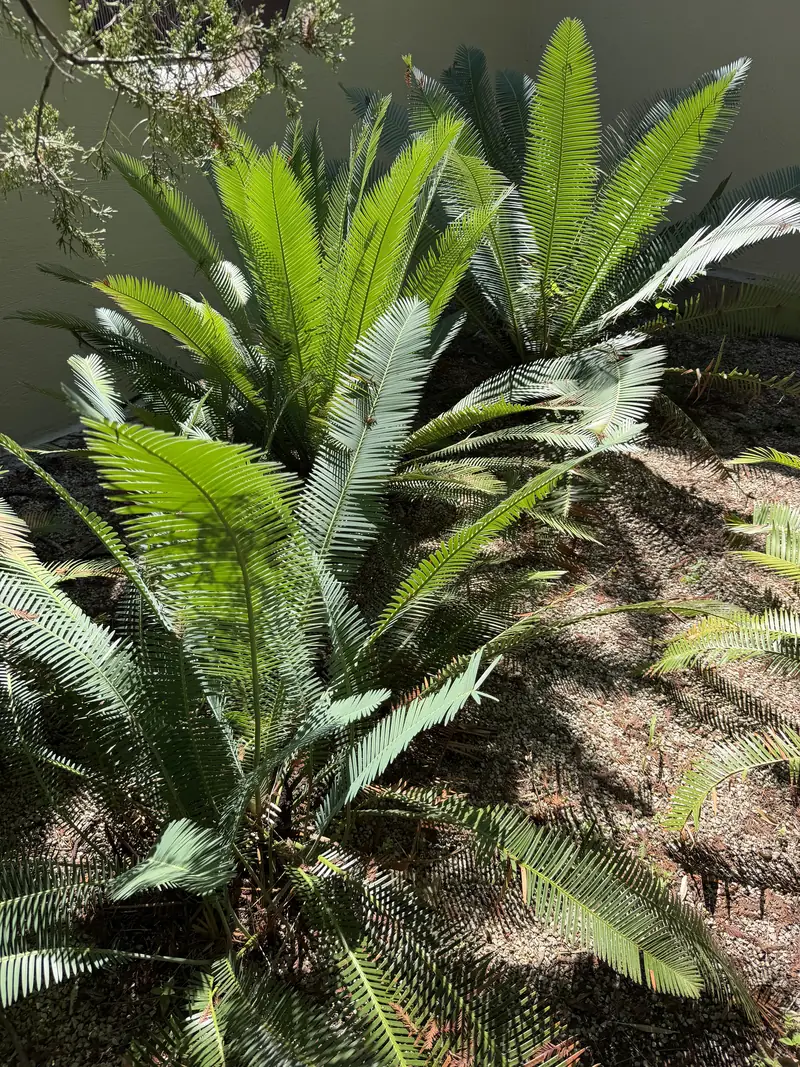
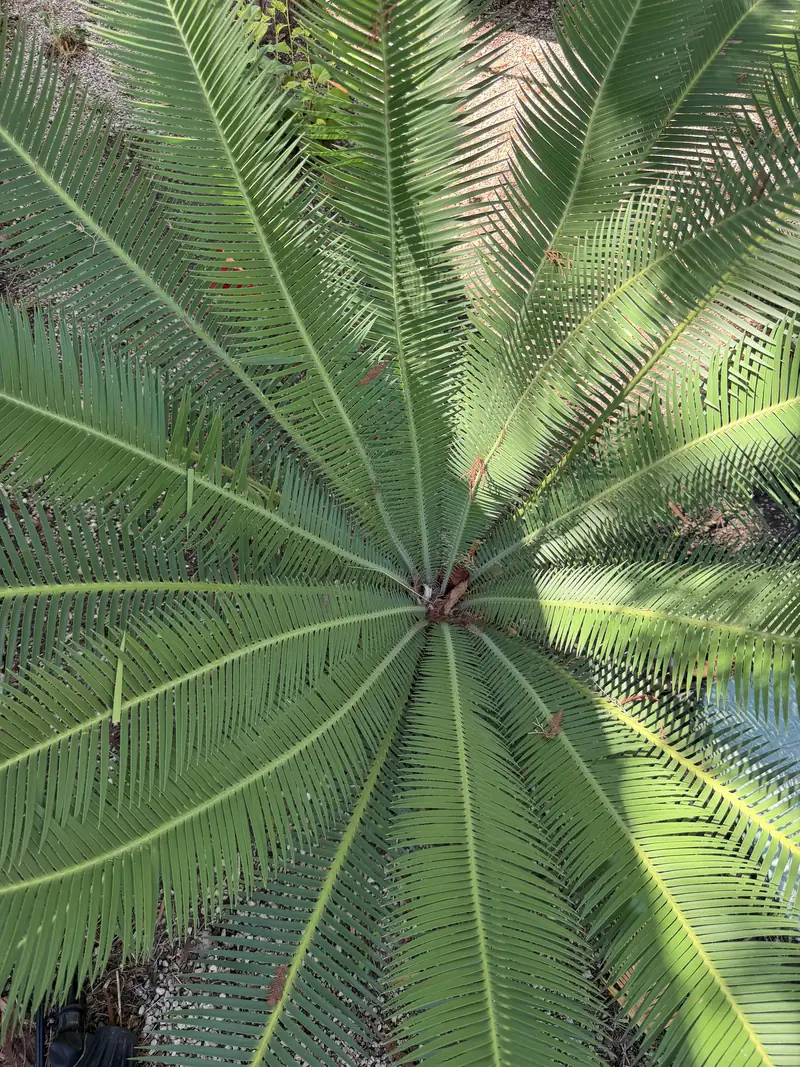
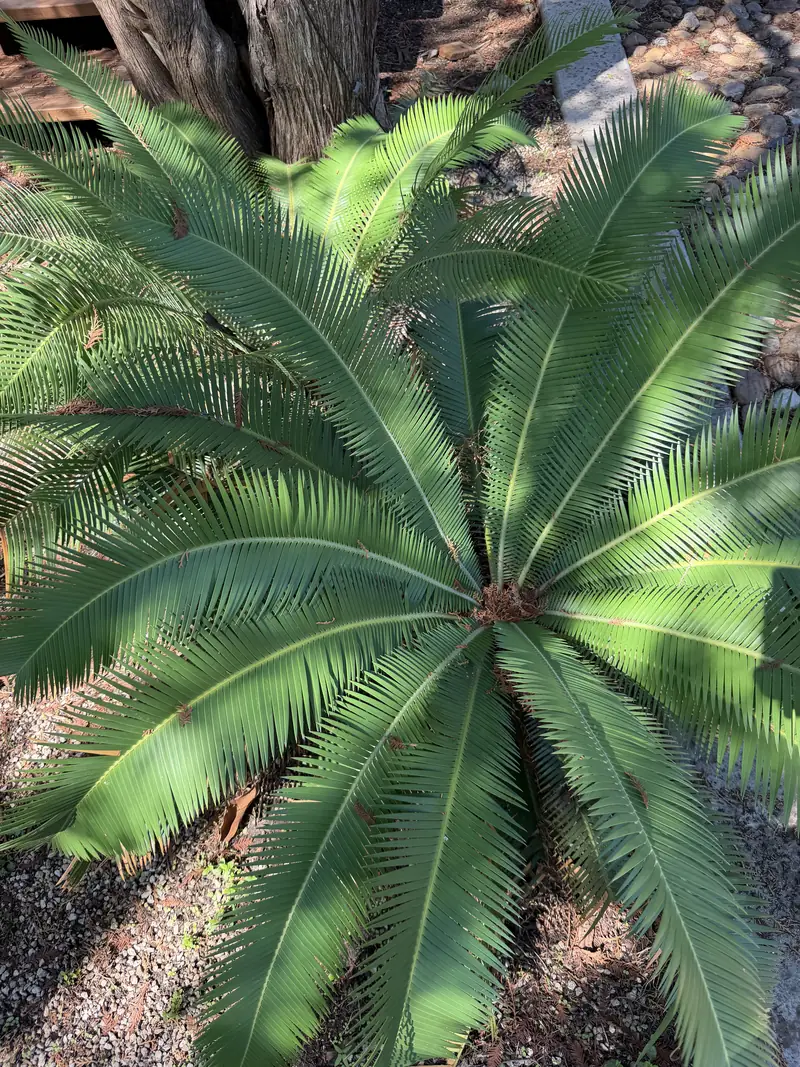
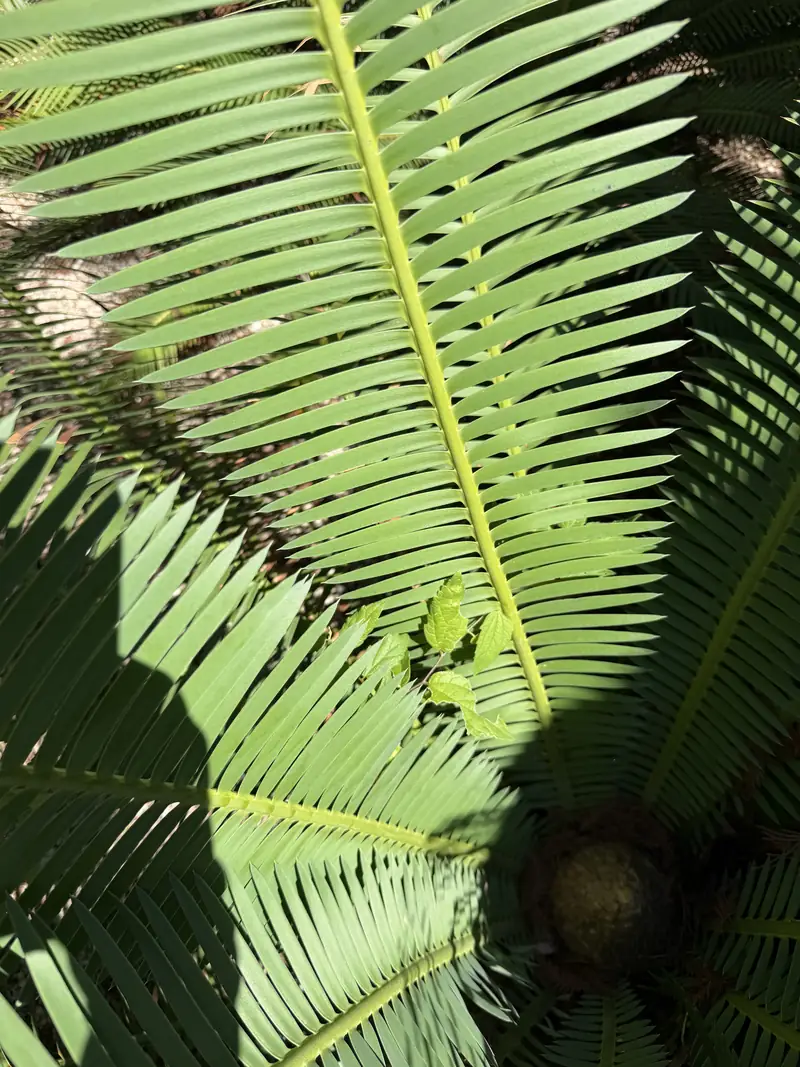
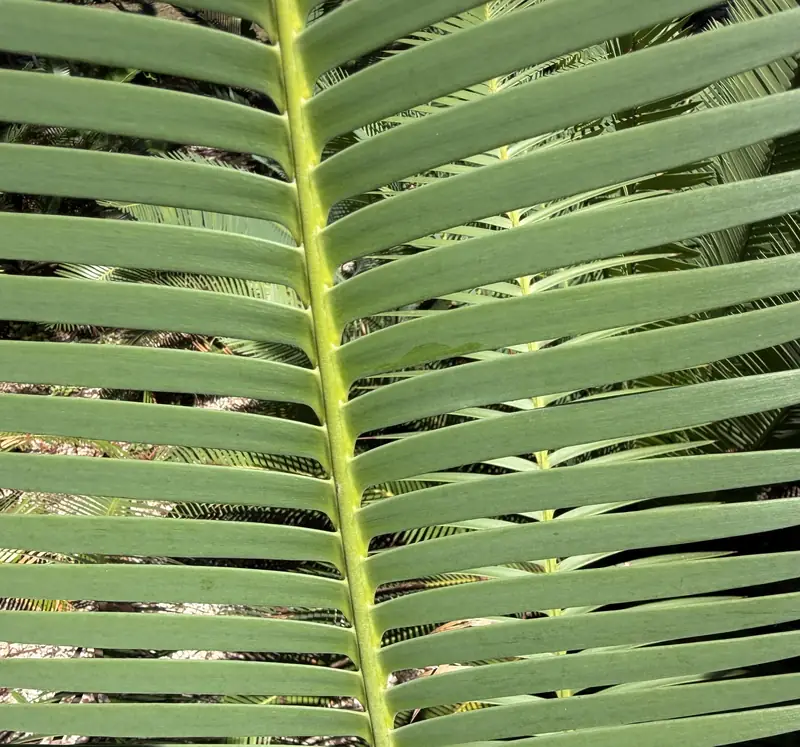
Dioon and sago palm are both cycads, not palms, and they look alike from a distance: a stiff crown of feather-shaped leaves on a short, thick trunk. Dioon edule comes from eastern Mexico and has gray-green to blue-green leaves with flat, sharp-tipped leaflets. Sago palm (Cycas revoluta) comes from Japan and southern China and has glossy green leaves whose edges roll under. The Dioon in these photos grows in a shaded gravel courtyard in East Austin.
Are Dioon and Sago Palm Really Palms?
No. NC State Extension describes sago palm as a cycad, not a true palm, native to Japan and southern China. The Missouri Botanical Garden lists Dioon edule, also called chestnut dioon or virgin’s palm, as a slow-growing evergreen cycad native to eastern Mexico. It notes that Dioon carries male and female cones on separate plants.
In a design, the word palm sets the wrong picture. Neither plant gives you a tall trunk with a canopy overhead. Both grow slowly and stay low for many years, so they work as sculpture at eye level and below. For a true palm that suits Austin, see our guide to the blue Sonoran palm.
How Do You Tell Them Apart?
Look at one leaf up close.
- Leaf color: Dioon is gray-green to blue-green. Sago palm is glossy green.
- Leaflets: Dioon leaflets are flat and end in a sharp tip. Sago leaflets have edges that roll back under.
- Size: the Missouri Botanical Garden lists Dioon edule at 6 to 8 feet tall and 4 to 6 feet wide, with leaves 3 to 6 feet long. NC State lists sago palm at 3 to 10 feet tall and wide.
- Origin: Dioon is from eastern Mexico. Sago palm is from Japan and southern China.
A plant tag settles it. Ask the nursery for the botanical name, and keep the tag.
Which One Handles an Austin Winter?
Both are rated for the Austin area, and both want a sheltered spot for a hard freeze.
The Missouri Botanical Garden rates Dioon edule for USDA zones 9 to 11, and zone 8 with protection. The University of Arizona Campus Arboretum lists it as hardy to 15°F. NC State rates sago palm for zones 9a to 12b.
Now the Austin numbers. The USDA’s 2023 hardiness map puts most of the Austin area in zone 9a, where the coldest night of an average winter falls between 20 and 25°F. Camp Mabry reached 15°F in December 2022 and fell into the single digits in February 2021. An average winter sits inside the range for both plants, and a hard freeze goes past it.
That makes placement the decision that counts. Give either plant the most sheltered spot the yard has: a courtyard, a walled entry, or the cover of a tree canopy. The Dioon in these photos has that kind of spot, with a wall behind it and mature trees overhead.
What Do They Need?
The care numbers here are for Dioon edule, from the Missouri Botanical Garden:
- Light: full sun to part shade
- Soil: gritty and well drained
- Water: established plants tolerate drought
- Growth: slow, so buy the size you want to look at
NC State describes sago palm as very slow growing as well.
Drainage is the part to get right. East of I-35, in neighborhoods like Mueller, yards sit on the Blackland Prairie side of Austin, where the soil is heavy clay. A raised bed with gritty soil gives a cycad the root zone it wants. Our gravel landscaping ideas show how gravel courtyards and beds come together.
Both plants belong in a xeriscape, on a low-water drip zone kept apart from lawn irrigation.
What Should Pet Owners Know?
Sago palm is poisonous to pets. NC State rates its toxicity as high: every part of the plant contains the toxin cycasin, the seeds hold the most, and pets are drawn to them. The Merck Veterinary Manual notes that dogs are extremely sensitive to it and that all parts of the plant are toxic.
Dioon is a cycad too, so place it with the same care around pets and children. In a yard where a dog chews plants, choose a different plant for that bed. Our list of plants that survive an Austin summer is a place to start.
Where Does a Cycad Fit in a Design?
A cycad reads best against a plain background: a smooth wall, a field of gravel, or the trunks of mature trees. The courtyard in these photos uses all three, and the plants stand out because nothing around them competes.
Give each crown room. The leaflets end in sharp tips, so keep the full spread of the leaves clear of a path, a gate, or a seat. Plant in a small group with open gravel between the crowns, and each one keeps its own outline.
At night, one low light across a crown shows its shape. Every Red Agave project starts with a free consultation, and the CAD plan is included, so each plant is drawn at its mature size before anything goes in the ground. See our landscape design page.
Questions We Hear
Is Dioon a palm?
No. The Missouri Botanical Garden lists Dioon edule as a cycad native to eastern Mexico. Sago palm is a cycad too, not a true palm.
Is sago palm toxic to dogs?
Yes. NC State Extension rates its toxicity as high, with the toxin cycasin in every part of the plant and the most in the seeds. The Merck Veterinary Manual notes that dogs are extremely sensitive to it. Call a veterinarian right away if a pet chews any part of one.
How fast do Dioon and sago palm grow?
Slowly. The Missouri Botanical Garden lists Dioon edule as slow growing, and NC State describes sago palm as very slow.
Do they want sun or shade?
The Missouri Botanical Garden lists Dioon edule for full sun to part shade. The Dioon in these photos grows under mature trees in East Austin.
How cold hardy is Dioon?
The University of Arizona Campus Arboretum lists Dioon edule as hardy to 15°F. The Missouri Botanical Garden rates it for USDA zones 9 to 11, or zone 8 with protection.