Red Agave Landscape runs steel edging through boulders by cutting a slot into the stone with an angle grinder and seating 1/4-inch steel inside it. The steel does not stop short of the boulder or bend around it. It goes into the rock, so the edge and the stone read as one piece. The photos below are from a front yard we built in East Austin.
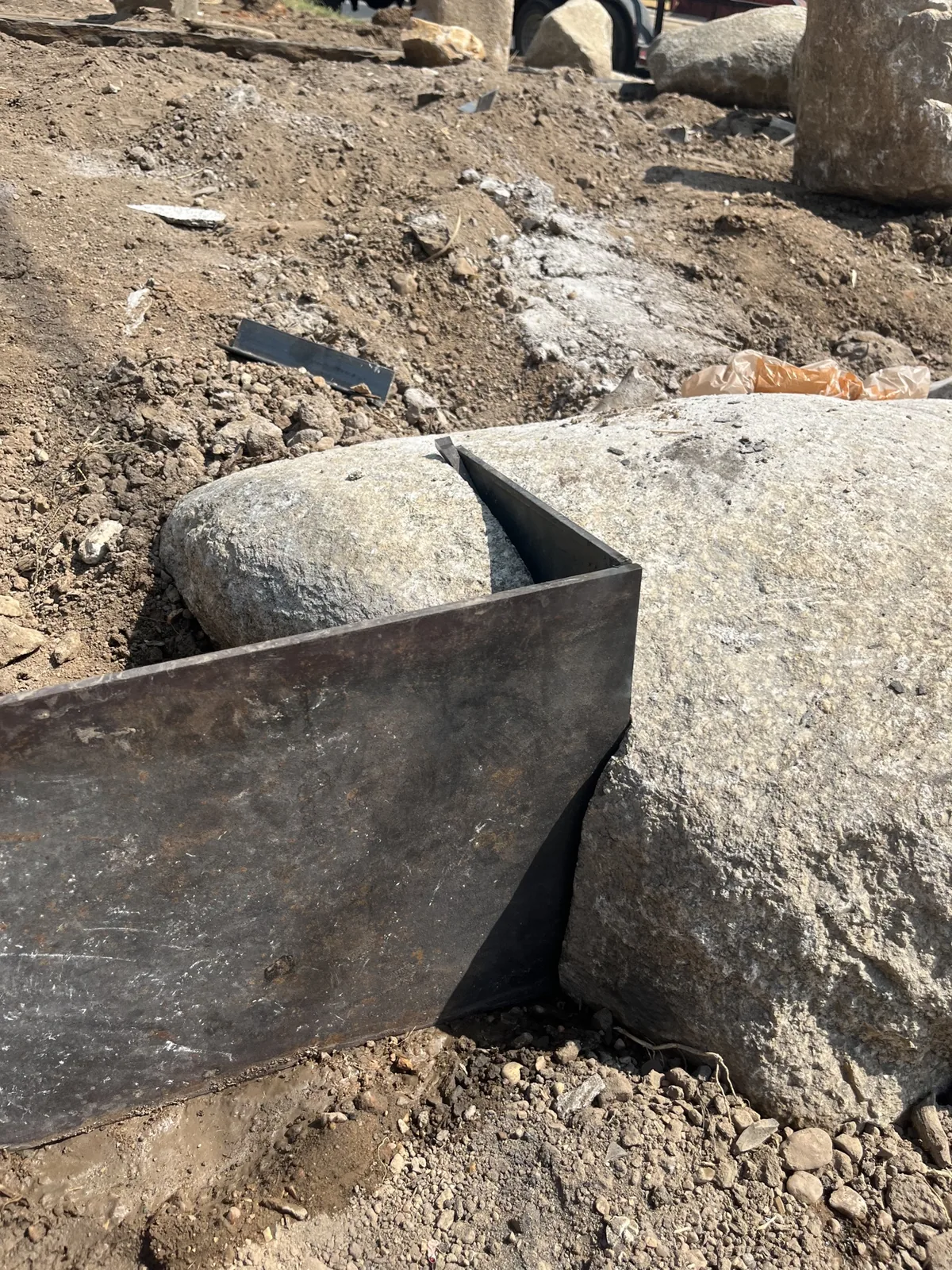
How Do You Get Steel Into a Boulder?
You cut the stone to fit the steel. There are four steps.
- Set the boulder first: the stone is placed before the steel
- Cut the slot: an angle grinder cuts a narrow slot down into the rock, just wide enough for the plate
- Seat the steel: the 1/4-inch plate slides into the slot and stops inside the stone
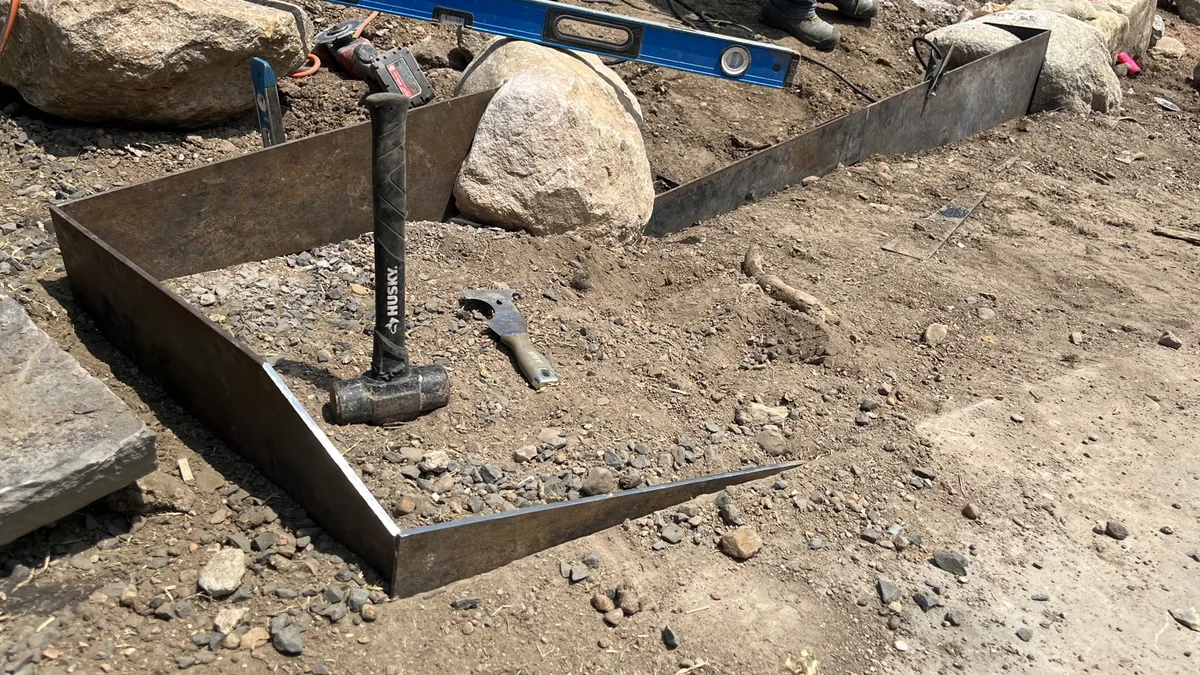
- Level the run: a level across the top of the steel checks the run
In the photo below the edging is still bare and the ground is still open. The steel runs in straight lines between the boulders, with sharp corners where the line turns.
Why Cut the Boulder Instead of Stopping the Steel?
Because a gap is where an edge fails. Steel edging has one job, which is to keep two materials apart. If the steel stops beside a boulder, the two materials meet in the space between them.
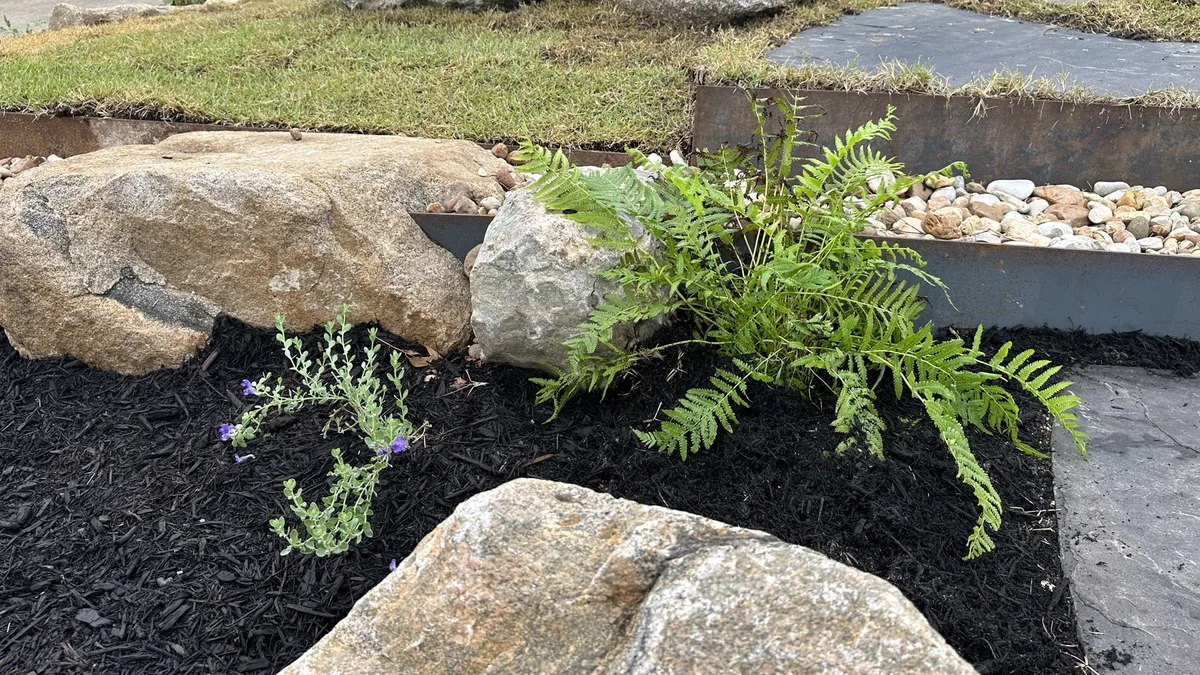
In this yard the steel holds black mulch on one side and river rock on the other. Where the edge meets a boulder, the steel is inside the stone, so there is no opening for the rock to spill into the mulch.
There is a second reason, and you can see it. A line that runs into a boulder looks as if the stone was always there and the yard was built around it. A line that stops an inch short looks like two things placed near each other.
Why 1/4-Inch Steel?
Because it stays straight. We use 1/4-inch steel for our edging and cut, bend, and weld it on site. Thin 1/8-inch decorative edging bows under the pressure of the soil behind it.
Thickness matters even more at a boulder. The slot is cut to the plate, so the plate has to be flat and true to seat in it.
The steel is mild steel, left raw. It develops a natural rust patina over 6 to 12 months. In the finished photo above, taken a few weeks after the install, the edging has already started to turn.
See our steel edging page, our guide to steel edging fabrication, and our steel retaining walls, which use the same plate.
Should You Cut a Boulder Yourself?
No. Cutting stone makes a dust you should not breathe.
OSHA states that respirable crystalline silica is created when cutting, sawing, grinding, drilling, and crushing stone and rock. The particles are at least 100 times smaller than ordinary beach sand. Workers who breathe them are at increased risk of silicosis, an incurable lung disease, and OSHA also lists lung cancer, chronic obstructive pulmonary disease, and kidney disease.
A boulder is also heavy, and the cut is made in place, low to the ground, with a grinder. This is work for a crew that does it often. Source: OSHA, Silica, Crystalline.
What Else Do We Do to Boulders?
We cut them, drill them, carve them, and build fire between them. A boulder is the one part of a yard that does not look built, so we work it into the parts that are.
- Cut: a slot for 1/4-inch steel edging, as in East Austin
- Drilled: in Southeast Austin, water comes out of a hole drilled in a boulder and runs down a steel channel into a round water feature
- Carved: a gas fire pit carved into the boulder itself
- Spanned: in Southeast Austin, a square steel fire pit is suspended between two boulders
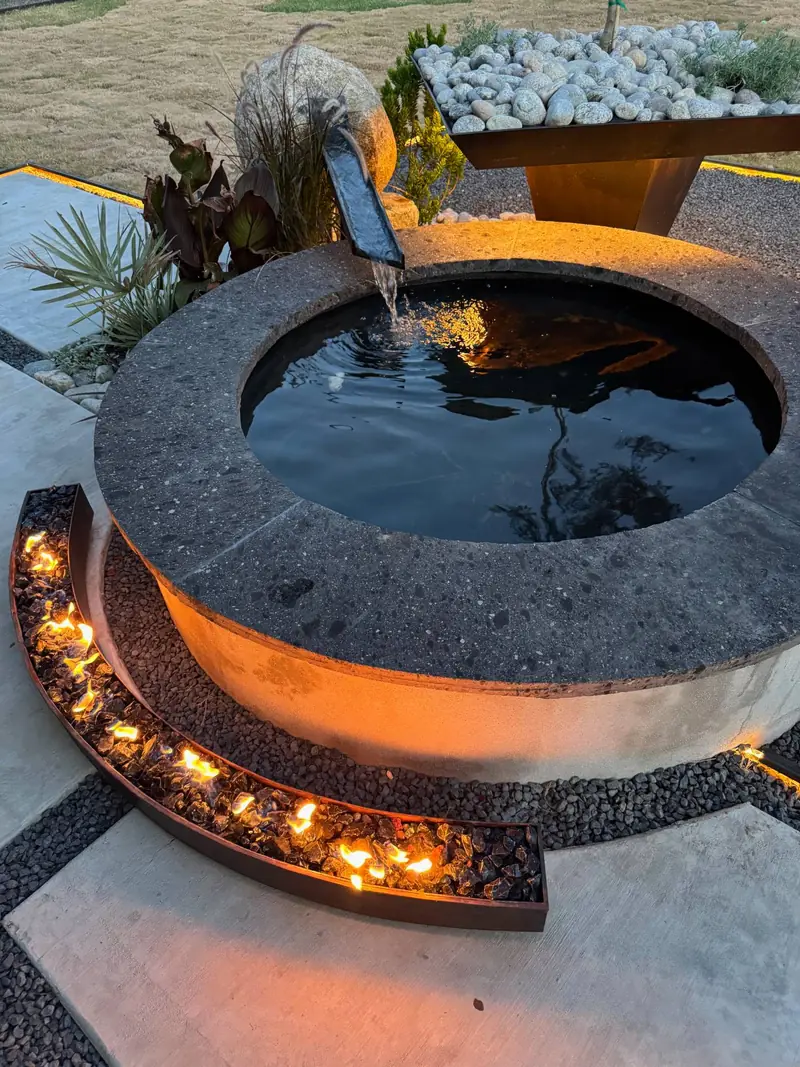
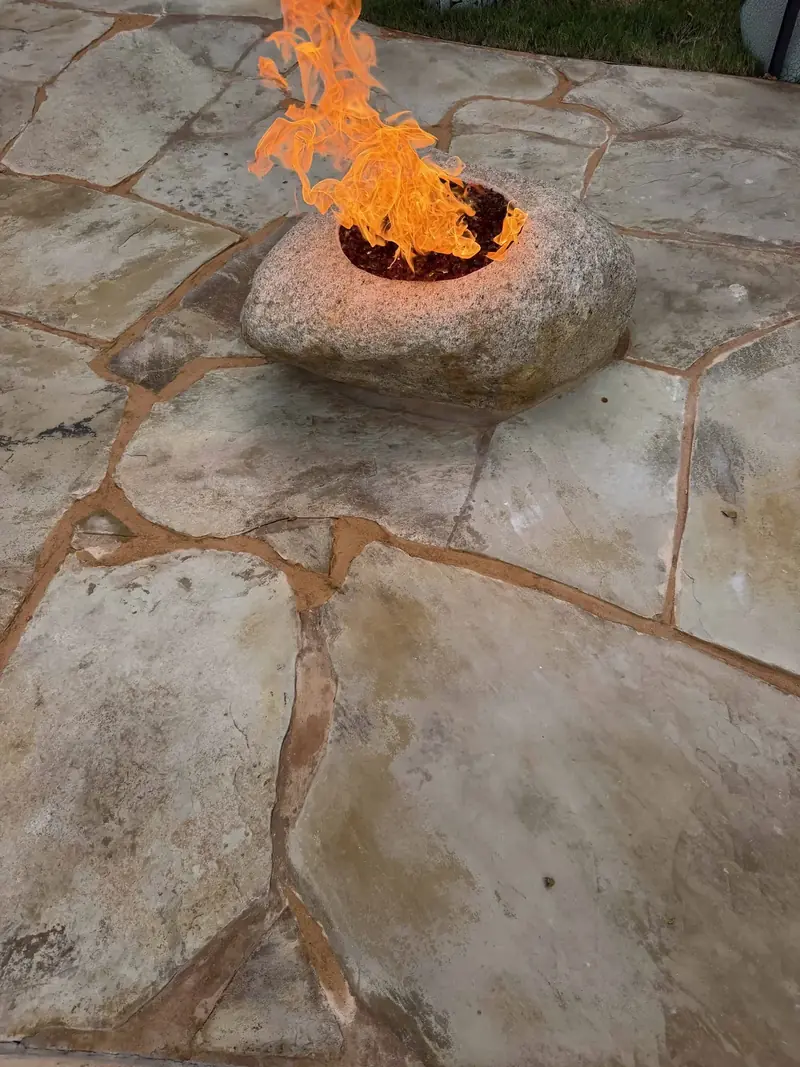
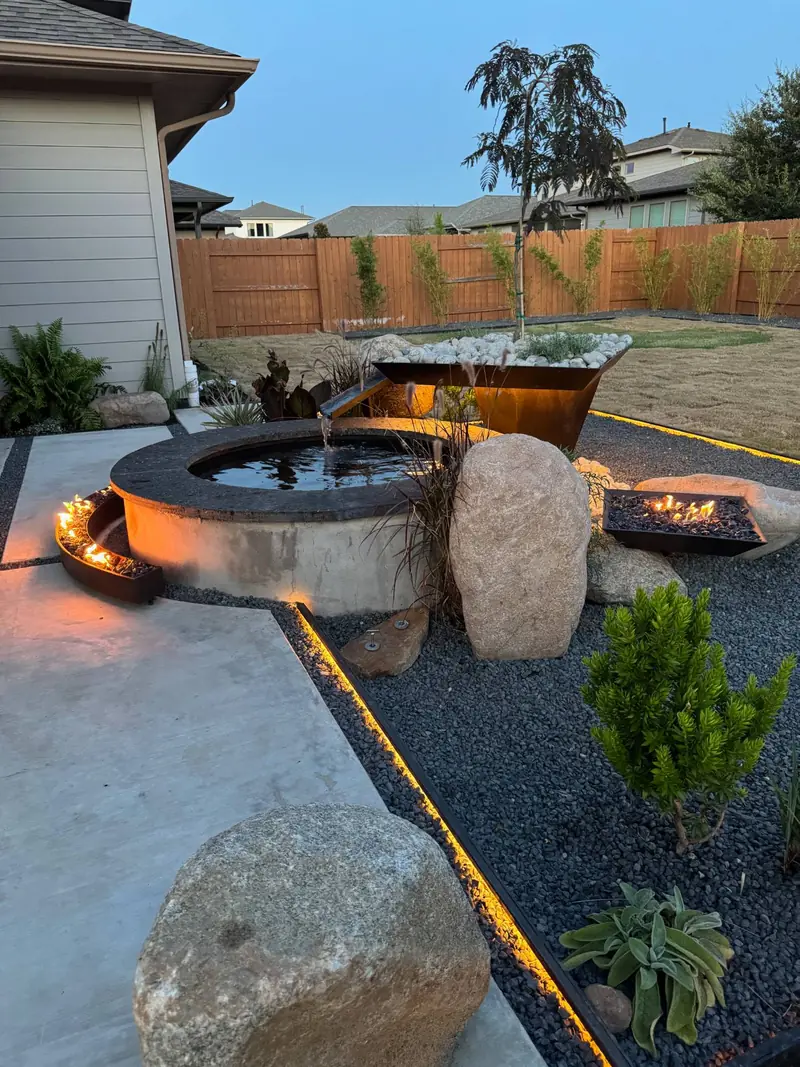
Red Agave is the only company in Austin that builds carved boulder fire pits. See our post on custom fire pits and the Southeast Austin water feature.
Where Does This Detail Belong in a Yard?
Anywhere a steel edge and a boulder meet.
- Planting beds: where steel holds mulch or gravel and a boulder sits on the line
- Terraces: where a boulder sits at a change in level. On our steel terraces at the Overlook at Lewis Mountain in Southwest Austin, boulders sit at the grade breaks.
- Paths: where an edge runs along stone pavers and a boulder marks a turn
It is planned on paper first. Our plans show the boulders and the steel lines together. See our design plans.
Every Red Agave project starts with a free consultation, and the CAD plan is included. We serve the Austin area, and our xeriscape service lists steel edging and boulders among what we build.
Questions We Hear
Can steel edging go through a boulder?
Yes. We cut a slot into the boulder with an angle grinder and seat the steel inside it, so the edge runs into the stone with no gap.
What tool cuts the slot?
An angle grinder. The slot is cut narrow, just wide enough for the plate.
How thick is the steel?
1/4 inch. It is cut, bent, and welded on site, and it stays straight where thin 1/8-inch edging bows.
Does the steel rust?
Yes, by design. Raw mild steel develops a natural rust patina over 6 to 12 months.
Is the boulder set before or after the steel?
Before. The boulder is set in place, and the steel is cut and fitted to it.