Hardscaping is the built part of a yard: the patios, walls, decks, steps, and edging. Xeriscaping is a way of designing the whole yard so it needs little water, and it uses plants and hardscape together to do it. One is a set of things you build, and the other is a method. Red Agave Landscape designs and builds both in Austin, TX, and the Southeast Austin front yard on this page shows the two in one design.
What Is the Difference Between Hardscaping and Xeriscaping?
Hardscape answers "what is it made of?" Xeriscape answers "how much water does it need?" A yard can have one, both, or neither.
| Question | Hardscaping | Xeriscaping |
|---|---|---|
| What is it? | The built, non-living parts of a landscape | A method of landscaping that saves water |
| What does it cover? | Patios, walkways, walls, decks, pergolas, fire pits, water features | Seven principles: the plan, the soil, the size of the lawn, the plants, irrigation, mulch, and upkeep |
| What is it made of? | Steel, concrete, stone, wood, gravel | Low-water plants, mulch, drip irrigation, a smaller lawn |
| How much water does it need? | None | Low, once the plants are rooted |
| Which Austin rule applies? | Impervious cover limits, set by zoning | Austin Water’s watering schedule |
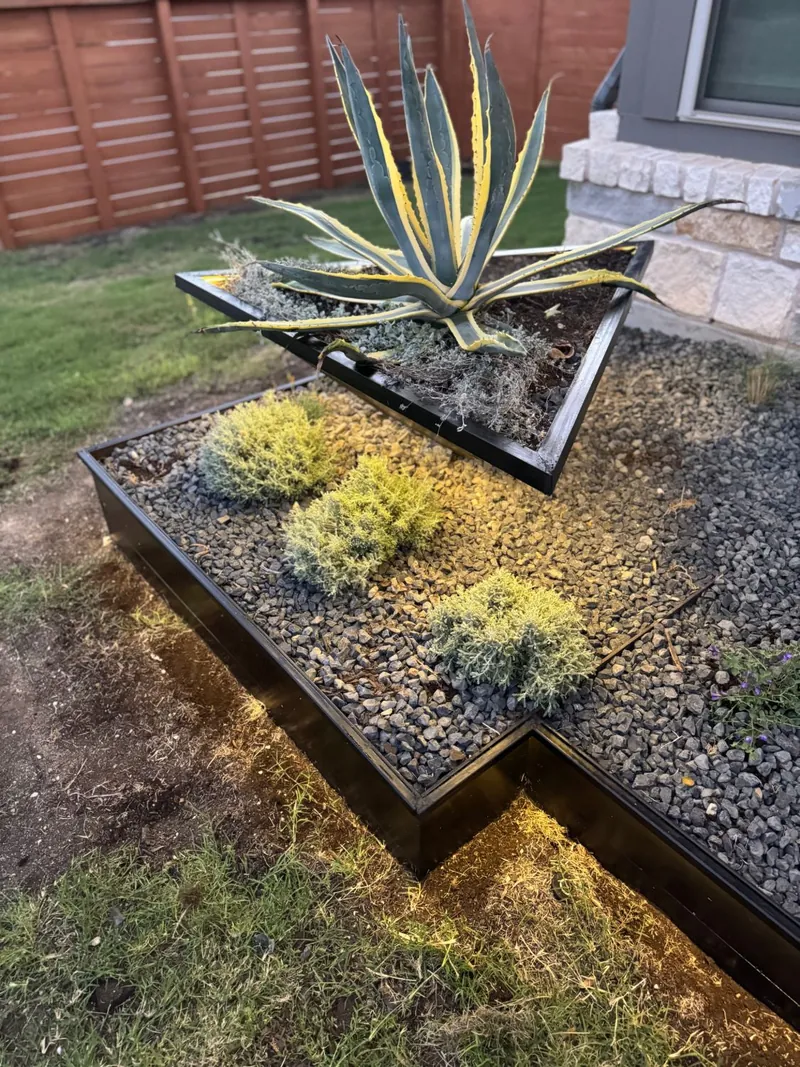
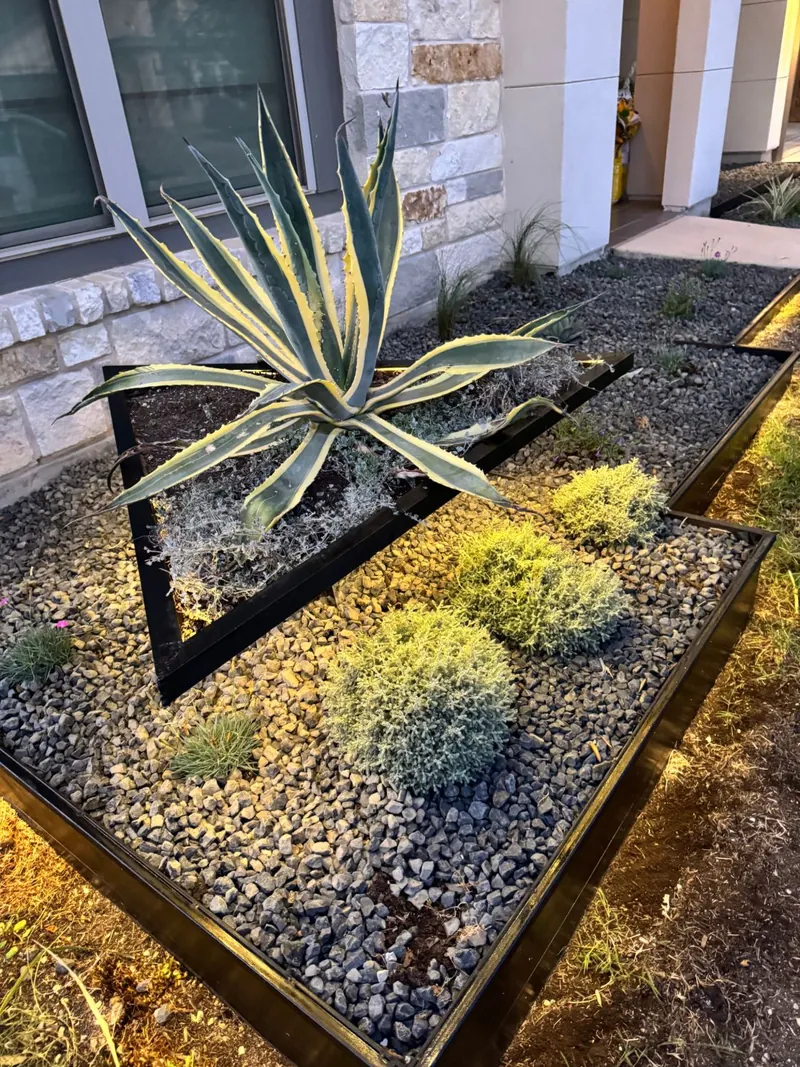
| What is it in our Southeast Austin yard? | Terraced black steel beds and a floating steel planter | Century agave, silver ponyfoot, silver santolina, and artichoke agave in basalt gravel |
What Counts as Hardscaping?
Everything that is built and not grown. The University of Nebraska-Lincoln’s Backyard Farmer program defines hardscapes as the non-living elements of a landscape, such as patios, walkways, and walls, and describes them as the framework the plants are designed around.
Red Agave builds hardscape in five materials: steel, concrete, stone, wood, and gravel. Hardscape goes in first, because it sets the levels of the yard. Our post on hardscaping in Austin shows each material on a real build, and our hardscaping page lists what we build.
One Austin rule applies to hardscape. Austin Development Services defines impervious cover as any human-made surface that does not absorb rainfall. Walkways, impermeable driveways, rooftops, parking areas, and some decks count toward it, and the share a lot is allowed is set by its zoning. That is one reason we pour patios as separate concrete pads with gravel joints, so rain soaks in between them.
What Counts as Xeriscaping?
A yard designed to need little water. Denver Water coined the word in 1981 by joining "landscape" to the Greek word "xeros", which means dry.
Texas A&M AgriLife Extension teaches the same approach in its Earth-Kind guide to landscape water conservation. The guide lists seven principles:
- Planning and design
- Soil analysis
- Practical turf areas
- Appropriate plant selection
- Efficient irrigation
- Use of mulches
- Appropriate maintenance
AgriLife is direct about what this is not: a water-saving landscape does not have to be a cactus and rock garden. About 25 percent of the water supply in the urban areas of Texas goes to landscape and garden watering, and turfgrass needs more frequent watering than most other landscape plants.
See our xeriscape service and our guide on how to xeriscape a lawn in Austin.
Is Gravel Hardscape or Xeriscape?
Both. The job the gravel does decides which.
- Gravel as a floor is hardscape. A gravel court is a surface you walk and sit on, and it needs a steel edge to stay where it is put.
- Gravel over a planting bed is mulch, and mulch is xeriscape. AgriLife lists inorganic materials such as lava rock and limestone next to bark and compost as mulches. A good mulch cuts the water that evaporates from the soil, holds down weeds, and keeps the soil temperature more even.
In our Southeast Austin yard the basalt gravel does the second job. It covers the soil around every plant, inside black steel edges.
Where Do Hardscape and Xeriscape Meet?
At the lawn. AgriLife’s guide says a real cut in water use and upkeep can mean making the lawn smaller, and it names patios, decks, shrub beds, and groundcovers as the things that replace it. So hardscape is one of the tools of a xeriscape. A patio needs no water at all.
They meet at the hose too. Austin Water has kept the city in its Conservation Stage since September 2, 2025. A home with an automatic irrigation system waters one day a week, before 10 a.m. or after 7 p.m. Drip irrigation and hose-end sprinklers get two days, and a hand-held hose is allowed at any time. The same page lists a variance for a newly installed xeriscape that needs a special watering schedule while it roots in.
The more of the yard that is patio, gravel, and low-water planting, the less of it waits on a watering day.
What Does a Yard With Both Look Like?
Like our Chrysler Bend project in Southeast Austin. Red Agave designed and built this front yard, with lawn in front of the beds.
The hardscape:
- Beds: terraced black steel, set on edge and stepping toward the front door
- Planter: a welded steel triangle that floats on one post above the beds, with an angle iron rim
- Finish: a black penetrating sealer on the steel
- Light: a custom light rim around the outside of the steel, and a second one on the planter
The xeriscape:
- In the planter: one variegated century agave, with silver ponyfoot trailing around it
- Under the planter: three silver santolina
- In the beds: maiden grass and artichoke agave
- Mulch: basalt gravel over every bed
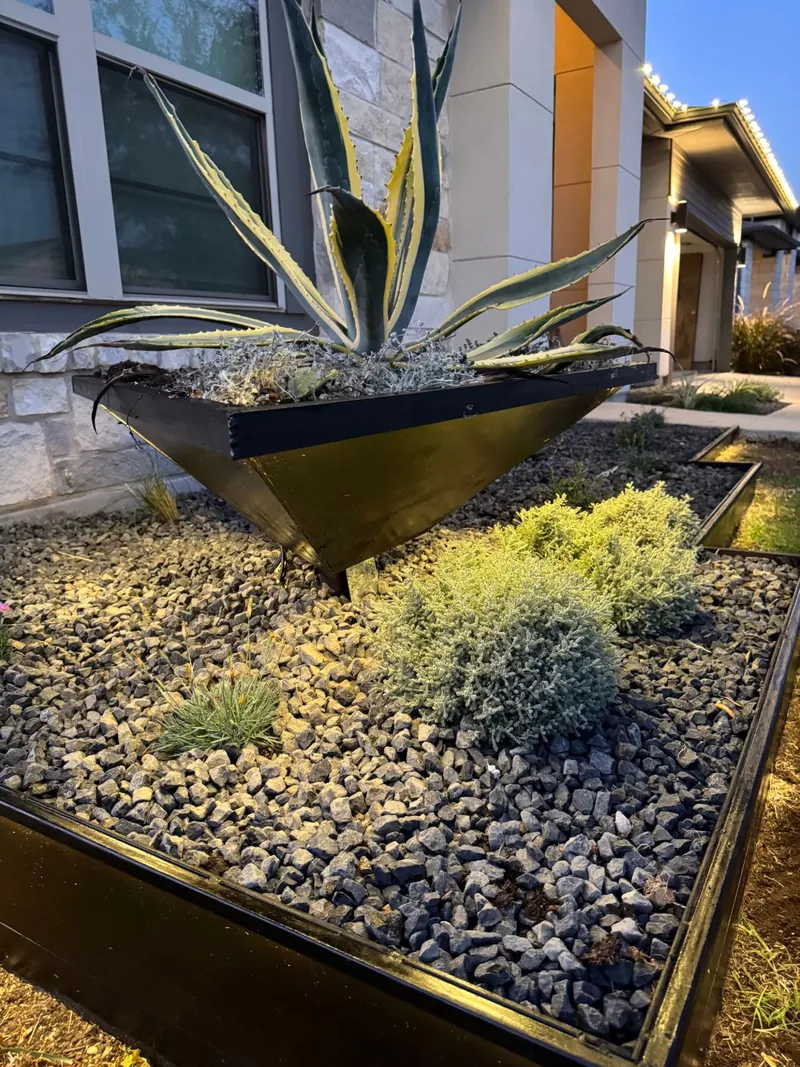
The Lady Bird Johnson Wildflower Center rates the plants. It lists the century plant, Agave americana, as a low water use plant for full sun and dry soil. It lists Parry’s agave, the artichoke agave, the same way. Silver ponyfoot is native from West Texas to southeastern Arizona and Mexico, and the Center marks it heat tolerant and suited to dry soil.
See our post on the floating triangle planter, and our service area pages from Southeast Austin south to Buda and Kyle.
Which One Does Your Yard Need?
Start with the problem.
- A slope, a muddy path, or no level place to sit: that is a hardscape problem. Walls, steps, and a patio fix it.
- A lawn that browns between watering days, or a water bill that climbs every summer: that is a xeriscape problem. A smaller lawn, low-water plants, drip, and mulch fix it.
- Most Austin yards: both, on one plan.
Every Red Agave project starts with a free consultation, and the CAD plan is included. For pricing, see our xeriscaping cost guide.
What Sources Did We Use?
We read each of these in November 2026.
- University of Nebraska-Lincoln, Backyard Farmer, Hardscapes
- Texas A&M AgriLife Extension, Earth-Kind, Water Conservation
- Denver Water, Xeriscape plans
- City of Austin, Austin Development Services, Glossary of terms, impervious cover
- City of Austin, Austin Water, Find Your Watering Day
- Lady Bird Johnson Wildflower Center, Agave americana, Agave parryi, and Dichondra argentea
Questions We Hear
What is the difference between hardscaping and xeriscaping?
Hardscaping is the built part of a yard: patios, walls, decks, steps, and edging. Xeriscaping is a method of designing the whole yard to need little water. A xeriscape uses low-water plants, mulch, efficient irrigation, a smaller lawn, and hardscape.
Is xeriscaping just rocks and cactus?
No. Texas A&M AgriLife Extension says a water-saving landscape does not have to be a cactus and rock garden. It is built on seven principles that cover the plan, the soil, the lawn, the plants, irrigation, mulch, and upkeep.
Is gravel hardscape or xeriscape?
Both. A gravel court you walk on is hardscape. Gravel spread over a planting bed is mulch, which is one of the seven principles of a water-saving landscape.
Does hardscape count toward impervious cover in Austin?
Austin Development Services defines impervious cover as any human-made surface that does not absorb rainfall, and counts walkways, impermeable driveways, rooftops, parking areas, and some decks. The share a lot is allowed is set by its zoning.
Can one company build the hardscape and the xeriscape?
Yes. Red Agave Landscape designs and builds both. The owner draws one plan, and our own crew builds it.